

Developed by the American Society for Testing and Materials (ASTM), the standard "ASTM F406 Standard Consumer Safety Specification for Non-full-size Cribs/Playpens" is a consumer safety specification that includes testing requirements for structural integrity and performance requirements for non-full-size cribs and playpens, both with hard sides and mesh/fabric mounts. This standard also specifies labeling and training material requirements. For the purposes of this standard, the term "unit" or "product" refers to a non-full-size crib or playpen.
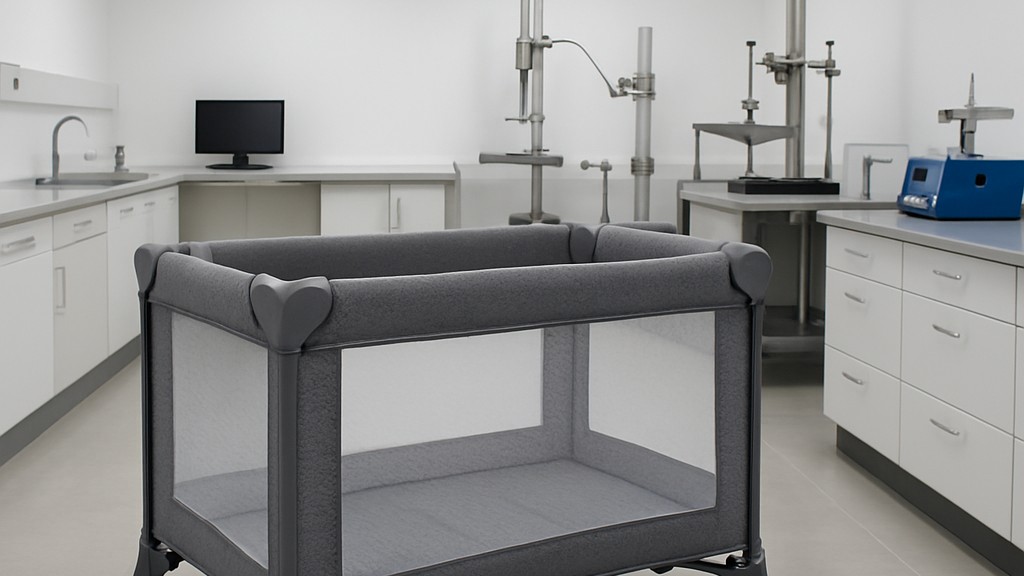
This standard covers a framed enclosure with a floor, designed to provide a sleeping and play area for a child who cannot climb and is less than 890 mm tall. It also covers a bassinet, changing table, or similar accessory for a non-full-size crib or playpen. These accessories must also comply with the applicable requirements of the standards for these accessories. For example, a changing table attached to a playpen must also comply with the applicable requirements of ASTM F2388. This standard does not cover inflatable products.
No product manufactured after the approval date of this consumer safety specification shall display on its label or otherwise as conforming to this standard unless it complies with all applicable requirements contained herein before and after all testing.
In the world of parenting, few products are as important as baby products designed for sleep and play. Cribs and playpens (versatile enclosures that serve as comfortable sleeping areas or safe playpens for babies) that are not full-size must balance comfort, portability, and, above all, safety. That's where ASTM F406 comes in. This standard has become a cornerstone of children's product safety, influencing regulations worldwide and helping to prevent the tragedies that can arise from everyday daycare accidents.
Recent updates to this standard reflect ongoing improvements to address emerging risks, ensuring these products evolve with real-world use and technological advancements.
The genesis of the ASTM F406 standard dates back to the early 2000s, when concerns about infant injuries in portable cribs increased. During that period, a series of incidents involving non-full-size cribs and playpens were identified, including strangulation due to net entrapment, equipment entrapment, and structural collapses. These were attributed to safety vulnerabilities in designs that prioritized portability over durability.
The initial standard focused specifically on cribs, toddler beds, playpens, bassinets, and changing tables. The primary purpose of this standard was to establish rigorous testing requirements for structural integrity and performance, covering both solid-sided and mesh- or fabric-sided cribs. It also mandated clear labeling and educational materials to inform parents about the safe use of these products.
The scope of the standard is clear: it applies to enclosures with frames shorter than 890 mm that provide sleeping or play spaces for children who cannot yet go outside. This standard also includes add-ons such as cribs or changing tables, which must meet the relevant standards.
In essence, the ASTM F406 standard is a blueprint for hazard-resistant design. By addressing the most common points of failure through a series of tests and requirements, it ensures products can withstand the rigors of everyday life, from teething babies to enthusiastic jumpers.
Structural integrity and performance tests include:
This standard directly addresses the risks of drowning and provides the following entrapment and drowning precautions:
Safety isn't just about build quality; it's also about usability. The ASTM F406 standard requires:
These elements ensure that caregivers can set up and monitor products correctly, even during the sleep-deprived environment of new parenthood.
The ASTM F406 standard has also been incorporated into federal law. Under the Consumer Product Safety Improvement Act (CPSIA), the standard has been tweaked to focus on cribs or playpens.
Since its inception, the ASTM F406 standard has significantly reduced accidents. Studies show a sharp decline in reported injuries related to crib collapses and net breaks. Major manufacturers have harmonized their entire product lines by introducing innovations such as self-locking frames and antimicrobial nets.
Ultimately, ASTM F406 stands out as a testament to evidence-based safety in an age of rapid consumer trends. For manufacturers, it's a roadmap to reduced liability and market confidence.
Ultimately, the ASTM F406 standard is critical because it establishes strict safety requirements for non-full-size cribs and playpens, protecting infants from risks such as entrapment, suffocation, and structural collapse. This standard reduces injuries and deaths by requiring robust design, testing, and clear labeling.
Our organization, which has been operating for many years and meticulously follows global developments in science and technology, employs a team of experienced professionals and a broad infrastructure to conduct testing, measurement, and analysis in a wide range of areas for businesses across all sectors. In this context, we also provide testing services in accordance with ASTM F406 Standard Consumer Safety Specification for Non-Full-Size Cribs/Play Areas.
To get an appointment, to get more detailed information or to request an evaluation, you can ask us to fill in our form and reach you.

