
In the standard “ASTM D5725-99 Standard test method for surface wettability and absorbency of sheet materials using an automatic contact angle tester” developed by the American Society for Testing and Materials (ASTM), in contact with a flat sample of a film or paper substrate under certain test conditions A test method for determining the contact angle of a test liquid is disclosed. This testing method can be used with any liquid of interest that is compatible with the equipment used, particularly in terms of liquid viscosity, viscosity and vapor pressure (evaporation). This testing method can be used with any substrate that can be cut to dimensions compatible with the equipment used.
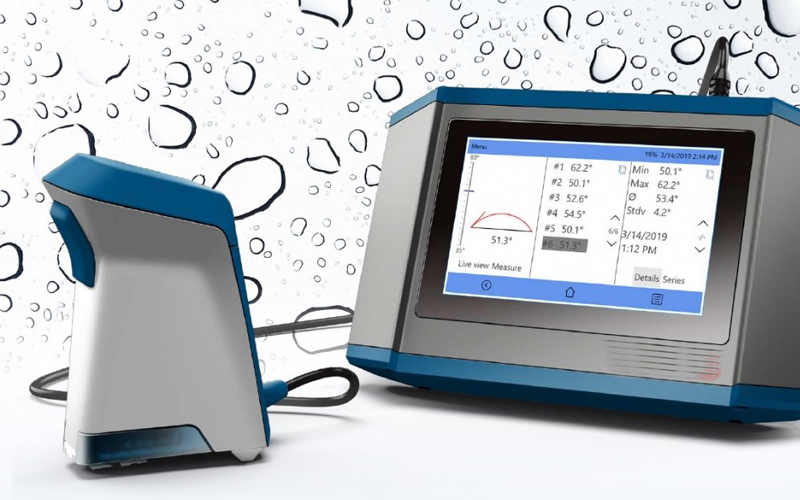
For materials that absorb the test liquid under specified test conditions, the rate of change of the contact angle as a function of time can be significant and can be determined using the procedures described in this test method. Since the volume of liquid remaining above the sample surface is measured as a function of time, it is also possible to evaluate the absorbent properties of a surface.
The conditions required in this test method specify reagent water as the test liquid when testing papers designed to be absorbent, such as absorbent paper types.
Testing of a wide range of papers considered low-absorbent or non-absorbent, including release papers, dimensional, coated or non-dimensional papers designed for printing, writing, packaging and similar tasks where the paper surface interacts with aqueous or solvent-based inks or other aqueous or non-aqueous liquids Conditions for this are stated. In such cases, test liquids other than reactive water, including writing and printing inks, or organic liquids or mixtures of organic liquids may be used as test liquids with prior agreement of the test participants, provided that the liquid is compatible with the equipment used. In cases where test liquids other than reagent water are used, the actual liquid used is reported.
Conditions are also specified for testing polymer films, polymer-coated papers, paper laminates, felt, textiles and nonwovens using water or other liquids that are compatible with the equipment, including bonding and printing, and are important to the end-use applications of the materials being tested.
Surface wettability is characterized by the contact angles of a water droplet on a solid surface, and this expression is used to describe the ability of a water droplet to maintain contact with the solid surface. For condensing or evaporative applications, techniques to modify surface wettability are important.
Most materials of practical interest are neither completely wetting nor completely non-wetting. Surface wettability refers to the degree to which a surface is hydrophilic (i.e., water-loving) or hydrophobic (i.e., water-fearing). Through careful design, it is possible to change the natural wettability of a surface to become more water-loving or water-phobic. This is mainly achieved by changing the surface chemistry or surface roughness. In some cases, changing the surface may provide operational benefit or advantage. For example, aluminum and copper, used in the construction of heat exchangers, tend to retain water in the application, which can reduce performance. Modifying the surface to be superhydrophilic can help disperse condensation, reduce airside pressure drop, and facilitate drainage.
Among the numerous testing, measurement, analysis and evaluation studies carried out for businesses in various sectors, our organization, with its trained and expert staff and advanced technological equipment, provides "Standard test method for surface wettability and absorbency of sheet materials using ASTM D5725-99 Automatic contact angle tester" It also provides testing services defined in the ” standard.
To get an appointment, to get more detailed information or to request an evaluation, you can ask us to fill in our form and reach you.

