

The lifting eye bolts defined in the DIN 580 standard published by the German Standardization Institute (DIN) have a thread on one end and a ring on the other. Widely used in rigging equipment for vertical or angle loading.
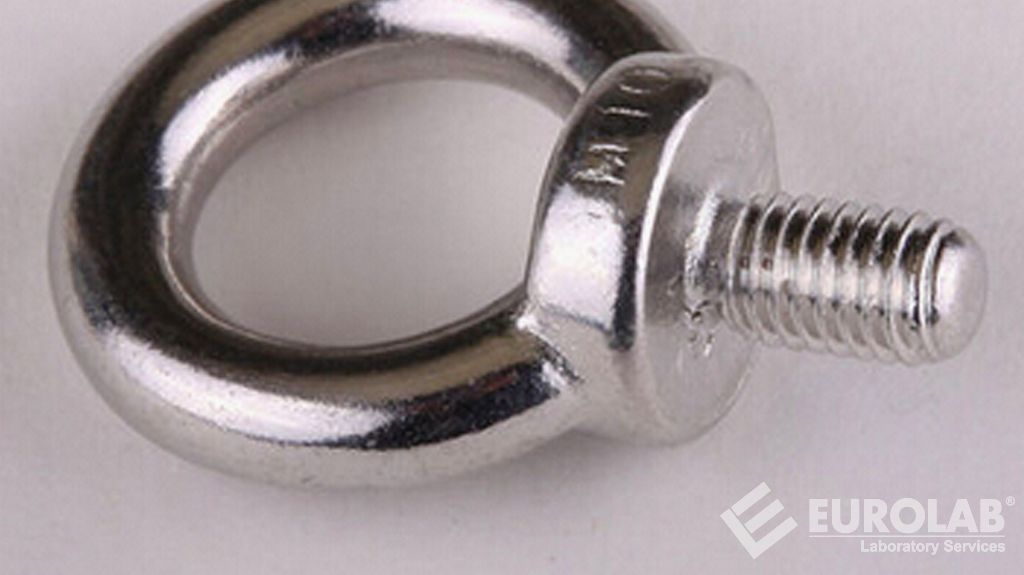
Requirements for lifting eyebolts are included in the DIN 580 standard under the following headings:
Stainless steels are divided into three groups as austenitic, ferritic and martensitic. Austenitic steel is by far the most common type (more than 90 percent of commercial fasteners). Steel groups and strength classes are indicated with four-digit letters and numbers as shown in the table in the standard. The DIN EN ISO 3506 standard contains the requirements for screws and nuts made of stainless steel.
A ring bolt is a mechanical fastener with a threaded shaft and a ring-forming head. These bolts are used to attach a loop to a structure through which rope, cable or shackles can be fixed. A common use is to create a lifting eye so that a crane can be attached to a machine, with special purpose lifting eyes rated for safe working loads.
Low-strength eyebolts are usually formed from a length of rod with the diameter of the nominal thread size. The head is bent into a ring from a smooth section of the rod. This type of eyebolt can handle axial loads quite well but should not be used for off-axis loads. The opening where the end of the rod is closed to complete the ring can be welded, but is likely to remain a potential point of failure.
High-strength eyebolts have forged heads that normally include a substantial shoulder. The shoulder allows them to support significant off-axis loads. The ability to support off-axis loads is often important in lifting applications where multi-leg lift slings are used to attach to multiple lifting eyes.
Among the numerous test, measurement, analysis and evaluation studies it provides for businesses in various sectors, our organization also provides testing services for eye bolts for lifting purposes, within the scope of DIN 580 standard, with its trained and expert staff and advanced technological equipment.
To get an appointment, to get more detailed information or to request an evaluation, you can ask us to fill in our form and reach you.

