

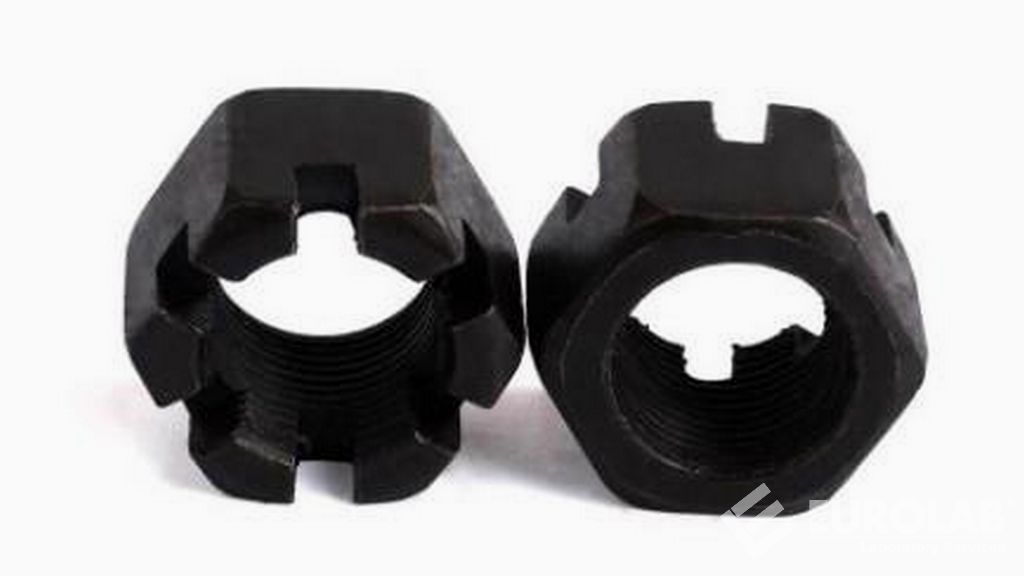
Metric thin hexagonal slotted castle nuts, as defined in the DIN 979 standard published by the German Institute for Standardization (DIN), are hexagonal nuts where the slots are cut into one side of the nut (up to 12 mm diameter) or the top (diameter greater than 12 mm). These slots are designed to offer a locking feature where a split pin/wedge pin, R-clip, or safety wire can be aligned through the slots and routed through a hole in the shank of the matching bolt. These nuts are similar to those defined in the DIN 935 standard but are thinner, making them ideal when space is limited. They are generally produced in diameters ranging from M6 to M30 and in marine-grade stainless steel.
The requirements in the DIN 979 standard are under the following headings:
Slotted nuts are used in applications where vibration or movement can loosen the locknut. Both the castle nut and slotted nut look similar and are often interchangeable, as they have nearly the same dimensions. However, they differ from each other in that the protrusions on a slotted nut are from the base of the nut and include the corners. Whereas, a castle nut is similar to a standard nut with protruding triangular segments but not including the hexagonal corners. Slotted nuts are generally produced from 4, 8 and 10 grade steel and A2 and A4 stainless steel as standard.
In short, a slotted nut has slots cut into one end of the nut. When used in an application, a bolt or threaded rod usually has a pre-drilled hole so that when the slotted nut is screwed in and torqued to the required position, it can then be secured with a cotter pin.
Among the numerous test, measurement, analysis and evaluation studies it provides for businesses in various sectors, our organization also provides testing services for thin hexagonal slotted castle nuts, within the scope of DIN 979 standard, with its trained and expert staff and advanced technological equipment.
To get an appointment, to get more detailed information or to request an evaluation, you can ask us to fill in our form and reach you.

