

The DIN 6798 standard published by the German Standardization Institute (DIN) describes the requirements for knurled lock washers. This standard includes three types of stamps:
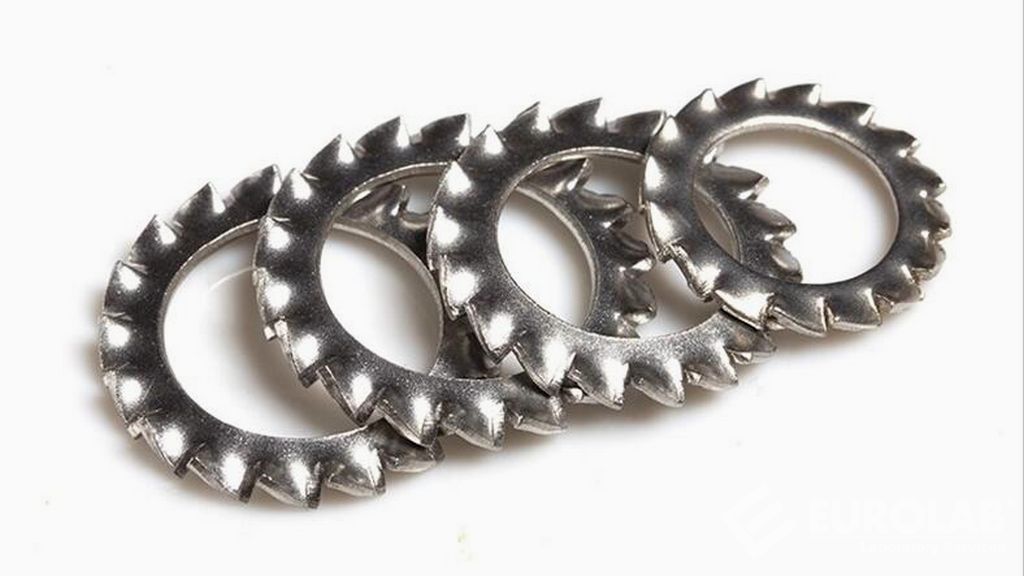
Form A has teeth on the outer edge of the washer that allow maximum contact on the largest possible surface area. The teeth overlap each other to maximize friction between the surface of the substrate and the fastener.
Form J has threads that extend inward from the inside edge of the washer and is recommended when the head of the screw is smaller than the diameter washer or when the surface of the fastener is uneven or convex.
Form V has a conical shape with threads extending outwards and is used with 90-degree countersunk screws. The threads bite into the substrate surface to resist any loosening forces.
The requirements for serrated lock washers are included in the DIN 6798 standard under the following headings:
Serrated lock washers increase friction between bolt head/nut and mating surface. It does this by clinging to mating surfaces. Serrated lock washers are fitted between the bolt head/nut and the mating surface. The bolt joint is then tightened in the same way as an unsecured bolt. If voltage loss occurs in the bolted connection, the washer is no longer effective and must be replaced. Solid serrated washers can damage painted or coated surfaces as they tend to rotate with the fastener. This runs the risk of damaging the surface, cracking the paint or coating and causing corrosion.
Serrated washers, which are generally shake-proof, are attached internally to the equipment before a locknut to act as an anti-vibration device. This prevents accidental loosening of the accessory.
Our organization also provides testing services for serrated lock washers within the scope of DIN 6798 standard, with its trained and expert staff and advanced technological equipment, among the numerous test, measurement, analysis and evaluation studies it provides for businesses in various sectors.
To get an appointment, to get more detailed information or to request an evaluation, you can ask us to fill in our form and reach you.

