

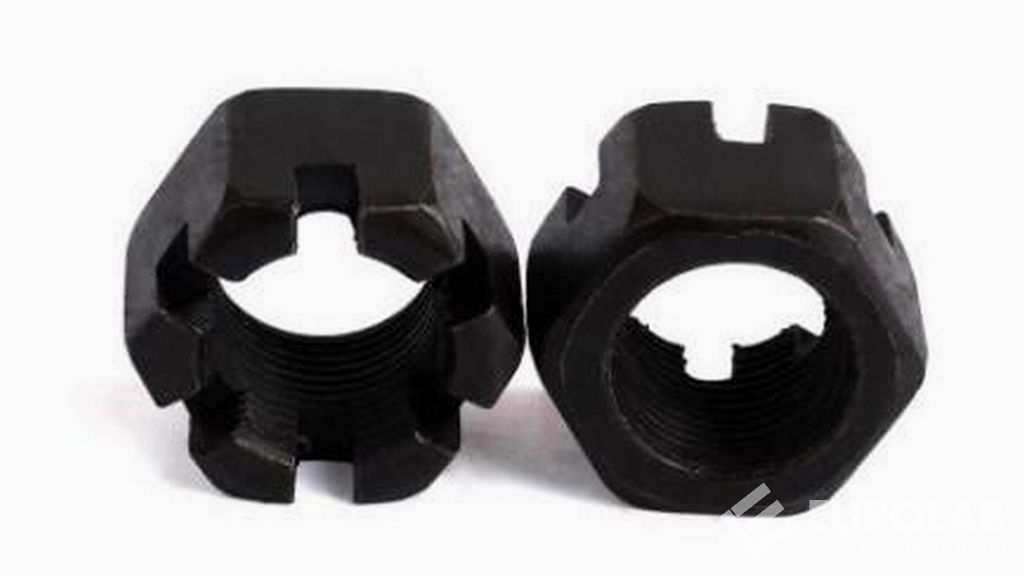
Metric hexagonal slotted castle nuts, defined in the DIN 935 standard published by the German Institute for Standardization (DIN), are hex nuts in which the slots are cut on one side of the nut (12 mm diameter) or at the top (diameter greater than 12 mm). These slots are designed to provide a locking feature where a split pin/copper pin, R clip, or safety wire can be aligned along the slots and routed through a hole drilled in the shank of the mating bolt. It is generally manufactured in diameters ranging from M5 to M39 and from marine grade stainless steel and zinc-plated steel.
Essentially, this standard consists of three parts:
The requirements in the DIN 935 standard are under the following headings:
The structural uniqueness of hexagonal slotted castle nuts allows them to be used in mechanical and automotive applications where positive locking is required, such as holding a wheel bearing in place. They are also used as a safety nut for other component design applications. These screws are characterized by protrusions extending from their bodies, making them look like the top of a castle, hence the name castle nuts.
Castle nuts have pre-drilled holes where cotter pins can be inserted to hold the nuts securely in place. This gives the nuts the ability to withstand constant vibrations and keeps them in place during minor movements. These nuts can be used without a pilot hole as they are pre-drilled. These nuts are slotted to allow installation and removal using screwdrivers.
Among the numerous test, measurement, analysis and evaluation studies it provides for businesses in various sectors, our organization also provides testing services for hexagonal slotted castle nuts within the scope of DIN 935 standard, with its trained and expert staff and advanced technological equipment.
To get an appointment, to get more detailed information or to request an evaluation, you can ask us to fill in our form and reach you.

