

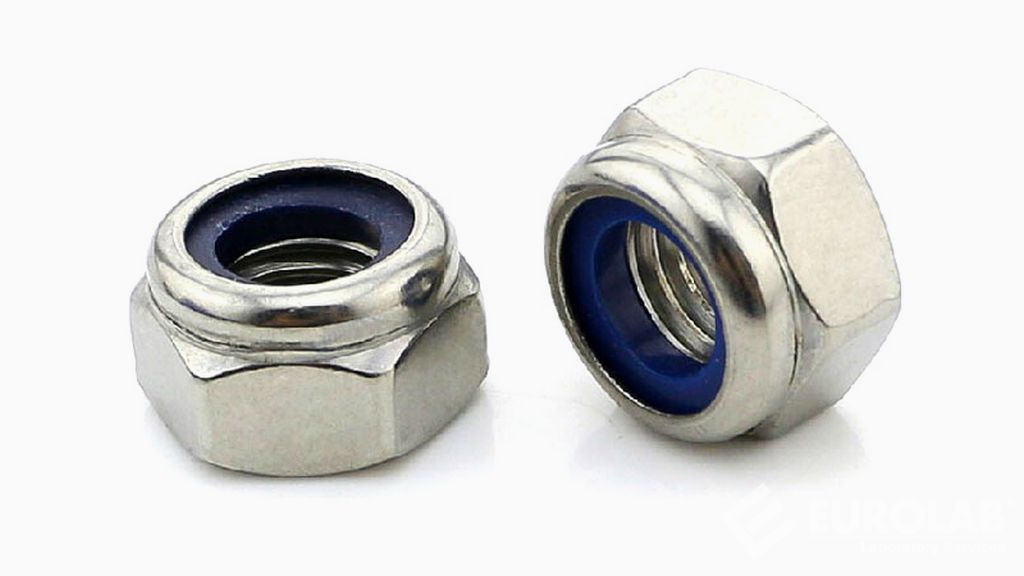
Metric nylon insert lock nuts, as defined in the DIN 985 standard published by the German Standardization Institute (DIN), are low-profile, dominant torque type lock nuts that have a permanently small, non-metallic spacer (nylon/polyamide) that produces friction between the threads of the mating component, thus increasing resistance to loosening forces. Nylon insert lock nuts have a limited number of reuses because the threads of the mating bolt may deform, but the polymer insert does not. These nuts are considered one-way lock nuts because they can only be fitted in one direction. The nylon insert limits their use at high temperatures or when exposed to certain chemicals. Generally, nylon insert lock nuts are manufactured from marine-grade stainless steel, brass, and steel, in diameters ranging from M2,5 to M30.
Similarly, in the ISO 10511 standard published by the International Standards Organization (ISO), threads from M3 to M36 (inclusive), product classes A and above M16 and feature classes 16 for threads up to and including M04 and 05 for threads of product class B torque type hex thin nuts (with non-metallic ends) are described (ISO 10511 Dominant torque type hex thin nuts with non-metallic ends).
Nylon snap locknuts are six-sided internal thread fasteners with a nylon ring secured to the top of the thread to prevent the nut from loosening under normal operating conditions. These nuts should not be installed with any power tool. The increased friction caused by turning a nylon insert locknut with a rotary tool such as an air ratchet or impact tool can damage threaded components and cause an undesirable situation where the nut engages the outer thread or the nylon insert is damaged.
Among the numerous test, measurement, analysis and evaluation studies it has given for businesses in various sectors, our organization, with its trained and expert staff and advanced technological equipment, within the scope of DIN 985 standard, for low profile nylon snap hex lock nuts and within the scope of ISO 10511 standard, the dominant torque It also provides testing services for type hexagonal thin nuts (with non-metallic ends).
To get an appointment, to get more detailed information or to request an evaluation, you can ask us to fill in our form and reach you.

