

The DIN 981 standard, published by the German Institute for Standardization (DIN), describes the requirements for lock nuts designed for use with bearings.
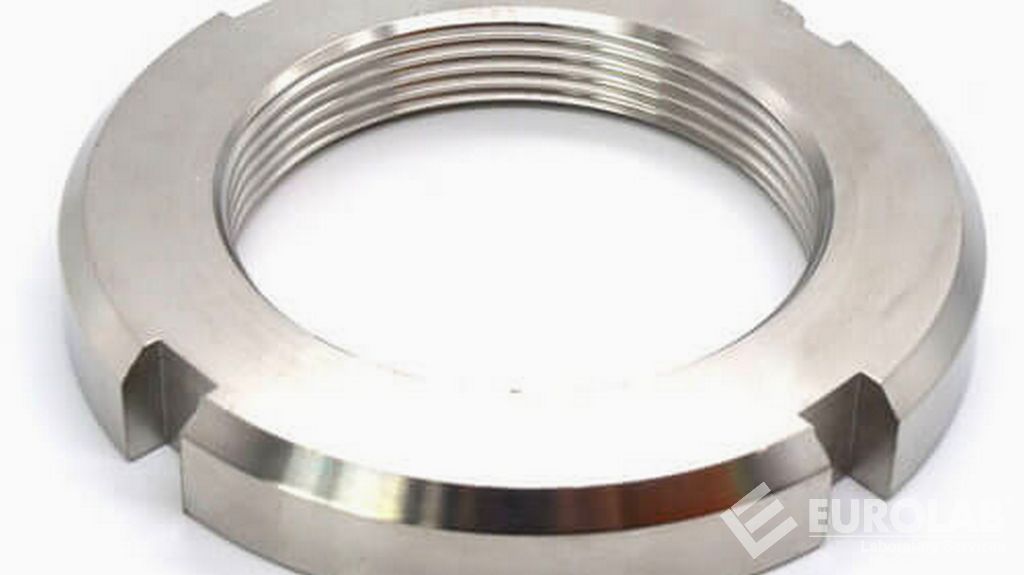
The requirements in the DIN 981 standard are under the following headings:
Bearing locknuts have a different appearance than conventional hex locknuts. Bearing locknuts are typically rounded with externally keyed slots. This design requires a special tool called a wrench or socket to install or remove. Bearing locknuts are used in a wide variety of applications, including the automotive and agricultural industries.
Lock nuts use opposing friction against another lock nut or a standard hex nut to lock into place on a threaded shaft or rod. There are conflicting viewpoints on which nut should be tightened first. However, the most common use case involves tightening the lock nut first. The lock nut is then followed by a second nut that is tightened against the first lock nut. Properly tightening both nuts in this configuration is difficult, making it undesirable for critical applications where the assembly carries a stress load.
Locknuts for use with bearings are internally threaded fasteners used on shafts with external metric threads. These nuts are used to hold bearing assemblies in place around a round shaft. These nuts can also be used to secure components such as gears or pulleys to a shaft. Locknuts are round spindle nuts with slots on the outside that are used to turn the nut with a tool called a hook wrench.
Jam nuts or half nuts for short are low profile hex nuts with a profile half the height of a standard hex nut.
Among the numerous test, measurement, analysis and evaluation studies it provides for businesses in various sectors, our organization also provides testing services for lock nuts designed for use with bearings, within the scope of DIN 981 standard, with its trained and expert staff and advanced technological equipment.
To get an appointment, to get more detailed information or to request an evaluation, you can ask us to fill in our form and reach you.

