

Metric double-ended studs, defined in the DIN 938 standard published by the German Institute for Standardization (DIN), are headless machine screw fasteners and may or may not be fully threaded depending on the length of the fastener. Depending on the application, either end can accept a nut, or one end can be threaded into a predrilled hole, leaving the other end usable to attach a matched component secured with a nut.
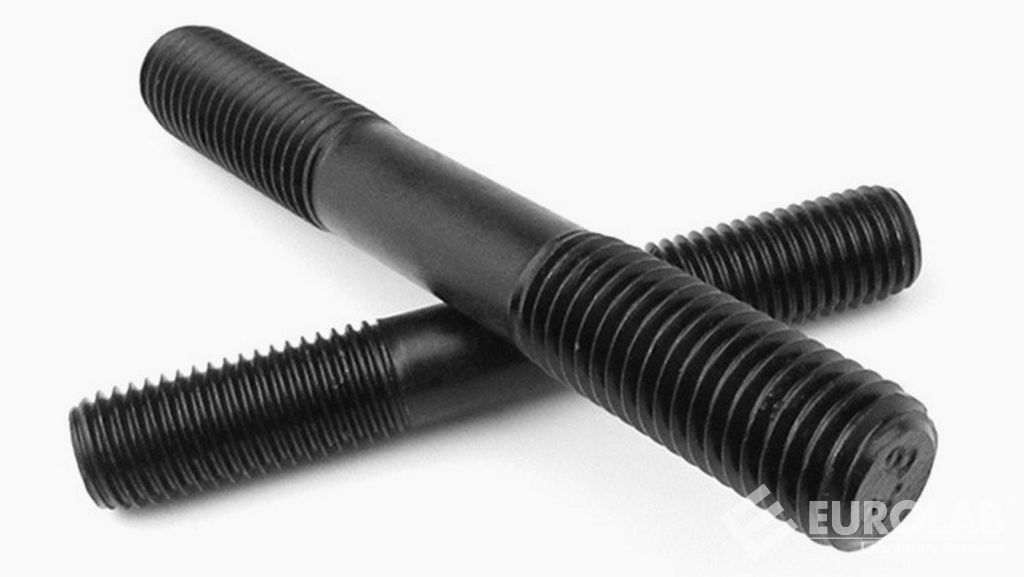
Stud assemblies offer several advantages over bolts. It eliminates the need for perfect squareness in an assembly by first allowing a nut to float and adjust on the nut end threads. In addition, studs can act as pilots to facilitate assembly and disassembly of mating parts. In general, double-ended studs are manufactured from marine grade stainless steel, in diameters ranging from M5 to M30 and in lengths up to 120 mm.
The requirements in the DIN 938 standard are under the following headings:
Double-ended studs are threaded fasteners that have a thread on each end and a non-threaded part between the two threaded ends. Double-ended studs are designed for use where one threaded end is inserted into a threaded hole and a hex nut is used at the other end to clamp a fixture to the surface where the stud is threaded. Double-ended studs have different thread lengths at each end. It has a short thread intended for use in a threaded hole. For metric double-ended studs, the thread of the guide tip is not included in the nominal length of the stud. These studs have a guide tip equal to the diameter of the stud. Also these studs are manufactured from feature class 5.8, stainless steel and brass.
Among the numerous tests, measurements, analyses, and evaluations our organization provides for businesses in various sectors, we also offer testing services for double-ended studs (1xD) according to the DIN 938 standard, with our trained and expert staff and advanced technological equipment.
To get an appointment, to get more detailed information or to request an evaluation, you can ask us to fill in our form and reach you.

