

Long hook-end slotted set screws, defined in the DIN 417 standard published by the German Standardization Institute (DIN), are generally used to fix one object in or against another. Because the setscrew is headless and threaded the entire length of the screw, it can pass through the threaded hole of one object and tighten against another object. It is often used to prevent relative motion between two rotating parts, such as the movement of a pulley or a gear on a shaft. The clamping force is produced by the lower end of the screw protruding from the outer object to or against the inner object. The hook point is a flat end that protrudes from the opposite end of the slotted drive and is usually placed in the groove of a shaft that allows the shaft to rotate while holding the part in place on the shaft. The slotted driver allows tightening and loosening with a single blade slotted screwdriver.
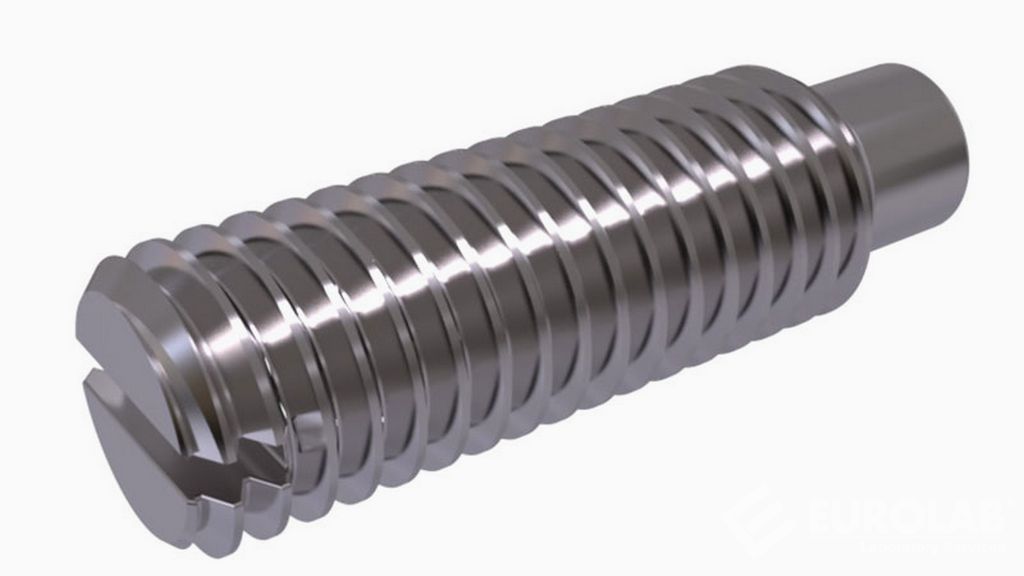
Similarly, in the ISO 7435 standard published by the International Standards Organization (ISO), the features of products with metric dimensions and thread sizes from M 1,6 to M 12 and product class A are defined (ISO 7435 Long hook-end slotted set screws) . At the same time, this standard contains specifications for international standards, presenting in tabular thread sizes from M 2 to M 60 in nominal lengths from 1,6 mm to 12 mm.
The requirements for long hook-ended slotted set screws are listed in the DIN 417 standard under the following headings:
Our organization, among the numerous test, measurement, analysis and evaluation studies it has given for businesses in various sectors, with its trained and expert staff and advanced technological equipment, within the scope of DIN 417 standard, for long hook-end slotted adjustment screws and within the scope of ISO 7435 standard, long hook-end It also provides testing services for slotted setscrews.
To get an appointment, to get more detailed information or to request an evaluation, you can ask us to fill in our form and reach you.

