
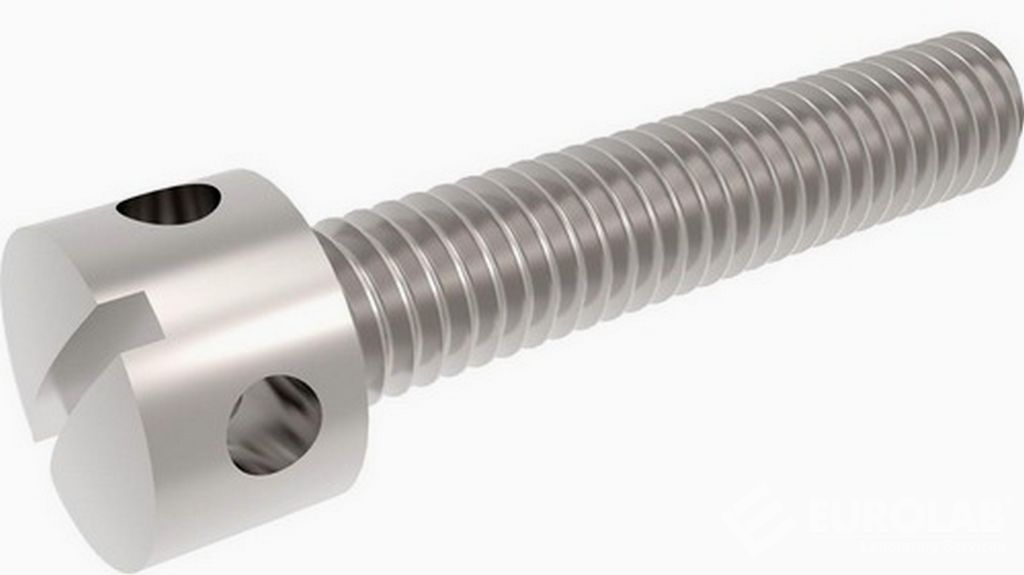
The slotted capstan screws (aka Tommy bolts) defined in the DIN 404 standard published by the German Institute for Standardization (DIN) have a unique design in that the head, resembling a cheese head, has two holes drilled from the side of the head at a 90 degree angle serving a dual purpose. Slotted capstan screws can be tightened by inserting a T-shaped rod into the hole when it is not possible to use a screwdriver to tighten the screw. Locking wires can be inserted into the cross holes to fix the screw.
Requirements for slotted capstan screws are included in the DIN 404 standard under the following headings:
Stainless steels are divided into three groups as austenitic, ferritic and martensitic. Austenitic steel is by far the most common type (more than 90 percent of commercial fasteners). Steel groups and strength classes are indicated with four-digit letters and numbers as shown in the table in the standard. The DIN EN ISO 3506 standard contains the requirements for screws and nuts made of stainless steel.
Austenitic steel is a type of austenitic stainless steel. It contains a high percentage of nickel and chromium, providing great strength and resistance to corrosion as well as increasing its ability to be formed and easily welded to any shape.
The use of austenitic group stainless steel is as follows:
Austenitic stainless steels find use in many industries due to their ability to be shaped easily, their strength to withstand, and their properties at extreme temperatures.
Our organization, among the numerous test, measurement, analysis and evaluation studies it provides for businesses in various sectors, also provides testing services for slotted capstan screws, within the scope of DIN 404 standard, with its trained and expert staff and advanced technological equipment.
To get an appointment, to get more detailed information or to request an evaluation, you can ask us to fill in our form and reach you.

