

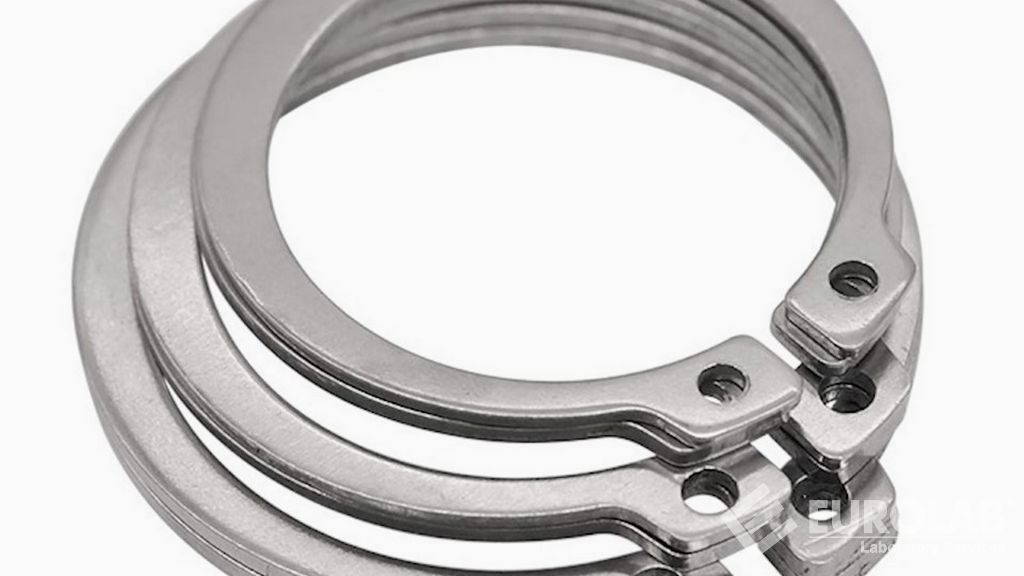
The DIN 983 standard, published by the German Institute for Standardization (DIN), describes the requirements for lugged retaining rings (external retaining rings) designed for use in shafts.
The requirements in the DIN 983 standard are under the following headings:
Retaining rings are used to hold components on a spindle or in a hole. The smooth, rounded finish of most shafts or holes makes it difficult to connect them using alternative methods, while retaining rings clamp around them, creating a shoulder that holds the parts in place. It is this shoulder that gives the rings their functionality, they can be attached to the outside of a shaft or inside a hole.
Retaining rings serve an important purpose in any project. These rings are one of the smallest and most inconspicuous components in the assembly, but are essential to performance as they help absorb vibration and discrete tolerances.
Different retaining rings are used either to create full contact with the groove and absorb heavier impact loads, or to make installation easier while maintaining aesthetics. During design, three factors need to be evaluated: machining processes, the layout of the assembly to see if it is possible to fit the rings, and the axial load under which the components will be. Questions to analyze when selecting rings are : What are the main critical dimensions? What is the maximum thrust force? What type of assembly does the application require? What is the rotational speed?
In short, retaining rings (outer circlips) fit into grooves on the outside of shafts of all sizes. The fields of the ring protruding from the shaft hold it in place.
Among the numerous test, measurement, analysis and evaluation studies it provides for businesses in various sectors, our organization also provides testing services for lug retaining rings (outer circlips) for use on shafts, within the scope of DIN 983 standard, with its trained and expert staff and advanced technological equipment.
To get an appointment, to get more detailed information or to request an evaluation, you can ask us to fill in our form and reach you.

