

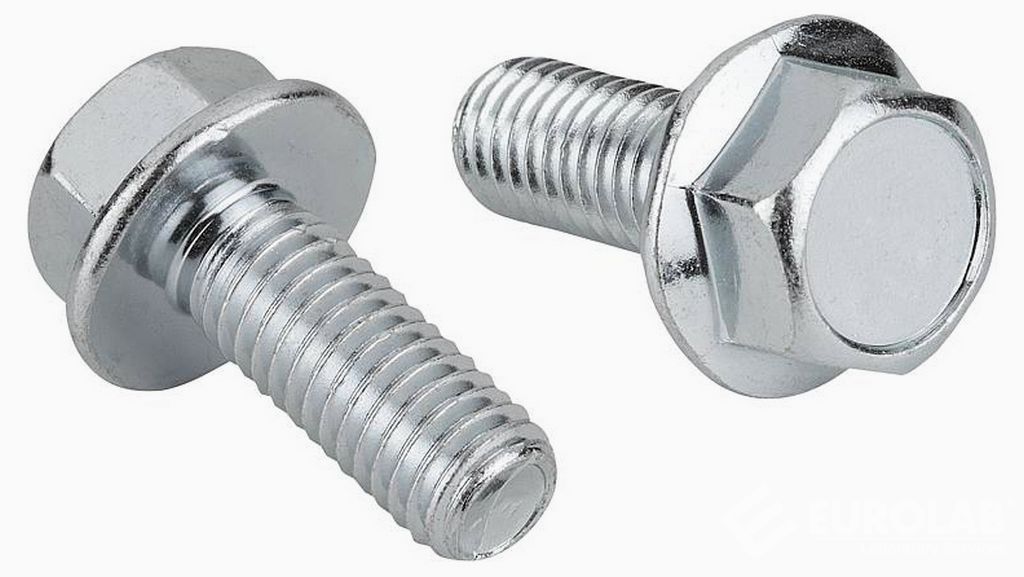
Hex flanged bolts, defined in the DIN 6921 standard published by the German Institute for Standardization (DIN), are machine threaded bolts with a circular washer-like flange under the head that increases the bearing surface to distribute the load when the bolt is fixed to the substrate. This standard includes two types of bolts: serrated and non-knurled.
Similarly, the European standard EN 1665 also describes the requirements for flanged hexagonal bolts (heavy series) (EN 1665 Flanged hexagonal bolts - Heavy series).
A flange bolt is a hex head bolt or screw with a flange that eliminates the need for washers. Flange bolts are a more attractive alternative to their hex driven counterparts. Typically used where the flange provides protection for the bolted component. In this case, the drive tool may otherwise scratch its surface. It is usually produced with a full thread, but sometimes some stocks may include a partially threaded shaft.
In the DIN 6921 standard, the requirements for hexagonal flange bolts are under the following headings:
Bolts are usually made of steel or stainless steel. The strength of the bolts is directly related to the materials used to make them. Depending on the intended use of the bolt, different steel grades are used. The higher the tensile strength, the tighter the bolt connection and the more torque the bolt can take.
Flat bevel washers are also known as hardened washers. Used with high-strength friction bolting assemblies. It is designed to distribute force into the material over a larger area, rather than preventing the bolt head or nut from sinking into the material or deforming under load.
Our organization provides testing services for hexagonal flanged bolts within the scope of DIN 6921 standard and for flanged hexagonal bolts within the scope of EN 1665 standard, with its trained and expert staff and advanced technological equipment, among the numerous test, measurement, analysis and evaluation studies it provides for businesses in various sectors. also gives.
To get an appointment, to get more detailed information or to request an evaluation, you can ask us to fill in our form and reach you.

