

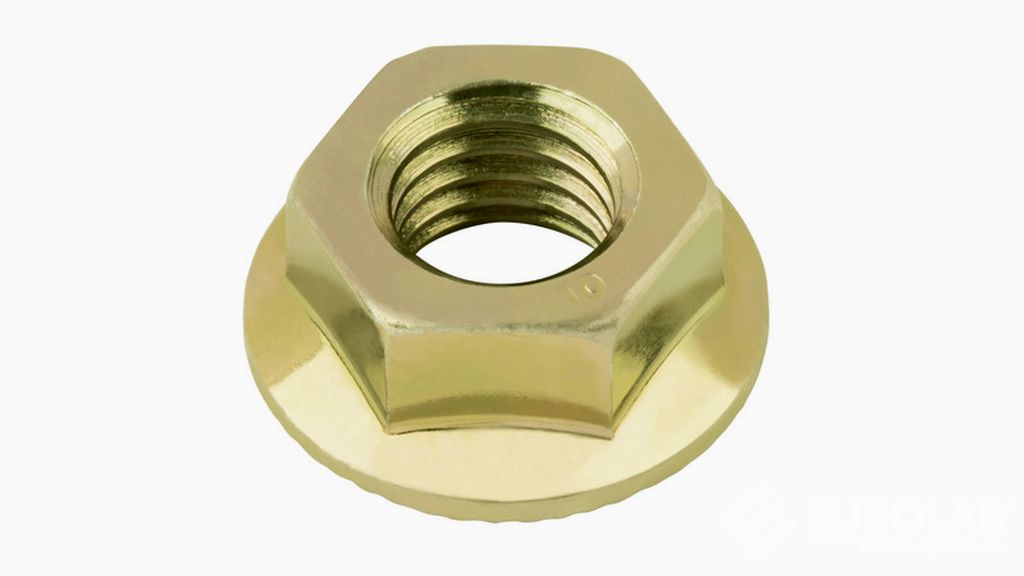
Hexagon flanged nuts, defined in the DIN 6923 standard published by the German Institute for Standardization (DIN), have a circular washer-like flange-shaped base that increases the weight-bearing surface area when tightened to distribute the load over a larger area. The flange eliminates the need to use a nut washer. This standard includes two types of nuts: knurled and unknurled. The teeth act as a locking mechanism to reduce loosening due to vibration forces.
In the DIN 6923 standard, the requirements for hexagonal flange nuts are under the following headings:
Similarly, the European standard EN 1661 defines the requirements for flanged hex nuts with product class A threads including M5 and product class B threads above M20 (EN 16 Flange hex nuts) including threads M16 to M1661. nuts).
Hexagonal flange nuts are generally manufactured from steel, stainless steel A2 or stainless steel A4. Steel is a material with 8 strength class and galvanized coating.
Nuts with hexagonal flanges defined in the DIN 6923 standard are serrated and therefore do not need washers. The serration ensures that the nut does not come loose. The flange may be serrated to provide a locking action. The serration is angled to prevent the nut from turning in the direction that will loosen the nut. Also, the knurling helps prevent the vibration of the nut from moving the fastener, thus maintaining the holding power of the nut.
Flanged and threaded hex nuts are mostly used for joining wood and plastic. Sometimes both sides of the nut are serrated, allowing both sides to be locked.
Our organization provides testing services for hexagonal flanged nuts within the scope of DIN 6923 standard and for flanged hexagonal nuts under EN 1661 standard, with its trained and expert staff and advanced technological equipment, among the numerous test, measurement, analysis and evaluation studies it provides for businesses in various sectors. also gives.
To get an appointment, to get more detailed information or to request an evaluation, you can ask us to fill in our form and reach you.

