

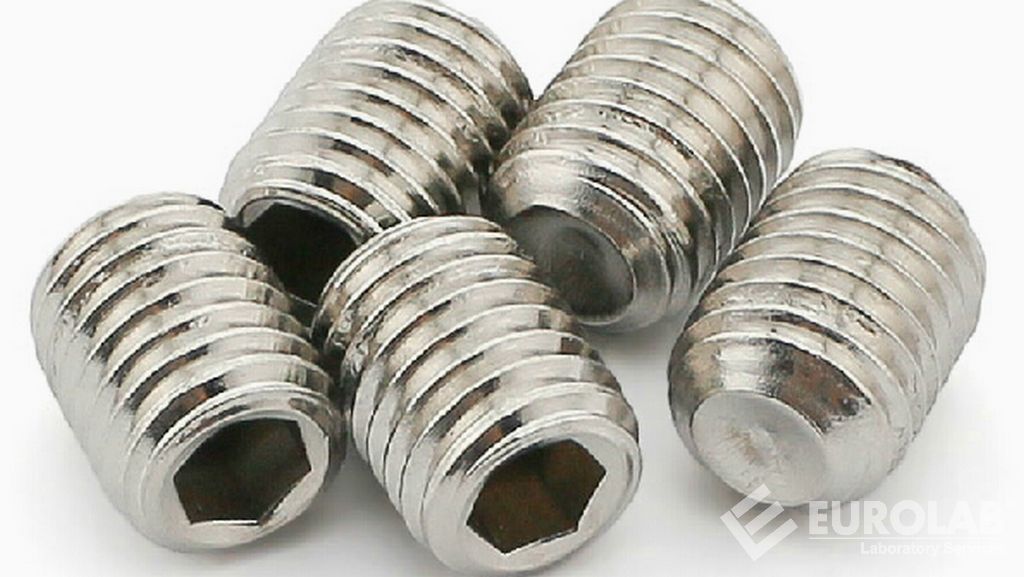
Flat-ended metric hexagon socket set screws, defined in the DIN 913 standard published by the German Institute for Standardization (DIN), are headless and full-threaded screws with a built-in hexagonal driver at one end and a flat surface at the other. These will be used to reset or relocate rigid shafts by passing them through pre-drilled aligned holes. Hex socket screws are generally produced in steel and stainless steel, with diameters ranging from M2 to M20 and lengths up to 100 mm.
The requirements in the DIN 913 standard are under the following headings:
Similarly, the ISO 4026 standard, published by the International Organization for Standardization (ISO), describes the specifications for flat-ended and threaded hexagonal socket set screws from M1,6 to M24 and belonging to product class A (ISO 4026 Flat-ended hexagonal socket set screws). In special cases, if specifications other than those listed in this standard are required, existing international standards such as ISO 261, ISO 898-5, ISO 965-2, ISO 3506-3 and ISO 4759-1 should be followed.
Essentially, the DIN 913 standard was designed on the basis of the ISO 4026 standard.
Metric flat point hex socket set screws are headless threaded fasteners with a flat tip and a hexagon socket driver embedded in the screw body. These screws are generally made of hardened alloy steel and stainless steel. It is used to connect two objects by snapping one object and applying pressure to the other object. It is designed to be mounted on a flat surface.
Our organization, among the numerous test, measurement, analysis and evaluation studies it has given for businesses in various sectors, with its trained and expert staff and advanced technological equipment, within the scope of DIN 913 standard, for flat-end hexagon socket set screws and within the scope of ISO 4026 standard, flat-ended hexagon It also provides testing services for socket set screws.
To get an appointment, to get more detailed information or to request an evaluation, you can ask us to fill in our form and reach you.

