

The "UNIFORM provisions on the approval of materials used in the interior of vehicles (buses and coaches) in category M3 with respect to their combustion behavior" regulation, developed by the United Nations Economic Commission for Europe (UN/ECE), applies to vehicles in categories M2, M3 (buses and coaches carrying more than 8 passengers) and N2, N3 (trucks over 3,5 tonnes).
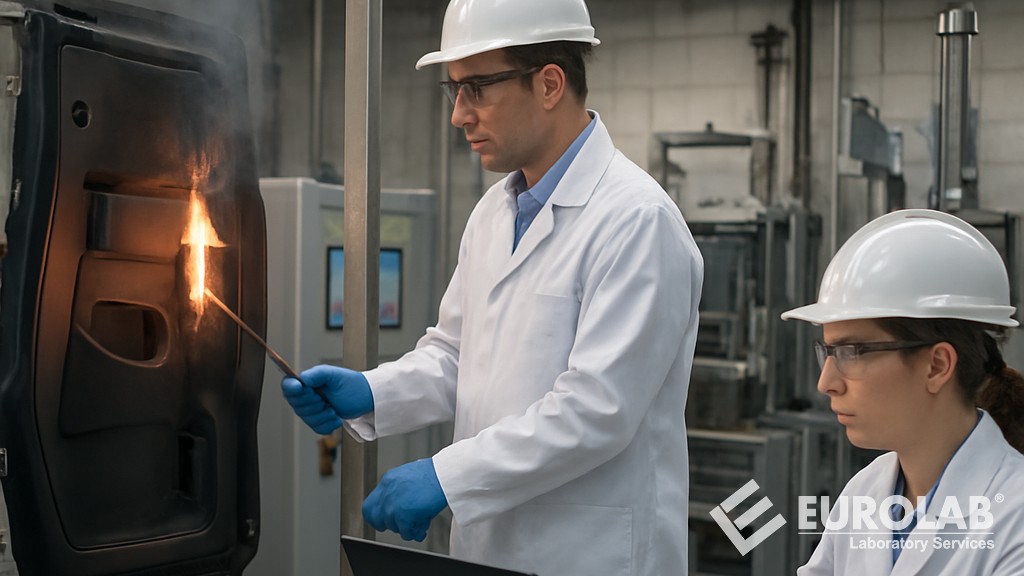
The primary aim of this regulation is to protect passengers and drivers in the event of an accident or emergency by ensuring that interior materials such as seat covers, wall panels, and headliner do not accelerate the spread of fire. As vehicles become more sophisticated with advanced materials, UN/ECE R118.02 and similar regulations play a vital role in harmonizing safety among numerous contracting parties.
In the automotive safety world, fire prevention is a critical but often overlooked aspect. The UN/ECE R118 regulation sets uniform technical rules for the combustion behavior of materials used in the construction of specific categories of motor vehicles. The latest update to this regulation marks a significant advance in fire safety standards, introducing stricter requirements for materials in buses and coaches to reduce the risk of fire spread in passenger compartments.
In short, this regulation is an international regulation that governs the testing and approval of materials such as interior upholstery, seats, headliner, and carpets used in passenger vehicles (buses) of classes M2 and M3, in terms of their flammability rate, flame spread, dripping, and melting behavior.
This regulation contains uniform technical instructions regarding the combustion behavior and fuel or lubricant propulsion capabilities of materials used in the construction of specific categories of motor vehicles. This regulation applies to the combustion behavior (flammability, rate of combustion, and melting point) and fuel or lubricant propulsion capabilities of materials used in M3, Class II, and Class III vehicles.
Type approvals are granted according to the following:
The origins of the UN/ECE R118 regulation lie in growing concerns about post-accident fires in commercial vehicles. The initial regulation focused on basic flammability tests for textiles and plastics. However, real-world incidents highlighted the need for stricter standards. The UN/ECE R118.02 regulation is a direct response to these gaps. The amendment introduces stricter limitations on material flammability for Class II and III vehicles (buses with more than 22 seats or standing places).
The UN/ECE R118.02 regulation classifies materials according to their location in the vehicle and their fire risk. It divides interiors into zones (e.g., high-risk areas such as seats and low-risk areas such as instrument panels) and mandates compliance through performance-based testing. Materials must either rapidly self-extinguish or repel flammable liquids such as fuels and lubricants.
This regulation focuses on passenger buses (Category M vehicles). The classes are as follows:
This regulation includes the following tests, which involve standard laboratory procedures:
Samples (5-10 per material facet) are conditioned at 23 degrees Celsius and 50% humidity before being exposed to a calibrated flame (e.g., 3 W/cm² radiation). Metal assemblies and stainless steel grids are used to ensure consistency in testing. Non-conformity may result in the rejection of type approval and affect market access.
The UN/ECE R118.02 regulation has profoundly impacted vehicle design. By mandating flame-retardant treatments and low-emission materials, it reduces fire growth rates by up to 50% in simulated accidents, according to studies. It simplifies certification for manufacturers, as a single test can satisfy multiple markets, reducing costs and time.
This regulation promotes halogen-free alternatives by complying with the EU's REACH regulations from an environmental perspective.
Today, UN/ECE R118 continues to evolve. AI-powered modeling is being integrated for predictive testing, while nano-coatings for self-extinguishing surfaces are being investigated. New studies emphasize sustainability, requiring recyclability assessments. With the rise of autonomous and hydrogen-powered vehicles, this regulation will remain a benchmark in the coming period.
For many years, our organization, with its competent and experienced team, has been understanding the needs of its clients, providing the advanced testing services they require, and assisting them in the establishment, implementation, and improvement of management systems. Within this framework, we also provide testing services compliant with the UN/ECE R118.02 regulation.
To get an appointment, to get more detailed information or to request an evaluation, you can ask us to fill in our form and reach you.

