

The standard “ABNT NBR 8660 Reaction to fire test on floors - Determination of combustion behavior using a radiant heat source”, developed by the Brazilian Association of Technical Standards (ABNT), describes a test method used to classify the combustion behavior and flame spread of horizontally installed floor tiles exposed to a radiant heat flux gradient in a test chamber when ignited by pilot flames.
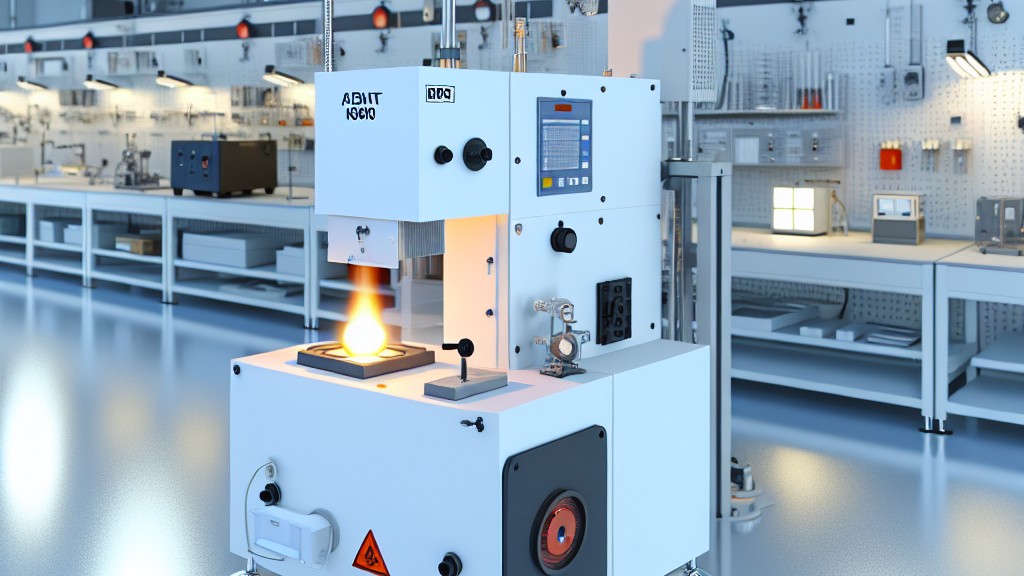
This method is applicable to all types of flooring including textile carpet, cork, wood, rubber and plastic coverings and coatings. The results obtained by this method reflect the performance of the flooring including any substrate, if used. Substrate replacement, bonding to a substrate, other changes to the substrate or flooring may affect the test results.
This standard is applicable to the measurement and description of the properties of floors in response to heat and flame under controlled laboratory conditions. It should not be used alone to describe or assess the fire risk or fire hazard of floors under actual fire conditions.
For the purposes of this standard, the following terms and definitions apply:
The test equipment shall be placed in a room at least 0,4 m from the walls and ceiling. The room shall consist of calcium silicate plates, 13 mm plus/minus 1 mm thick, and having a density of 650 kg/m3, which is not observed during the test. The outer casing of the chamber shall be metal. Under this observation window there is a closing door through which the sample platform can be moved in and out. Starting from the inner corner of the sample support, a steel ruler marked at 10 mm and 50 mm intervals is placed on both faces of the sample.
The bottom of the chamber shall consist of a sliding platform capable of rigidly supporting the sample holder in a fixed and level position. The total air access area between the chamber and the test specimen shall be 0,23 m2 plus/minus 0,03 m2, evenly distributed along the edges of the test specimen.
The radiant heat energy source shall be a porous refractory panel mounted on a metal frame with a radiation surface of 301 mm plus/minus 10 mm x 450 mm plus/minus 1 mm.
The panel must withstand temperatures up to 900 degrees and use a combustion gas and air mixing system 1 with appropriate instrumentation to ensure consistent and repeatable operation. The radiant panel shall be placed on the test specimen support so that its largest dimension is inclined 30 degrees plus/minus 1 degree to the horizontal plane.
The specimen holder shall be manufactured from heat-resistant stainless steel L-shaped profiles with a thickness of 2,0 mm plus/minus 0,1 mm and the dimensions shown in the figure. The specimen is exposed through an opening of 200 mm plus/minus 3 mm x 1015 mm plus/minus 10 mm. The specimen holder shall be attached to a sliding steel platform by means of two bolts at each end. The test specimen holder shall be provided with means for securing the test specimen (e.g. clamps on the steel bar). The total thickness of the support is 22 mm plus/minus 2 mm.
The pilot burner used to ignite the test specimen shall have nominal dimensions of 6 mm for the inside diameter and 10 mm for the outside diameter, be made of stainless steel and have 0,7 rows of 19 equally spaced 2 mm diameter holes drilled radially along the centerline and 60 equally spaced 0,7 mm diameter holes drilled radially 16 degrees below the line.
Test specimens should be representative of the floor in its final use. For materials with isotropic properties, four test specimens measuring 1050 mm plus/minus 5 mm x 230 mm plus/minus 5 mm should be cut.
Our organization, which has been trying to support businesses from every sector with its testing, measurement, analysis and evaluation studies carried out in a wide range for years, has a strong staff that closely follows the developments in the world in the field of science and technology and constantly improves itself. In this context, testing services are also provided to businesses in accordance with the standard “ABNT NBR 8660 Fire reaction test on floors - Determination of combustion behavior using a radiant heat source”.
To get an appointment, to get more detailed information or to request an evaluation, you can ask us to fill in our form and reach you.

