

The standard "ASTM E814, Standard Test Method for Fire Tests of Penetrating Firestop Systems," developed by the American Society for Testing and Materials (ASTM), describes a test method applicable to firestop systems constructed from a variety of materials and constructions. Firestop systems are designed for use in openings in fire-resistant walls and floors evaluated in accordance with the standard "ASTM E119, Standard Test Methods for Fire Tests of Building Construction and Materials."
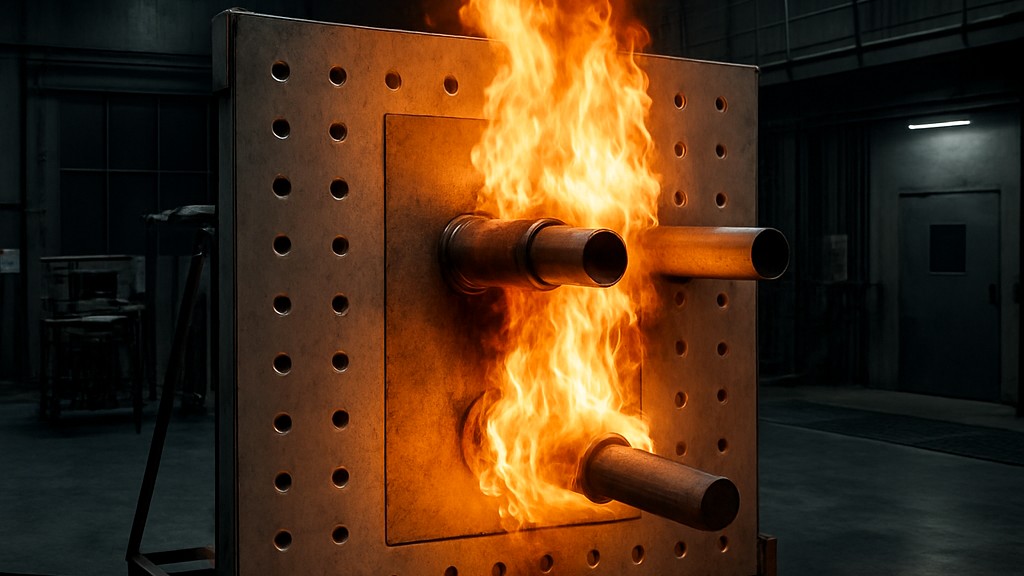
Tests performed in accordance with this test method record the firestop system performance during the test exposure, but these tests should not be interpreted to determine the suitability of the firestop system for use after the test exposure.
This test method also measures the resistance of firestop systems to an external force induced by water flowing from a hose. However, this test method should not be interpreted to determine the performance of a firestop system under actual fire conditions where it is subjected to forces such as failure of cable support systems and falling debris.
The purpose of this test method is to develop data that will assist others in determining the suitability of firestops for use in locations requiring fire resistance.
This test method is not applicable to membrane penetrations of a floor-ceiling assembly or roof-ceiling assembly tested as part of the assembly in accordance with the test methods described in ASTM E119. It is also not applicable to membrane penetrations of load-bearing walls.
This test method is used to determine the performance of a firestop system against exposure to a standard time-temperature fire test and a hose stream test. The performance of a firestop system depends on the construction of the materials tested (including the number, type, and size of penetrations and the floors or walls into which it is installed).
Two ratings are assigned to each fire suppression system:
These ratings, along with detailed performance data such as the location of penetration openings and temperatures of penetrating parts, are intended as a factor in evaluating the performance of fire suppression systems.
After the time-temperature phase is completed, ASTM E814 requires a hose flow test to be conducted on the same test setup. This second phase determines the firestop's resistance to external forces and its structural integrity after exposure to realistic fire conditions. This is critical because a firestop system must function properly under harsh conditions. This phase is crucial for the firestop system's proper operation under harsh conditions, determining the system's resistance to external forces and its integrity after exposure to heat from a fire.
The ultimate goal of the ASTM E814 standard fire resistance test is to gather data that will help determine how well a firestop system is suited to maintaining the fire resistance rating of a wall or floor assembly. This test is applicable to most firestops.
The following targets are excluded from the firestop testing scope:
The ASTM E814 firestop system testing procedure consists of the following steps:
Many organizations do not have the materials or space to perform this testing themselves, so it is best to work with a reliable, independent laboratory.
In short, the ASTM E814 standard is a test used to evaluate whether a firestop will achieve firestop status under fire conditions.
A firestop system is a system that passively prevents fires from spreading throughout a building. It does this by sealing the openings between panels or joints in fire-rated walls and floors. They also detect and notify you of a fire and are used in openings in fire-rated floors and walls.
In buildings, firestops should be installed at the following points:
A firestop system can take the form of a sealant, cushion, pipe clamp, or composite board. Common firestop materials include non-combustible materials such as:
All firestops, including those made from materials not listed above, are subject to the test requirements of ASTM Standard E814.
Our organization, which has been supporting businesses across all sectors for years through a wide range of testing, measurement, analysis, and evaluation activities, has a strong team of employees who closely follow global developments in science and technology and are constantly improving themselves. In this context, we also provide testing services in accordance with the "ASTM E814 Standard Test Method for Fire Testing of Penetrating Firestop Systems."
To get an appointment, to get more detailed information or to request an evaluation, you can ask us to fill in our form and reach you.

