

The standard “EN IEC 60331 Tests for electrical cables under fire conditions - Circuit integrity”, which is based on a European standard and subsequently published by the International Electrotechnical Commission (IEC), consists of the following subsections published under the same title:
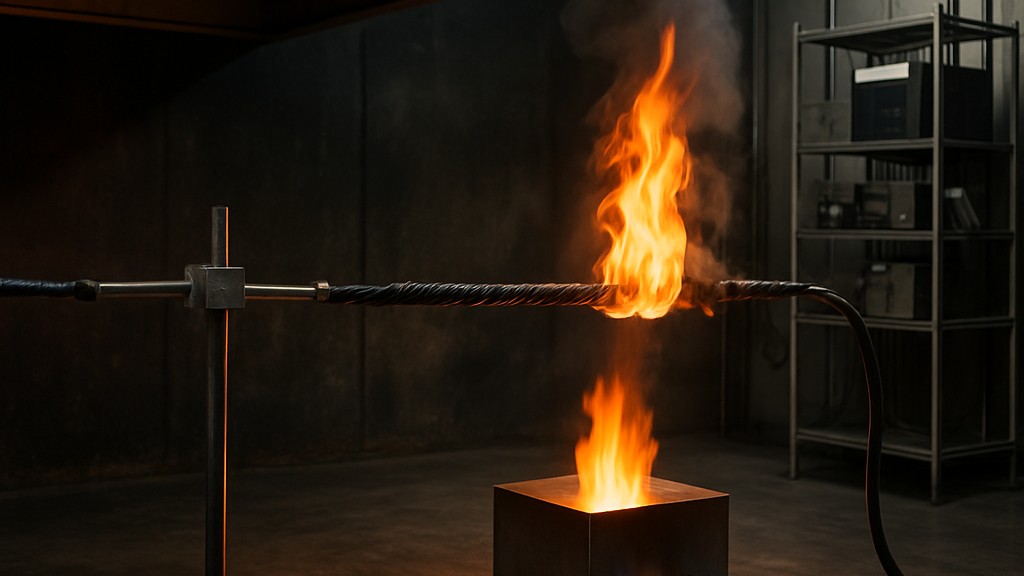
This standard applies to cables with a nominal voltage not exceeding 600/1000 V, metallic data and telecom cables, and fiber optic cables, including those with a nominal voltage below 80 V. It is intended for use in testing cables with an overall diameter greater than 20 mm. Cables with smaller diameters are intended to be tested using the apparatus, procedures, and requirements of EN IEC 60331-2.
This standard contains details regarding the specific fault point, continuity check arrangement, test specimen, test procedure and test report for electrical power and control cables having a rated voltage up to and including 600/1000 Volts.
Details regarding the specific fault point, continuity check arrangement, test sample, test procedure, and test report for metallic data and telecom cables and fiber optic cables are not given in EN IEC 60331-1. Although the scope is limited to cables with a nominal voltage up to 0,6/1,0 kV, the procedure may also be used for cables with a nominal voltage up to 1,8/3 kV, with agreement between the manufacturer and the purchaser, provided that suitable fuses are used.
Annex A provides the method for verifying the burner and control system used for testing. Requirements are specified for an identification that may optionally be marked on the cable to indicate compliance with this standard.
This standard applies to cables with a nominal voltage not exceeding 600/1000 V, metallic data and telecom cables, and fiber optic cables, including those with a nominal voltage below 80 V. It is intended for use in testing cables with an overall diameter not greater than 20 mm. Cables with larger diameters are intended to be tested using the apparatus, procedures, and requirements of EN IEC 60331-1.
This standard contains details regarding the specific fault point, continuity check arrangement, test specimen, test procedure and test report for electrical power and control cables having a rated voltage up to and including 600/1000 Volts.
Details regarding the specific fault point, continuity check arrangement, test sample, test procedure, and test report for metallic data and telecom cables and fiber optic cables are not given in EN IEC 60331-2. Although the scope is limited to cables with a nominal voltage up to 0,6/1,0 kV, the procedure may also be used for cables with a nominal voltage up to 1,8/3 kV, with agreement between the manufacturer and the purchaser, provided that suitable fuses are used.
Annex A provides the method for verifying the burner and control system used for testing. Requirements are specified for an identification that may optionally be marked on the cable to indicate compliance with this standard.
This standard applies to cables having a nominal voltage not exceeding 600/1000 Volts, including metallic data and telecom cables and fiber optic cables having a nominal voltage below 80 Volts. It is intended for use in testing cables having an overall diameter not greater than 20 mm. This standard details the specific fault point, continuity check arrangement, test specimen, test procedure, and test report for electric power and control cables having a nominal voltage up to and including 600/1000 Volts.
Details regarding the specific point of failure, continuity check arrangement, test sample, test procedure, and test report for metallic data and telecom cables and fiber optic cables are not given in EN IEC 60331-3. Although the scope is limited to cables with a nominal voltage up to 0,6/1,0 kV, it may also be used for cables with a nominal voltage up to 1,8/3 kV, provided that suitable fuses are used, with the agreement of the manufacturer and the purchaser.
Cables successfully evaluated using this method are not assumed to meet the requirements of EN IEC 60331-1 or EN IEC 60331-2. Tests must be performed separately according to either of these two standards. This additional performance can be recognized by marking in accordance with EN IEC 60331-1 and EN IEC 60331-2. Annex A provides the verification method for the burner and control system used for testing.
The test method described in this standard is limited to conductor sizes up to 120 mm². Test results for 120 mm² conductor structures also support larger cross-sections of the same cable structure. For pre-assembled three-core cables, the entire cable is considered tested when the entire cable is tested as a single core.
This standard specifies the specific fault point, continuity check arrangement, test specimen, test procedure, and test report for electric power cables with nominal voltages greater than 0,6/1,0 kV up to 18/30 kV. Annex A provides the method for verifying the burner and control system used for the test. Annex B provides the selection of recommended test apparatus. Annex C provides guidance for the optional use of water spray or water jet protocols. Annex D provides an optional flame temperature of 1000°C, applicable to specific applications. Requirements are specified for an identification that may be optionally marked on the cable to indicate compliance with this standard.
Focusing on the circuit integrity safety test method for power cables with rated voltages greater than 1 kV, up to 30 kV and under fire conditions, this group safety publication is primarily intended for use as a product safety standard for products specified in the scope.
For the purposes of this standard, the term circuit integrity refers to the ability to continue operating as specified when exposed to a specified flame source for a specified period of time.
The test shall be conducted in a suitable room equipped to remove harmful combustion gases. Adequate ventilation shall be provided to maintain the flame throughout the test. The room shall be maintained in an outdoor environment where the temperature is between 5°C and 40°C. The same ventilation and protection conditions shall be used in the room during both the verification and cable testing procedures.
This standard also describes sample preparation methods, continuity check arrangements, an electrical test procedure, a cable burning method, and includes requirements for evaluating test results. It is intended to cover low-voltage power cables and specifies requirements for evaluating test results.
This standard also describes sample preparation methods, continuity check arrangements, electrical test procedures, a method for burning cables, and specifies requirements for evaluating test results. It covers electrical data cables used in non-rated voltage and very-low-voltage circuits.
This standard also describes sample preparation methods, continuity check arrangements, optical test procedures, a method for burning cables, and specifies requirements for evaluating test results. It covers electrical data cables used in non-rated voltage and very-low-voltage circuits.
Our organization, which has been operating for many years and meticulously follows global developments in science and technology, employs a skilled team and extensive infrastructure to conduct testing, measurement, and analysis in a wide range of areas for businesses across all sectors. In this context, we also provide testing services in accordance with the EN IEC 60331 "Testing of electrical cables under fire conditions - Circuit integrity" standard.
To get an appointment, to get more detailed information or to request an evaluation, you can ask us to fill in our form and reach you.

