IEC 60332 Tests on Electrical and Optical Fiber Cables Under Fire Conditions
The standard “IEC 60332 Tests on electrical and optical fiber cables under fire conditions”, published by the International Electrotechnical Commission (IEC), consists of the following sub-sections published under the same title:
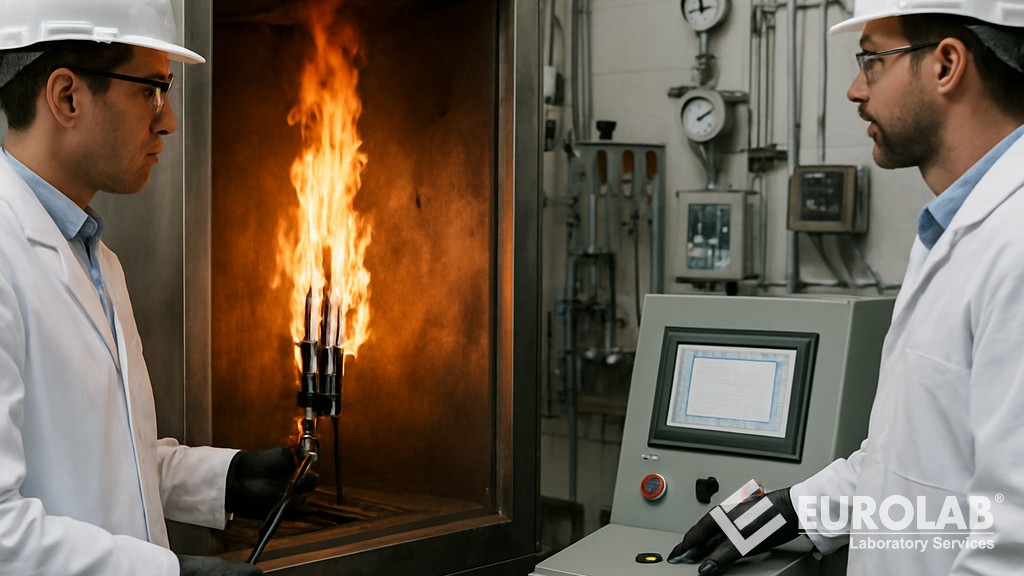
- The standard “IEC 60332-1-1 Part 1-1: Test for vertical flame propagation for a single insulated wire or cable - Device” describes a test device for testing the resistance of a single vertical electrically insulated conductor or cable or optical fiber cable to vertical flame propagation under fire conditions. This procedure is given in the standard IEC 60332-1-2, together with an informative annex of the recommended requirements for performance.
In the world of electrical engineering and safety standards, ensuring that cables and wires are resistant to fire hazards is paramount. One of these critical standards is IEC 60332-1-1, a fundamental tool for evaluating the resistance of single-insulated electrical conductors, cables, or optical fiber cables to vertical flame propagation under fire conditions. This standard addresses the need for consistent testing methods to prevent fire spread in installations where cables are used individually.
As buildings, vehicles, and industrial installations become more complex, the risk of fire spreading through wiring has also increased. The IEC 60332-1-1 standard provides the necessary tools (test equipment) to simulate real-world fire exposure. This standard covers the precise setup required to provide repeatable and reliable results, not the complete procedure. It is a fundamental element for manufacturers, regulators, and engineers aiming to certify products that minimize fire risks.
The EC 60332-1-1 standard essentially involves a rigorously designed test chamber and burner assembly for exposing a cable sample to a controlled flame. The device ensures environmental consistency, minimizing variables that could affect results. The key components are:
- Test chamber: Typically a metal enclosure, approximately 1 cubic meter in volume, lined to prevent heat loss and reflections. It includes a chimney for exhaust gases and observation points to monitor flame behavior. The chamber provides a draft-free environment to simulate still-air fire conditions.
- Burner: A standard gas burner calibrated according to IEC 60695-11-2 standard for 1 kW nominal pre-mixed flame characteristics, providing a precise flame. The flame is applied at a 45-degree angle to the lower end of the vertical cable sample.
- Sample holder: A rigid metal frame holds the cable vertically with clips at intervals to support it without affecting the combustion. The sample length is at least 600 mm and hangs freely to allow for natural combustion.
- Ignition source control: Thermocouples and flow meters regulate gas (propane or methane) and air mixtures for a constant flame height of 175–200 mm.
- Measuring tools: Rulers or measuring instruments are used to mark the cable for damage assessment, and cotton gauges are located at the bottom to detect fallen drops.
This design prevents external interference, allowing the test to isolate the cable's inherent flame resistance.
- The standard “IEC 60332-1-2 Part 1-2: Vertical flame propagation test for single insulated wire or cable - Procedure for 1 kW pre-mixed flame” describes the procedure for testing the resistance of a single vertical electrically insulated conductor or cable or optical fiber cable to vertical flame propagation using a 1 kW pre-mixed flame under fire conditions. If necessary, this test can be performed simultaneously with the test according to the IEC 60332-1-3 standard.
As modern infrastructure becomes increasingly reliant on complex cabling systems, fire safety in electrical and optical cabling remains a critical concern. While the IEC 60332-1-1 standard defines the basic test device, the IEC 60332-1-2 standard describes the detailed procedure for assessing vertical flame propagation in single-insulated conductors or cables using a 1 kW pre-mixed flame. This standard provides consistent and repeatable assessments that help prevent fire escalation in facilities.
This test is particularly relevant for general-purpose cables in buildings, vehicles, and industrial environments where individual cables must resist flame spread without bundling. As electrification accelerates (for electric vehicles and smart grids, for example), the IEC 60332-1-2 standard provides manufacturers and regulators with a reliable benchmark for certifying products that prioritize safety without compromising performance.
- The standard “IEC 60332-1-3 Part 1-3: Vertical flame spread test for single insulated wire or cable - Procedure for determining flame droplets/particles” describes a test procedure for evaluating falling flame droplets/particles when a single vertical electrically insulated conductor or cable or optical fiber cable is subjected to defined fire conditions. If necessary, this test can be performed concurrently with the test according to the IEC 60332-1-2 standard. Recommended requirements for performance are given in Annex A.
The IEC 60332-1-3 standard specifies the use of a 1 kW pre-stirred flame and is for general use; however, the specified procedure may not be suitable for testing small single-insulated conductors or cables with a total cross-section less than 0,5 mm² due to the conductor melting before the test is completed, or small optical fiber cables due to the cable breaking before the test is completed.
In the hierarchy of cable fire safety tests, the IEC 60332-1-3 standard stands out as a rigorous benchmark for evaluating how resistant a single electrical or optical cable is to intense flame exposure. While the IEC 60332-1-2 standard covers a 1 kW pre-mixed flame procedure, the IEC 60332-1-3 standard increases the difficulty by specifying the procedure using a 70 kW diffusion flame, a much more intense ignition source designed to simulate large-scale fire initiations such as burning debris or electrical arcs.
The IEC 60332-1-3 standard plays a critical role in high-risk applications where even a single cable failure can trigger a catastrophic fire spread. This standard is not for everyday cabling; it is reserved for cabling in critical infrastructure, transportation systems, industrial facilities, and offshore platforms where fire performance under extreme conditions is unquestionable.
- The standard “IEC 60332-2-1 Part 2-1: Test for vertical flame propagation of a single small insulated wire or cable - Device” describes a test device for testing the resistance of a single small vertical electrically insulated conductor or cable or optical fiber cable to vertical flame propagation under fire conditions. The procedure is given in the standard IEC 60332-2-2, together with an informative annex of the recommended requirements for performance.
In the complex world of cable fire safety, not all cables are created equal. While larger power cables are subject to rigorous scrutiny under the IEC 60332-1 series of tests, smaller conductors, such as those used in electronics, appliances, and instrumentation, require a more specialized approach. This is where the IEC 60332-2-1 standard comes into play, a fundamental standard defining a test device for assessing vertical flame propagation using a small flame source on vertically mounted, individually insulated small cables.
This standard defines a physical test setup (reservoir, burner, sample holder) for small cables with conductor cross-sections of up to 0,5 mm². It is the equivalent of the IEC 60332-1-1 standard, but scaled down for miniaturized cabling, ensuring that even the thinnest conductors in consumer appliances do not become fire vectors.
This standard is critical for manufacturers of flexible cables, sensor cables, telecommunications cables, and appliance internal wiring where space is limited but fire safety cannot be compromised. This standard applies to:
- Flexible and rigid small cables
- Small diameter optical fibers
- Internal wiring of electrical/electronic equipment.
- Automotive and aerospace wiring harness cables.
- The standard “IEC 60332-2-2 Part 2-2: Vertical flame propagation test for a single small insulated wire or cable - Diffusion flame procedure” describes the procedure for testing the resistance of a single small vertical electrically insulated conductor or cable or optical cable to vertical flame propagation under fire conditions. The device is defined in the IEC 60332-2-1 standard.
This standard provides a procedure for testing small optical fiber cables or small insulated conductors or cables where the method specified in IEC 60332-1-2 is not suitable, as some small optical fiber cables may fracture or small conductors may melt during flame application. The recommended application range is for testing single insulated conductors or cables with a cross-sectional area smaller than 0,5 mm².
In the invisible network of cables that power modern life, tiny wires with conductor cross-sections of no more than 0,5 mm² are everywhere: inside your smartphone charger, behind your car's dashboard, in medical monitors, and braided into household appliances. These miniature conductors pose a unique fire risk: they can melt, drip, and ignite long before larger cables are damaged. To address this problem, the IEC 60332-2-2 standard was designed, a precise test procedure for assessing vertical flame propagation using a small diffusion flame in small, individually mounted cables.
This test is not optional; it is mandated by global safety standards for electronic devices, household appliances, automotive systems, and medical devices. Passing the IEC 60332-2-2 standard means that a cable can be confidently tested to be fire-resistant.
- “IEC 60332-3-10 Part 3-10: Vertical flame spread test of vertically mounted bundled wires or cables - Device” describes the device, regulation and calibration of test methods for evaluating the vertical flame spread of vertically mounted electrical or optical bundled wires or cables under defined conditions.
- The standard “IEC 60332-3-21 Part 3-21: Vertical flame spread test of vertically mounted bundled wires or cables - Category AF/R” describes category AF/R for test methods to evaluate the vertical flame spread of vertically mounted bundled wires or cables under specific conditions. This standard applies only to power cables with a conductor cross-sectional area greater than 35 mm², mounted on a test ladder in a pre- and rear spaced configuration, and where the test specimen is a non-metallic material with a nominal total volume of 7 l/m³. The flame application time is 40 minutes. This mounting method is designed for special cable designs used in specific installations where required by the cable specification. Category AF/R is not intended for general use. The test is intended for type approval testing.
- The standard “IEC 60332-3-22 Part 3-22: Vertical flame spread test of vertically mounted bundled wires or cables - Category A” describes Category A for test methods for evaluating the vertical flame spread of vertically mounted bundled electrical or optical wires or cables under specific conditions. This standard relates to cables placed on a test ladder to obtain non-metallic material with a nominal total volume of 7 l/m³ of the test specimen. The flame application time is 40 minutes. This category is designed for general use where high-volume non-metallic materials need to be evaluated. The test is intended for type approval testing.
- The standard “IEC 60332-3-23 Part 3-23: Vertical flame spread test of vertically mounted bundled wires or cables - Category B” describes Category B test methods for evaluating the vertical flame spread of vertically mounted electrical or optical bundled wires or cables under specific conditions. This standard relates to cables placed on a test ladder to obtain non-metallic material with a nominal total volume of 3,5 l/m³ of the test specimen. The flame application time is 40 minutes. This category is designed for general use where medium-volume non-metallic materials need to be evaluated. The test is intended for type approval testing.
- The standard “IEC 60332-3-24 Part 3-24: Vertical flame spread test of vertically mounted bundled wires or cables - Category C” describes Category C test methods for evaluating the vertical flame spread of vertically mounted bundled electrical or optical wires or cables under defined conditions. This standard relates to cables placed on a test ladder to obtain non-metallic material with a nominal total volume of 1,5 l/m³ of the test specimen. The flame application time is 20 minutes. This category is designed for general use where low-volume non-metallic material needs to be evaluated. The test is intended for type approval testing.
- The standard “IEC 60332-3-25 Clause 3-25: Vertical flame spread test of vertically mounted bundled wires or cables - Category D” describes Category D test methods for evaluating the vertical flame spread of vertically mounted bundled electrical or optical wires or cables under specific conditions. This standard applies only to small cables with a total diameter of 12 mm or less and a cross-section of 35 mm² or less, mounted on a test ladder to obtain a nominal total volume of non-metallic material of 0,5 l/m³. The flame application time is 20 minutes. This category is designed for use with small cables where very low volumes of non-metallic material need to be evaluated. The test is intended for type approval testing.
For many years, our organization, with its competent and experienced staff, has been understanding the needs of its customers, providing the advanced testing services they require, and assisting in the establishment, implementation, and improvement of management systems. Within this framework, we also provide testing services to businesses in accordance with the "IEC 60332 Tests on electrical and optical fiber cables under fire conditions" standard.



