

The standard “ISO 22899-1 Determination of the resistance of passive fire protection materials to jet fires - Part 1: General requirements,” published by the International Organization for Standardization (ISO), describes the method for determining the resistance of passive fire protection materials and systems to jet fires. This standard provides an indication of how passive fire protection materials behave in a jet fire and provides performance data under specified conditions. However, it does not include the evaluation of other properties of the passive fire protection material, such as aging, shock resistance, impact or explosion resistance, or smoke production.
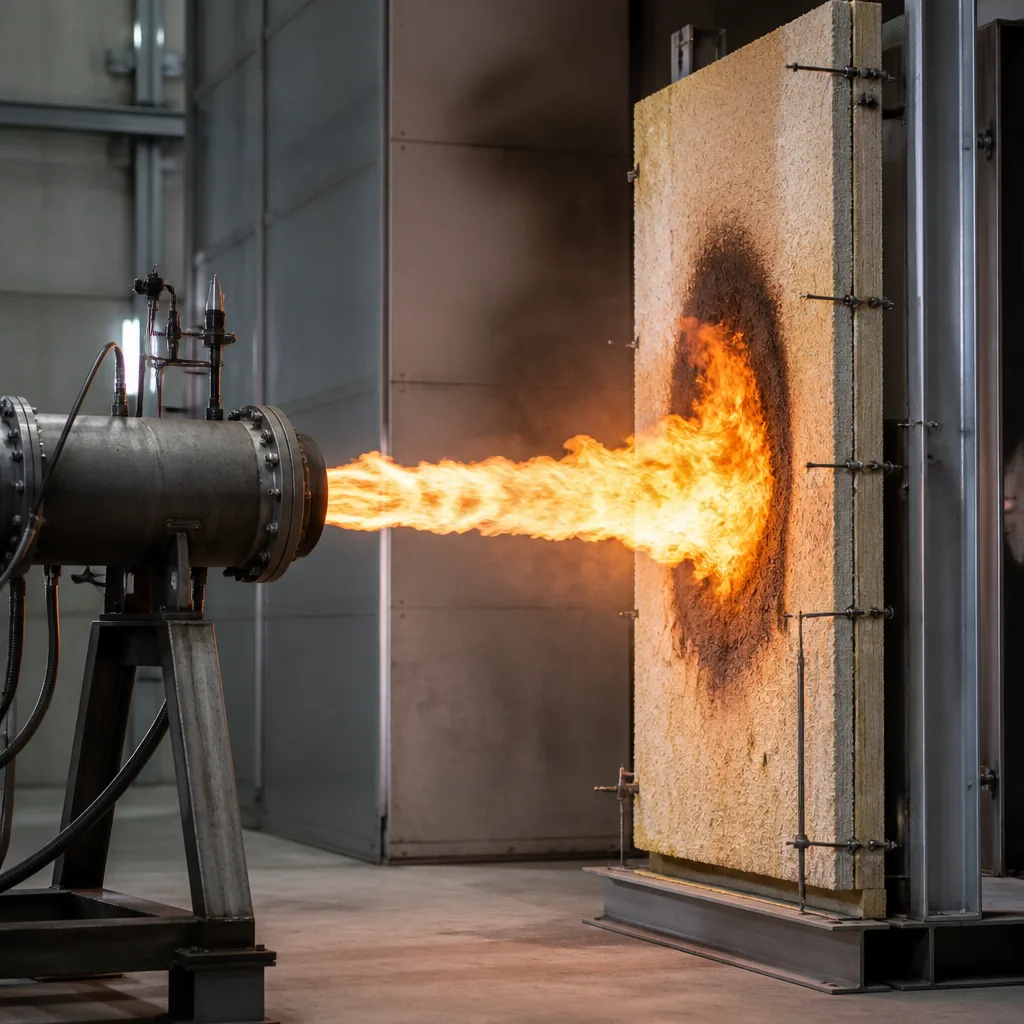
Furthermore, due to the degradation of jet properties, complete I-beams and columns cannot be tested according to this standard.
Fire can pose a serious threat to structures and equipment in industries where flammable gases or liquids are handled under pressure. A particularly dangerous scenario is a jet fire, which can occur when a pressurized flammable gas escapes, ignites, and produces a high-velocity flame that can apply intense thermal and mechanical stresses to nearby equipment.
The ISO 22899-1 standard provides a standardized method for evaluating the resistance of passive fire protection materials and systems when subjected to a defined jet fire test. This standard provides performance data that can be used to understand how passive fire protection systems behave under specified jet fire conditions.
The ISO 22899-1 standard defines a medium-scale test method designed to determine the resistance of passive fire protection materials and systems to jet fires. The primary aim of this standard is to provide a consistent laboratory method for determining how passive fire protection behaves when exposed to jet fire. This test provides information on:
A jet fire is the release of a combustible material under pressure by ignition. In the test method defined in the ISO 22899-1 standard, a jet fire is created using a controlled fuel supply and nozzle arrangement. Unlike a conventional pool fire, a jet fire produces a relatively intense, high-velocity flame. As a result, the protected material can be exposed to both significant heat and the mechanical stresses associated with the high-velocity flame. This makes jet fire testing particularly important for equipment located near pressurized hydrocarbon systems.
Passive fire protection is designed to protect structures or equipment from fire without requiring active intervention such as water spraying or manual fire extinguishing. Examples include:
The ISO 22899-1 standard evaluates the performance of these systems under specified jet fire exposure conditions.
In general, the testing process follows these steps:
The ISO 22899-1 standard includes specific provisions for measuring instruments, nozzle geometry and position, fuel, test environment, test procedure, repeatability, reproducibility, and measurement uncertainty.
When conducting tests in accordance with the ISO 22899-1 standard, the following factors are important:
When evaluating performance, factors such as temperature rise, integrity, and the duration for which the protection provides the required performance are considered, depending on the type of passive fire protection system. This standard also includes optional classification provisions covering the following:
These classifications can help communicate the conditions under which a particular test result was obtained.
However, the ISO 22899-1 standard does not evaluate the following characteristics:
Other appropriate tests or requirements may be used to evaluate these characteristics.
This standard is also not intended to replace hydrocarbon fire resistance testing. Rather, jet fire testing is considered complementary to other fire resistance assessments.
The ISO 22899-1 standard is particularly important in situations where failure of fire protection could lead to fire escalation or loss of critical equipment. The main benefits of this standard are:
The ISO 22899-1 standard is particularly relevant for facilities where pressurized flammable materials may be present. For example,
However, since the test result cannot recreate every characteristic of a real accidental fire in a laboratory setting, it should be evaluated in relation to real-world application.
For many years, our organization, with its competent and experienced staff, has been understanding the needs of its clients, providing the advanced testing services they require, and assisting them in the establishment, implementation, and improvement of management systems. Within this framework, we also provide testing services compliant with the ISO 22899-1 standard.
To get an appointment, to get more detailed information or to request an evaluation, you can ask us to fill in our form and reach you.

