

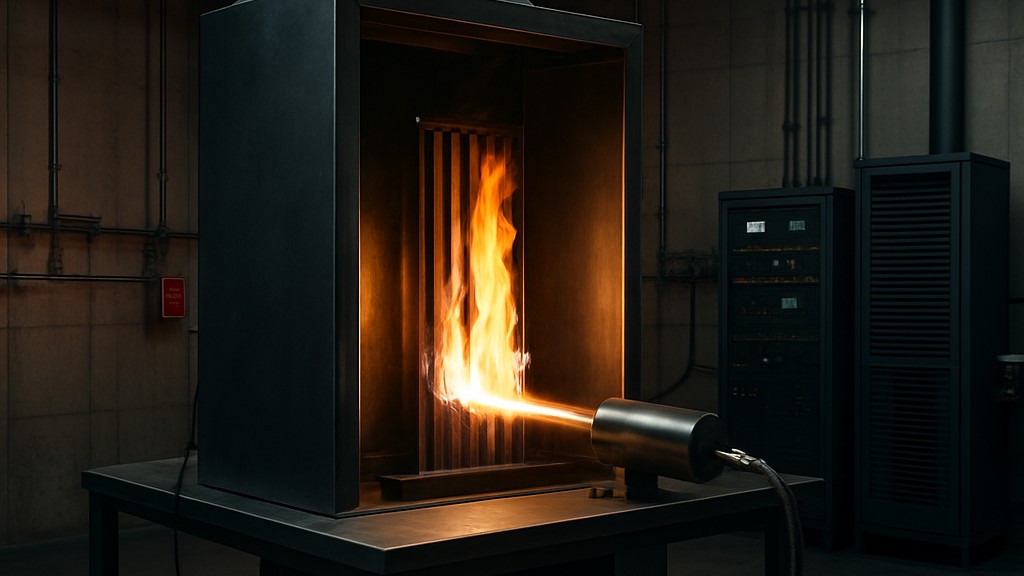
The Institute of Electrical and Electronics Engineers (IEEE) standard, "IEEE 1202 Flame Spread Testing of Wires and Cables," describes a procedure for exposing cable samples to a theoretical 20 kW flame ignition source for a 20-minute test period. This method determines the flame spread tendency of single-conductor and multi-conductor cables intended for use in cable trays in industrial and commercial applications.
Standardization of cable flame propagation tests is beneficial to cable manufacturers, distributors, and users. Uniform procedures, consistent, reproducible results, and measurable test acceptance criteria are essential for comparisons among competing products and for selecting the right product for the application. These criteria are detailed in this standard.
The purpose of IEEE Standard 1202 is to establish a test protocol and performance criteria for determining the flame propagation tendency of cables in a vertical cable tray. This standard applies to single-insulated conductor and multi-conductor cables permitted for use in horizontally or vertically installed cable trays in facilities covered by ANSI/NFPA 70 National Electrical Code. This standard is not intended to apply to facilities not covered by ANSI/NFPA 70.
The results obtained with this test do not imply that cables with similar cable construction will perform the same in other cable connections, other cable tray configurations, or other environments.
In an age where electrical systems power everything from industrial machinery to commercial buildings, fire safety remains a paramount concern. Wires and cables, often bundled in trays and exposed to potential ignition sources, can significantly contribute to the spread of fire if not properly tested. This is where IEEE 1202, a key standard that directly addresses this risk, comes in. This standard provides a rigorous protocol for evaluating how well cables resist flame propagation under controlled conditions. This standard protects life, property, and infrastructure by ensuring that cables used in critical applications like power distribution, signal transmission, and fiber optics do not exacerbate fires.
With the increasing reliance on complex electrical networks, the IEEE 1202 standard is gaining increasing importance. This standard benefits manufacturers, distributors, and end users by standardizing test procedures, ensuring consistent results and informed product selection.
This standard arose from the need to harmonize inconsistencies in cable flame testing methods, particularly between the protocols of the U.S. Underwriters Laboratories (UL) and the Canadian Standards Association (CSA). The first version focused on flame testing of cables used in cable trays in industrial and commercial applications. This test addressed criticisms of UL 1685 and similar standards that evaluated only specific structures, creating uncertainty about broader product groups. The standard was later updated with a more precise protocol for exposing cable samples to a theoretical 20 kW flame ignition source for a 20-minute period. The latest version includes uniform procedures for reproducible results and measurable acceptance criteria.
The IEEE 1202 standard essentially measures the flame propagation tendency of a cable in a vertical cable tray installation by simulating real-world fire scenarios in a controlled laboratory environment. This test is particularly crucial for multi-conductor, insulated cables used in power, signal, fiber, and splice applications.
The key test components are:
This procedure requires precise control over variables such as airflow, temperature, and sample preparation to ensure reproducibility. Accredited laboratories strictly adhere to these parameters, evaluating everything from single-insulated cables to complex fiber optic bundles.
The IEEE 1202 standard is largely based on the UL 1685 Vertical Tray Fire Spread and Smoke Release Testing standard. However, it includes improvements in severity and scope. While UL 1685 focuses on electrical and optical fiber cables, IEEE 1202 extends to broader industrial uses and has been integrated into nuclear standards such as IEEE 383.
The value of the IEEE 1202 standard lies in its ability to reduce fire risks in densely wired environments such as factories, data centers, and skyscrapers. By ensuring cables self-extinguish and limiting flame spread, it prevents small fires from escalating into catastrophic failures. In nuclear facilities, for example, compliance with the IEEE 1202 standard protects against malfunctions that could compromise safety systems.
Ultimately, the IEEE 1202 standard demonstrates engineering's commitment to safety by transforming abstract fire risks into measurable criteria. By standardizing flame spread tests, it not only saves lives but also facilitates innovation in wire and cable technology. As electrical demands increase, so does the need for such standards.
Our organization, which has been serving for many years and meticulously following global developments in science and technology, employs a skilled team and extensive infrastructure to conduct testing, measurement, and analysis in a wide range of areas for businesses across all sectors. In this context, we also provide testing services in accordance with the IEEE 1202 Flame Spread Testing of Wires and Cables standard.
To get an appointment, to get more detailed information or to request an evaluation, you can ask us to fill in our form and reach you.

