

The DIN 4102 standard, prepared by the German Standardization Institute (DIN), consists of the following sections under the main title of "Fire behavior of building materials and elements":
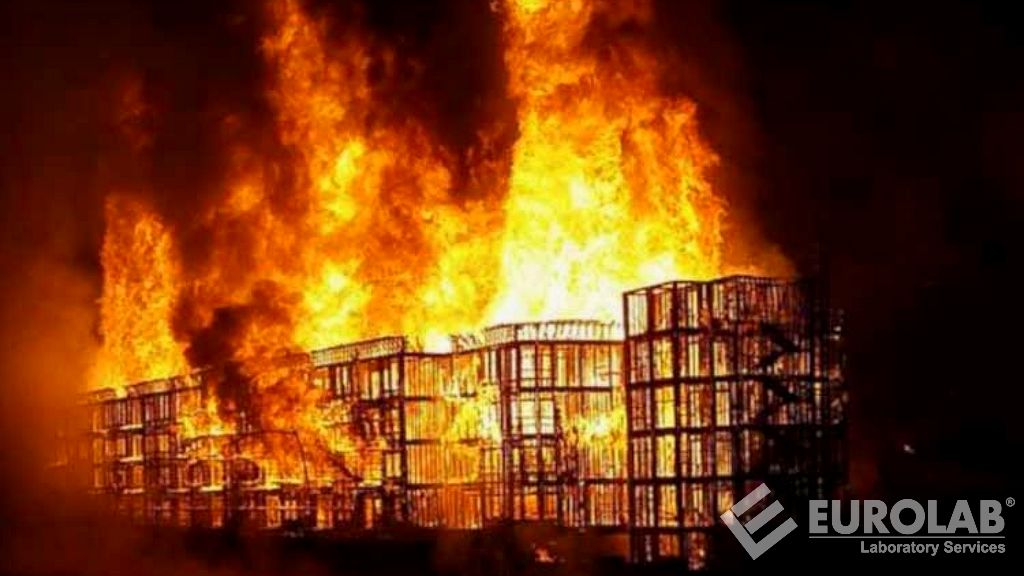
In the DIN 4102-1 standard, fire behavior classes for building materials are defined and requirements and test methods are explained for each class. This standard applies to sheet materials (including boards and floors), composite materials, material assemblies, coatings, insulation, coatings, pipes and fittings, decorative materials, curtains and other materials suspended from ceilings, fire retardants and intumescent coatings. The classification specified in this standard is intended to evaluate the fire behavior of materials alone or in combination. Fire behavior depends not only on the nature of the material, but also on its shape, surface properties, density, treatment and combination with other materials, including any binders or fasteners used.
The DIN 4102-2 standard describes fire protection definitions, requirements, and test methods for building components. According to this standard, walls, ceilings, beams, staircases, and similar structures are considered building materials. This standard stipulates that components enclosing a space must prevent fire passage for at least 30 minutes. Walls surrounding the space must withstand the load of the strength test. Supporting and non-load-bearing components must not collapse under constant load.
The DIN 4102-3 standard covers fire protection definitions, requirements and tests for firewalls and non-load-bearing exterior walls, including parapets and sills. According to this standard, firewalls should consist of Class A building material. Firewalls must meet the requirements of at least fire resistance class F90 with central and eccentric load. It should also remain stationary and close the field while testing impact loading. Integrity must be ensured during and after impact loading.
In the DIN 4102-4 standard, building materials, components and special components are classified according to other parts of this standard. This standard therefore includes proof of fire behavior and fire resistance and defines implementing regulations. Classification of individual components requires that the support and reinforcement components to which the individual components are attached have at least the same fire resistance.
The DIN 4102-5 standard describes fire protection definitions, requirements and test methods for fire barriers. This standard describes the requirements for structural unit, integrity, temperature limiting, tightness, self-closing and durability.
In the DIN 4102-6 standard, definitions, requirements and test methods for ventilation ducts are explained.
The DIN 4102-7 standard defines a test method for determining the fire behavior requirements of roofing materials and their resistance to flying marks and radiant heat.
Standard DIN 4102-8 defines a small-scale test furnace for fire resistance testing of building material or material details to determine certain fire protection properties. This standard covers, for example, heat release in building material under fire test conditions, thermal conductivity of mineral fiber inserts for fire barriers, fire response of intumescent fire protection coatings.
The DIN 4102-9 standard describes the requirements and test methods for insulating materials for cable penetrations designed to prevent the spread of fire at points where electrical cables pass through horizontal or vertical separating structural members (walls or floors) exposed to fire, subject to fire resistance requirements.
The DIN 4102-10 standard describes additional requirements regarding the fire behavior of building materials and components.
The DIN 4102-11 standard describes the definitions, requirements and test methods for fire protection technology for measures against the spread of fire in pipelines (including insulation layers and coatings, where appropriate) and service shafts and ducts and doors of inspection openings. Service shafts and ducts, and respectively pipe linings and gaskets, must by themselves prevent the spread of fire and smoke to other floors or through fireproof walls during the fireproofing period.
In the DIN 4102-12 standard, real fire conditions are most closely simulated in all electrical wiring systems with fasteners, and the requirements and test method for the fire resistance of the required electrical wiring system are explained. A group of power cables, telecommunications, data cables and similar equipment to be fixed to the support structure consisting of ducts, ladders, cable tray, items to be hanged are within the scope of this standard. The cables connected to this structure are powered by operating voltages. It is tested for functional integrity, short-circuit insulation or discontinuity of any wire cores.
The DIN 4102-13 standard describes the requirements and test methods for fire-resistant glass in fire resistance classes F30 to F120 and G30 to G120. Functional glass elements such as windows, door sets, and shutter assemblies are not covered by this standard.
The DIN 4102-14 standard describes a method for determining combustion behavior, critical radiation and smoke development for horizontally mounted flooring systems exposed to a radiant heat source at a test location during a pilot flame.
The DIN 4102-15 standard defines a test method called "Brandschact" for fire testing of building materials and components. This standard provides information on the type, dimensions, number, and setup of samples, and describes the test conditions and requirements for inspection testing.
DIN 4102-16 standard serves to perform uniform testing of building materials in fire chimneys according to DIN 4102-15 standard. This standard describes the following requirements: flame treatment of the test sample, distance of the test sample from the burner, testing of old samples, testing of exposed samples and completion of the test.
The DIN 4102-17 standard is valid for determining the adequate resistance of mineral fiber insulation materials in building components at a minimum fire load of 100 degrees Celsius. This standard describes the following requirements: flame treatment of the furnace according to the standard temperature curve for 90 minutes, simultaneous or sequential tests of the test sample, determination of the thickness of the test sample after flame treatment and an indication of thickness reduction in percent.
The DIN 4102-18 standard defines a test method for the verification of automatic closing for fire barriers. This standard applies to single-leaf hinged doors, types of gripping mechanisms, double-leaf hinged doors, center-space bending moments, flap-opening locking, fixed-wing locking (plug-in bolts, drive bolts, folding drive bolts), roller doors, sliding doors, and conveyor systems. describes the requirements for fire barriers.
In the DIN 4102-19 standard, a test room is defined for additional evaluations for wall and underfloor surface products in rooms.
The DIN 4102-20 standard describes a test method for checking and evaluating the reaction to fire of building materials and types intended for use on the surfaces of exterior partition walls of buildings. The assessment covers the behavior of cladding systems when exposed to flames blasting through an exterior wall opening after a flare in an adjacent room after a fire has fully developed. Exposure to fire on the back surface is excluded.
The DIN V 4102-21 standard describes the requirements for evaluating the performance of fire-resistant air ducts and defines a test method.
DIN 4102-22 is an implementation standard for DIN 4102-4, which is based on the design of partial safety factors within the context of the fire behavior of building materials and components.
The DIN V 4102-23 standard contains rules for the application of test results for roofs tested according to the DIN V ENV 1187 standard and the DIN 4102-7 standard.
Our organization also provides fire behavior testing services of building materials and elements within the scope of DIN 4102 standard, with its trained and expert staff and advanced technological equipment, among the numerous test, measurement, analysis and evaluation studies it provides for businesses in various sectors.
To get an appointment, to get more detailed information or to request an evaluation, you can ask us to fill in our form and reach you.

