

The standard “IMO 2010 FTP Code Part 4 - Testing of fire door control systems” published by the International Maritime Organization (IMO) covers fire door control systems where the fire door is tested in an oven while in use (opening and closing) at 200 degrees for 60 minutes. The test is then continued with temperatures increasing to 945 degrees, following the standard ISO time-temperature curve.
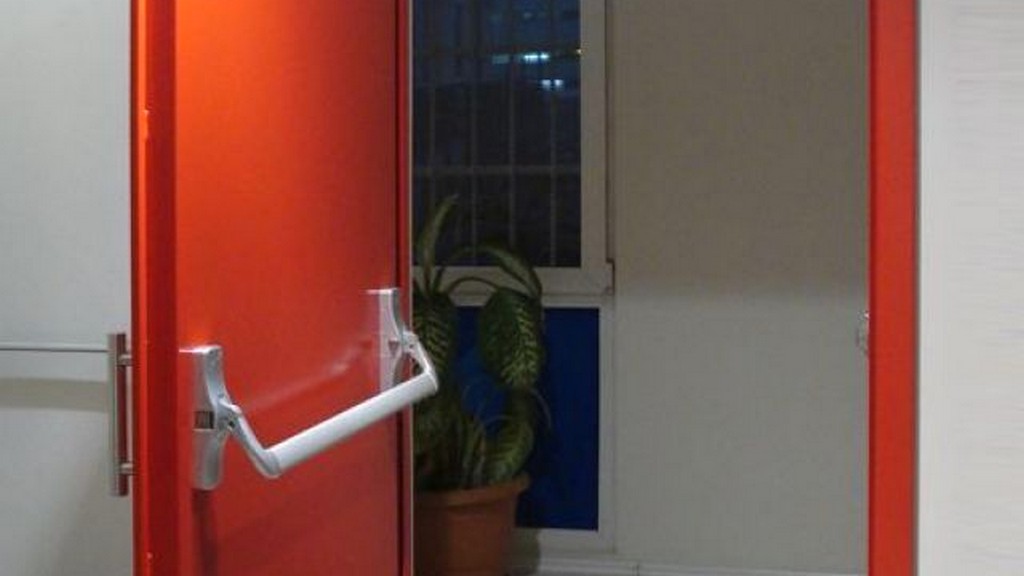
Materials to be used at sea are tested in accordance with the fire test procedure code defined in this standard. The results can be used for type approval.
Fire door control systems intended for use on fire doors that can be operated in the event of fire are tested in accordance with the fire test procedure described in this standard, regardless of the power source (pneumatic, hydraulic or electric). These tests are a prototype test and are carried out and evaluated in a dimensioned oven in advanced laboratories with a complete control system in accordance with resolution A.754(18) issued by the International Maritime Organization (IMO).
The structure to be tested should, as far as possible, be representative of that which will be used on ships, including materials and method of assembly.
In these tests, the functions of the control system, including the closing mechanism, are tested, i.e. its normal functions if this is a basis for the manufacturer's design, and if necessary, its emergency function, transition functions. The required type of installation and functions are understood from a detailed function description.
The installation of the prototype control system must be in full compliance with the manufacturer's installation manual. The prototype control system must include a typical door arrangement connected to the closing mechanism. A door model must be used for testing purposes. In the case of sliding doors, the model door must run on the original door tracks with the original support and guide rollers. The model door must be rated for the largest door weight that will be operated by this control system. In the case of pneumatic or hydraulic systems, the actuator (cylinder) must have the maximum length allowed by the oven.
Before the test, the drawings of the test setup and the bill of materials are submitted to the laboratory by the applicant. The test laboratory takes reference samples of all materials whose properties are important for the performance of the prototype control system (excluding steel and equivalent materials). If necessary, fire resistance tests of the insulation material are carried out in accordance with the IMO 2010 FTP Code Part 1 standard. The adhesives used in the manufacture of the sample do not need to be fire resistant, but must have low flame spread properties.
The density of each insulation material is determined. The density of mineral wool or similar compressible material is related to the nominal thickness. The thickness of each insulation material and material combination is measured using a suitable measuring instrument or caliper.
Conditioning of the prototype control system (excluding insulation) is not required. If insulation is used in the structure, the prototype control system should not be tested until the insulation is air dry. This condition is designed as a balance (constant weight) at 23 degrees Celsius and 50 percent relative humidity. Accelerated conditioning is permitted as long as the method does not alter the properties of the component materials. High-temperature conditioning should be below the temperatures critical to the materials.
If the prototype fire door control system and insulation are used for the protection of the system or parts thereof, they shall be mounted on the partition plate as shown in the figure given in the standard. The structural core shall be mounted on the furnace in accordance with the principles for Class “A” partitions. The door model shall be arranged inside the furnace. The structural core to which the system and door model are mounted shall not have a door opening. However, small openings are permitted for the release mechanism of the control systems.
The laboratory verifies that the prototype control system complies with the drawings and assembly method provided by the applicant and any areas of discrepancy are resolved prior to commencing testing. The laboratory checks the system for operability by opening the door model at least 300 mm away immediately prior to testing. The door model is then closed.
No more than 5 minutes before the start of the test, the initial temperatures recorded by all thermocouples are checked to ensure consistency and the data values are noted. Similar data values are obtained for deformation and the initial state of the prototype control system is noted.
During the test, the initial average indoor temperature should be 20 degrees plus/minus 10 degrees and within 5 degrees from the initial ambient temperature.
Among the numerous testing, measurement, analysis and evaluation studies that our organization has carried out for businesses in various sectors, it also provides testing services defined in the IMO 2010 FTP Code Part 4 - Fire door control systems testing standard with its trained and expert staff and advanced technological equipment.
To get an appointment, to get more detailed information or to request an evaluation, you can ask us to fill in our form and reach you.

