DIN 53438 Testing of Combustible Materials - Reaction to Ignition with a Small Flame
The standard “DIN 53438 Testing of flammable materials - Reaction to ignition with a small flame”, developed by the German Institute for Standardization (DIN) , consists of the following sub-sections published under the same title:
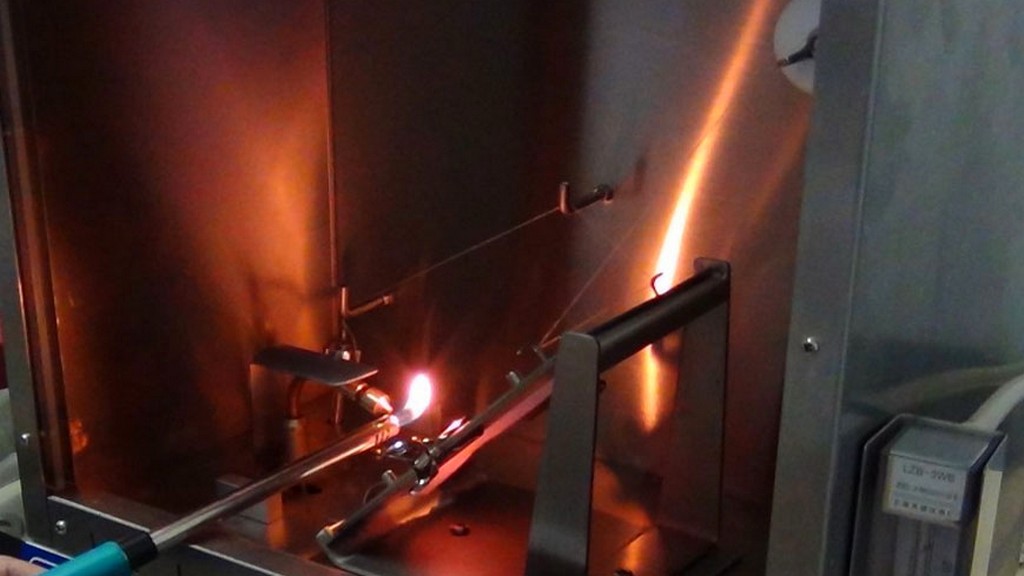
- The standard "DIN 53438-1 Part 1: General data" describes test methods for determining the response of combustible materials to a small flame from a burner in a flame test chamber under controlled test conditions. These test methods are suitable for production control purposes, where combustion consistency is to be tested, and for comparing the combustion characteristics of different products. Furthermore, the test results cannot provide more than general information about the combustion characteristics of a product under conditions different from those tested.
For the purposes of this standard, the following definitions apply:
- Burning time: The time from the first application of a burner flame until the other flames in the test piece cease burning or the time end reaches the upper indicator mark.
- Post-heating time: The time between the flame on the flame part being extinguished and the flame being extinguished.
During the test, the flame is applied to a test piece positioned vertically within the flame test chamber. In the edge ignition method (Method K) specified in DIN 53438-2, the flame is applied to the lower free edge of the test piece, while in the surface ignition method (Method F) specified in DIN 53438-3, the flame is applied to the surface of the test piece facing the burner. Tests must determine whether and when the flame tip reaches the specified measurement mark on the test piece.
The DIN 53438-1 standard provides definitions, principles, and general information, forming the basis for a range of relevant test procedures. It is widely used in industries where fire resistance and fire retardancy are critical safety factors. This standard applies to:
- plastic films
- foams
- Non-woven fabrics
- Filter media (e.g. for heating, ventilation and air conditioning, HVAC systems)
- Thermal and acoustic insulation materials
This standard is not limited to a single product type but defines general principles used across multiple material categories.
The purpose of this standard is to provide a standardized method for evaluating how readily a material ignites and burns when exposed to a small flame by simulating potential real-world ignition sources such as sparks, matches, or electrical shorts. These results help manufacturers:
- Classify materials according to their flammability
- Comparing the fire behavior of different materials
- Demonstrate compliance with safety standards or building regulations
- Optimizing material formulations to increase fire resistance
The basic principles of the DIN 53438-1 standard flame test are:
- Exposure to a controlled flame source (typically butane or propane)
- Observation of flame spread, ignition time and self-extinguishing behavior
- Positioning of samples (vertical or horizontal)
- Defined flame application time (e.g. 15 seconds)
- Recording of post-flame time, post-heat time and length of damaged/charred material
DIN 53438-2 Part 2: Edge ignition" is a German industrial standard that specifies test procedures for assessing the flammability of materials used specifically in air filters and filtration systems. This standard plays a critical role in ensuring fire safety compliance in industries where air filtration systems are used, such as HVAC, automotive, cleanrooms, and industrial ventilation.This standard is part of the broader DIN 53438 series, which focuses on the reaction of materials to fire. The test described here evaluates how a material responds when exposed to flame in a vertical direction. It applies specifically to filter media, which are typically made of synthetic or fiberglass-based materials and are commonly used in environments requiring fire-resistant components.
The essential components of the method described in this standard are:
- Test sample preparation: Samples are typically cut into strips of specified dimensions (e.g., 20 mm wide by 160 mm long). The material must be conditioned to a specific temperature and humidity before testing.
- Vertical strip flame test: A flame (usually from a standard gas burner) is applied to the bottom edge of a vertically mounted test strip. The flame is applied for a specified time (e.g., 15 seconds) and then removed.
- Evaluation criteria:
- Afterflame time: The time during which the material continues to burn after the flame is removed.
- Post-incandescence time: The time during which the material glows without an open flame.
- The length of material destroyed or charred.
- Whether flammable particles fall and ignite a cotton pad placed under the sample.
Materials tested according to the DIN 53438-2 standard are generally divided into three categories:
- F1: Non-flammable or flame retardant: Very safe, self-extinguishing.
- F2: Moderately flammable: Burns with medium speed and intensity.
- F3: Flammable: Continues to burn even after the flame is extinguished, less suitable for safety-critical applications.
These classifications help manufacturers and safety engineers select appropriate materials based on fire resistance needs.
The DIN 53438-2 standard is used primarily in the following areas:
- HVAC filters: Ensures that filters used in buildings or vehicles do not contribute to the spread of fire.
- Cleanroom filtration: Essential in the pharmaceutical and electronics industries, where both air purity and fire safety are critical.
- Industrial ventilation: Factories and processing plants use certified filters to meet occupational safety requirements.
The standard "DIN 53438-3 Part 3: Surface ignition" plays a key role in determining how materials used in air filtration and ventilation behave when exposed to an open flame. This standard provides a test method for assessing the flammability of non-metallic materials, particularly those used in air filters and insulation components.In safety-critical environments such as industrial facilities, HVAC systems and clean rooms, the fire resistance of materials used in air filtration and ventilation is critical.
The DIN 53438-3 standard is for testing the fire behavior of materials in a controlled laboratory environment. It is particularly important in industries that use porous or fibrous materials such as filter materials, textiles, and foam insulation.
DIN 53438-3 focuses on flame propagation testing for vertically mounted specimens. Its key features are:
- Vertical flame test method: This standard outlines a procedure in which a material sample is mounted vertically and exposed to a small, standard flame. The objective is to observe:
- Ignition behavior
- Flame propagation
- Self-extinguishing time
- Damage extent (charring length)
- Test classification: Based on test results, materials are classified according to their flammability. These categories are:
- F1: Non-flammable or self-extinguishing with minimal damage.
- F2: Limited flame spread with partial self-extinguishing.
- F3: Combustible materials with significant flame spread.
These classifications help manufacturers select appropriate materials based on the fire safety requirements of the application.
The DIN 53438-3 standard is widely used in the following areas:
- Filter media in HVAC systems
- Nonwoven fabrics used in clean rooms or the pharmaceutical industry
- Thermal insulation materials
Our organization, which has been operating for many years and meticulously follows global developments in science and technology, conducts testing, measurement, and analysis in a wide range of areas for businesses across all sectors with a skilled team and extensive infrastructure. In this context, we also provide testing services in accordance with the DIN 53438 "Testing of flammable materials - Response to ignition with a small flame" standard.



