

The American Society for Testing and Materials (ASTM) standard "ASTM E2058 Standard Test Methods for Measurement of Material Flammability Using Fire Propagation Apparatus (FPA)" quantifies material flammability properties related to the tendency of materials to support fire propagation through a fire propagation apparatus. The quantified material flammability properties include ignition time, chemical and convective heat release rates, mass loss rate, and effective heat of combustion.
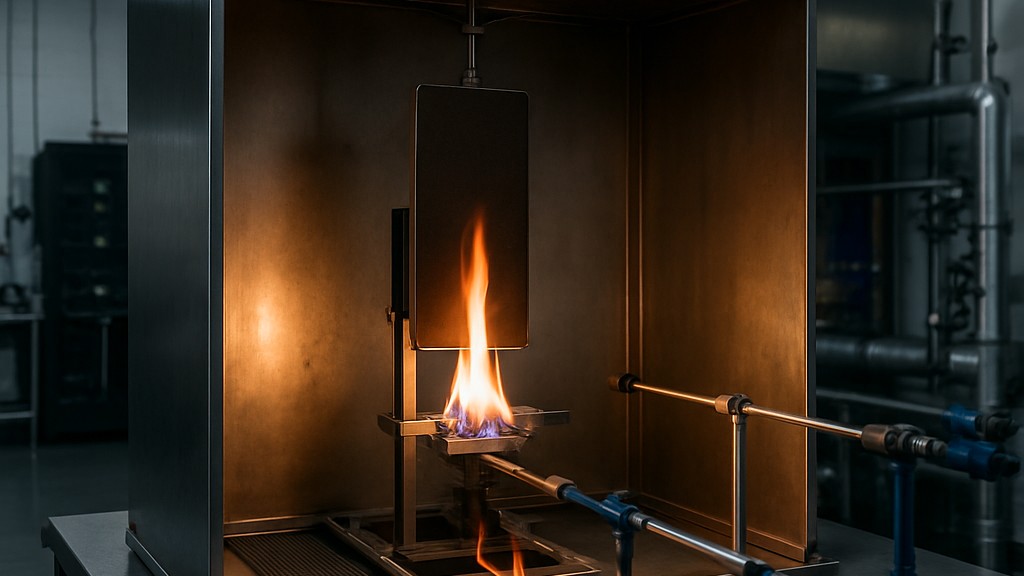
This standard defines the following test methods that can be performed separately and independently:
Distinctive features of fire spreading apparatus include:
The fire propagation apparatus is used to evaluate the flammability of materials and products. It is also designed to obtain the transient response of these materials and products to specified heat fluxes in specified inert or oxidizing environments and to obtain laboratory measurements of the production rates of fire products (carbon dioxide, carbon monoxide, and, if desired, gaseous hydrocarbons) for use in fire safety engineering.
Ignition of the sample is achieved by means of a pilot flame at a determined position relative to the sample surface.
Fire spread testing of vertical specimens is not suitable for materials that melt sufficiently to form a liquid pool when heated.
These test methods are integral to existing test standards for cable fire propagation and cleanroom material flammability, as well as an approval standard for conveyor belts. Sources use these test methods because the fire test response results from these test methods correlate with fire behavior during real-scale fire propagation tests.
The ignition, combustion, or fire spread test method, or a combination thereof, has been conducted with materials and products containing a wide range of polymer compositions and structures.
The fire spread test method differs from the test methods in the ASTM standards listed here in that it produces laboratory measurements of the rate of chemical heat release during upward fire spread and combustion on a vertical test specimen in normal air, oxygen-enriched air, or oxygen-contaminated air. Test methods in other standards, such as the ASTN E1321 test method, which provides measurements during horizontal/horizontal or downward flame spread over materials, and the ASTM E906, ASTM E1354, and ASTM E1623 test methods, which provide measurements of the rate of heat release from materials fully engaged in flaming combustion, typically use an external radiant flux rather than flames originating from the burning material itself to characterize fire behavior.
These test methods are not intended as routine quality control tests. They are designed to evaluate specific flammability properties of materials. The materials to be analyzed consist of samples taken from an end-use product or various components used in an end-use product. Results from laboratory procedures provide input for fire spread and growth models, risk analysis studies, building and product designs, and materials research and development.
Understanding how materials behave in fire is crucial in fire safety research and materials testing. One of the most advanced tools for this purpose is the fire propagation apparatus. This apparatus is subject to ASTM E2058.
This method allows researchers to measure ignition behavior, heat release rate, mass loss, smoke production, and gas evolution under controlled conditions. It is particularly useful for evaluating materials used in buildings, transportation, electronic devices, and consumer goods.
The fire spread apparatus is a bench-scale fire testing device designed to simulate realistic fire scenarios on a small sample of materials. It provides quantitative data on how materials behave when exposed to a controlled heat flow and an external flame. This apparatus is a versatile calorimeter that operates under oxygen consumption calorimetry, calculating the heat release rate based on the amount of oxygen consumed during combustion. ASTM E2058 defines the procedures, instrumentation, calibration, and analysis required for the effective use of the fire spread apparatus.
The main objectives of this standard are:
Major applications of this standard include testing materials used in the manufacture of:
The key components of the fire spread device used in these tests are:
The testing procedure simply follows these steps:
Unlike simpler fire tests such as vertical flame tests, the fire spread apparatus provides a comprehensive combustion behavior, making it ideal for:
This method is particularly valuable in situations such as aviation or mass transit materials where actual fire testing is too expensive or large-scale.
Our organization, which has been serving for many years and meticulously following global developments in science and technology, conducts testing, measurement, and analysis in a wide range of areas for businesses across all sectors with a skilled team and extensive infrastructure. In this context, we also provide testing services in accordance with ASTM E2058 Standard Test Methods for the Measurement of Material Flammability Using Fire Propagation Apparatus (FPA).
To get an appointment, to get more detailed information or to request an evaluation, you can ask us to fill in our form and reach you.

