

The International Organization for Standardization (ISO) standard "ISO 5657 Reaction to fire tests - Ignition of construction products using a radiant heat source" describes a method for examining the ignition characteristics of exposed surfaces of specimens of substantially flat materials, composites, or assemblies not exceeding 70 mm thick when placed horizontally and exposed to specified levels of thermal radiation. The standard appendix includes a commentary on the text and guidance notes for operators (Annex A). Recommendations on the limitations of the test are included in Annex B.
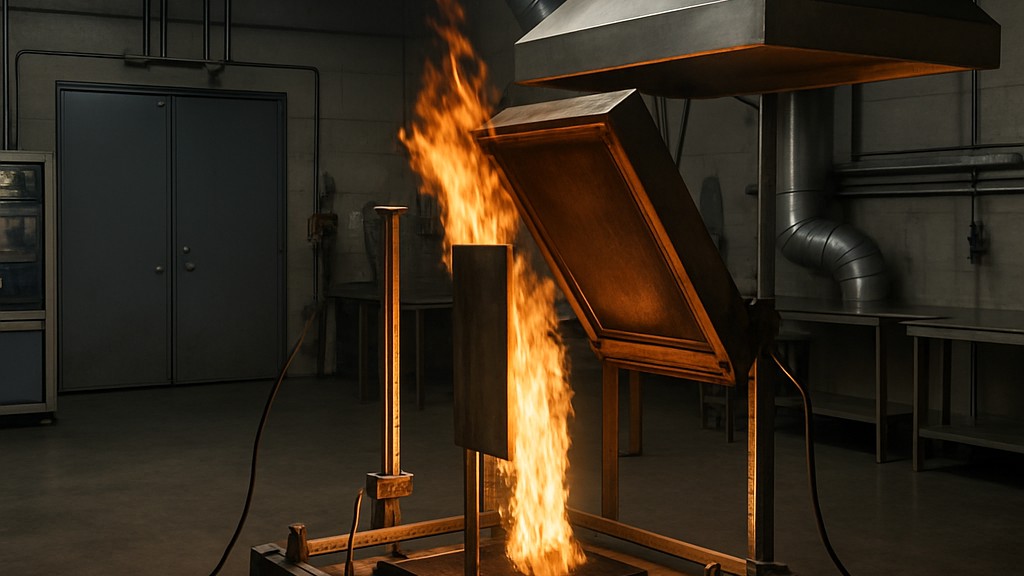
In principle, product samples are mounted horizontally and their upper surfaces are exposed to thermal radiation at selected constant irradiance levels ranging from 10 to 70 kW/m². A pilot flame is applied at regular intervals at a position 10 mm above the center of each sample, and the emitted volatile gases are ignited. The time when sustained surface ignition occurs is reported.
The annex to this standard contains information on the use of apparatus to determine the ignitability of materials under higher irradiances (Annex C). Other types of ignition that occur are reported.
Convection transfer may also contribute very little to the heating at the center of the sample and to the radiometer reading during the calibration procedure. However, the term radiation is used throughout this standard to best denote the primarily radiative mode of heat transfer.
The suitability of a product for testing is assessed as follows: A product with one of the following surface properties is suitable for testing:
If an exposed surface does not meet the requirements of this standard, the product should be tested in a modified form that conforms as closely as possible to the requirements given above. The test report should state that the product was tested in a modified form and clearly describe the change.
A product submitted for this test may have different surfaces or may contain laminates of different materials arranged in a different order relative to the two surfaces (asymmetrical products). If either surface could be exposed during use, such as in a room, space, or void, both surfaces should be tested.
Sample properties for the tests were determined as follows:
When the product is a material or composite that will normally be bonded to a well-defined substrate, it should be tested using the recommended fixing technique with that substrate, for example, bonded with a suitable adhesive or mechanically fastened. Alternatively, where the end-use substrate is non-flammable or has limited flammability, the material or composite can be tested using a reference substrate of a lower density than the end-use substrate. ISO/TR 14697 applies for recommendations on substrates.
One plinth is required for each test sample. However, since it is sometimes possible to reuse the plinth after testing, the total number required depends on the frequency of testing and the type of product being tested. Plinths should have sides of 165 mm plus or minus 5 mm and be constructed from non-combustible insulation board with an oven-dry density of 825 plus or minus 125 kg/m3 and a nominal thickness of 6 mm.
Before testing, samples and skirtings should be subjected to constant mass in an environment of 23 degrees plus/minus 2 degrees and 50 percent plus/minus 5 percent relative humidity, with free air access on both sides.
Our organization, which has been supporting businesses across all sectors for years through a wide range of testing, measurement, analysis, and evaluation activities, boasts a strong team of employees who closely follow global developments in science and technology and are constantly improving themselves. In this context, we also provide testing services in accordance with the ISO 5657 standard for "Reaction to fire tests - Ignition of building products using radiant heat sources."
To get an appointment, to get more detailed information or to request an evaluation, you can ask us to fill in our form and reach you.

