

The "BS 5852 Fire tests for furniture" standard, developed by the British Standards Institution (BSI), consists of the following subsections published under the same title:
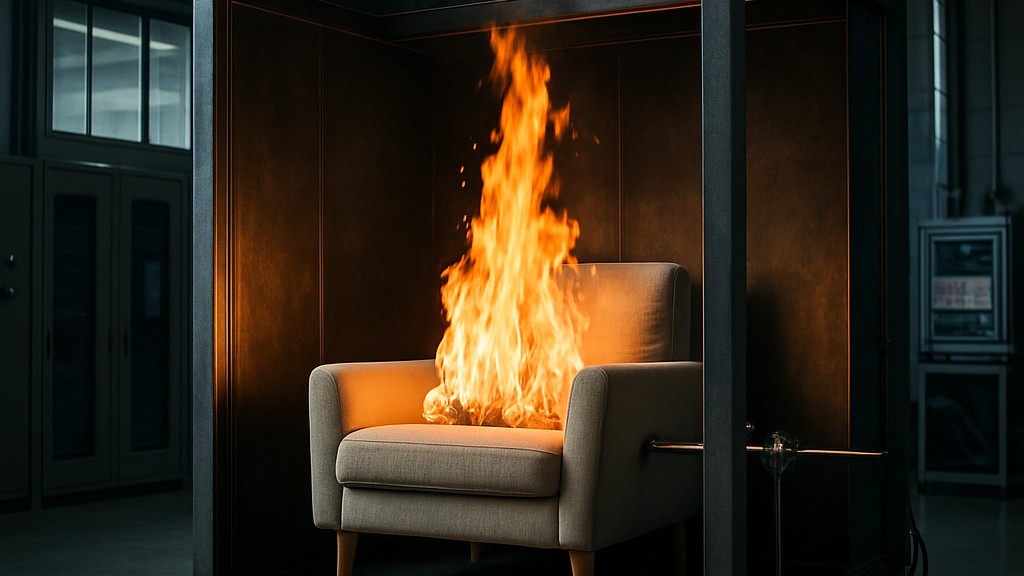
All household upholstered furniture must comply with applicable legal regulations. These regulations specify the technical ignition methods to be used for a piece of furniture or its components, the requirements, labeling, and the frequency of testing. In some cases, legal regulations impose requirements beyond those specified in the test standards they reference.
Tests are conducted in a test chamber with calibrated airflow. The cover fabric and padding are placed in a test rig to create a small sofa with a 90-degree angle between the seat and back. Ignition sources are located at the junction between the seat and back.
During the smoking test, the test assembly is not allowed to smolder for one hour after the start of the test. Furthermore, the test assembly is not allowed to show signs of charring more than 100 mm in any direction other than upward from the cigarette.
The test assembly is subjected to a match flame equivalent for 20 seconds. Flames are not allowed to continue for more than 120 seconds after the burner tube is removed.
BS 5852-1 is a British standard that specifies methods for assessing the flammability of upholstered furniture and flooring using the equivalent flame of a smoldering cigarette or match as an ignition source. This standard is an important part of the fire safety framework, particularly in domestic and commercial furniture production and other jurisdictions that apply British standards.
The primary purpose of this standard is to evaluate how readily upholstered furniture materials ignite when exposed to small ignition sources such as cigarettes or matches. This standard is particularly important for reducing fire risks in:
By simulating real-life ignition scenarios, this standard helps ensure that furniture components such as foams, fabrics and composite materials do not create unnecessary fire hazards.
This standard focuses on two types of ignition sources:
These tests determine whether the materials used in upholstered furniture will ignite or continue to burn under these relatively low-intensity fire conditions.
In short, BS 5852-1 plays a vital role in ensuring the fire safety of upholstered furniture. By simulating realistic ignition events, it provides a consistent framework for assessing fire risk, supporting manufacturers, retailers and regulators in protecting public safety.
All upholstered home furniture must comply with applicable legal regulations. These regulations specify the technical ignition methods to be used for a piece of furniture or its components, the requirements, labeling, and the frequency of testing. In some cases, legal regulations impose requirements beyond those specified in the test standards they reference.
Tests are conducted in a test chamber with calibrated airflow. The cover fabric and padding are placed in a test fixture to create a small sofa with a 90-degree angle between the seat and back. Ignition sources are located at the junction between the seat and back.
There are six different ignition sources, numbered 2-7. Ignition sources 2-3 are gas flames, and ignition sources 4-7 are wooden cribs (the larger the number, the larger the gas flame/crib).
During gas flame tests, the test assembly shall not be allowed to smolder for more than 30 minutes (60 minutes for wooden cribs) from the beginning of the test. The test assembly shall not be allowed to show signs of charring more than 100 mm in any direction other than upwards from the ignition source. Gas flames shall be removed after 40 seconds (ignition source 2) or 70 seconds (ignition source 3). Flaming shall not be allowed to continue for more than 120 seconds after the burner tube has been removed. After starting the test with ignition sources 4-5, flaming shall not be allowed to continue for more than 10 minutes (13 minutes with ignition sources 6-7).
The BS 5852-2 standard plays a vital role in non-domestic environments where the risk of fire is often higher due to increased public use and diverse environments.
This standard includes methods for assessing the flammability of composite furniture materials, such as fabric and padding combinations, when exposed to more intense ignition sources than BS 5852-1. This standard simulates intense fire scenarios, such as arson or accidents involving larger flames, which is critical for environments such as:
The scope of BS 5852-2 is broader than BS 5852-1 and uses larger ignition sources, for example:
These ignition sources simulate fire conditions that might be caused by newspaper, trash, or intentionally lit fires.
During the test, a composite sample (cover fabric and padding) is placed in a specific seat/back configuration. A cradle of wooden bars arranged in a square pattern is placed over the sample and ignited using a controlled ignition method. The following is done:
A sample passes the test if:
Test severity increases with ignition source number. Ignition source 7 is significantly more difficult to pass than ignition source 5.
The BS 5852-2 standard is primarily used for furniture in non-domestic environments where more stringent fire safety regulations apply. For example:
Hotel and public waiting room furniture is generally required to comply not only with BS 5852-1 but also with BS 5852-2.
In short, BS 5852-2 is a vital standard for ensuring fire safety in commercial and public spaces. By assessing how upholstered furniture responds to large open flames, it helps manufacturers, designers, and facility managers select safer materials that reduce fire risks in high-traffic environments.
Our organization, which has been operating for many years and meticulously follows global developments in science and technology, employs a skilled team and extensive infrastructure to conduct testing, measurement, and analysis in a wide range of areas for businesses across all sectors. In this context, we also provide testing services in accordance with the BS 5852 "Fire Testing for Furniture" standard.
To get an appointment, to get more detailed information or to request an evaluation, you can ask us to fill in our form and reach you.

