

Most construction products sold in the European Union must be tested and classified using a new test method called the single burning item (SBI) test. The European Commission's construction products directive requires all member states to eventually use this instead of the traditional regulatory methods used in every country to classify most construction products.
The Commission has recently defined criteria for assessing construction products into classes AF. These are set out in a table entitled “How to use SBI to classify combustion products”. Although other test methods are required, a single flame source (SBI) is required to classify all non-flooring products into classes A2, B, C and D, which are the main classes in which most products, except inorganic products, are classified as essentially non-combustible, experience exposure.
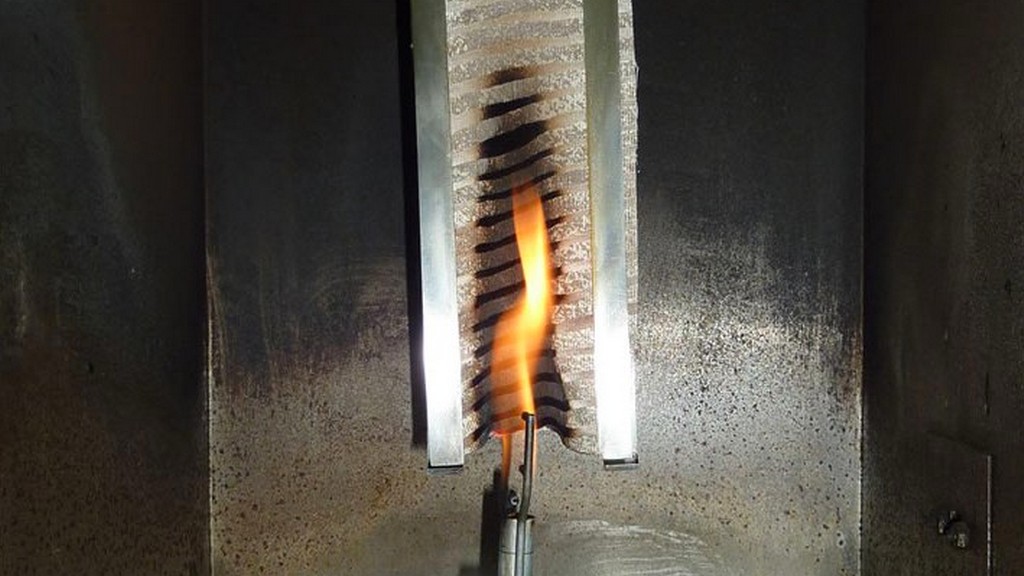
Single source flame (SBI) testing is a test method used to determine the fire response behavior of building products (excluding floors) when subjected to thermal attack by a single combustion product (a propane-fed sandpit burner). The specimen is mounted on a trolley positioned on a frame below an exhaust system. The response of the specimen to the burner is monitored instrumentally and visually. Heat and smoke release rates are measured instrumentally and physical properties are evaluated by observation.
The standard referenced for the single source of ignition (SBI) test is the European standard EN 13823 Reaction to fire tests for construction products - Construction products excluding floors subjected to thermal attack by a single burning substance. This standard describes a test method for determining the reaction to fire performance of construction products when subjected to thermal attack by a single burning substance (SBI), excluding floors and products specified in the regulation on the classification of the reaction to fire performance of construction products in accordance with the relevant legal regulations. Calculation procedures are included in the annex of this standard (Annex A). Information on the sensitivity of the test method is included in Annex B. This standard was developed primarily to determine the reaction to fire performance of flat products. The processing of certain product families, for example linear products (such as pipes, ducts, cables) may require special requirements.
For the purposes of this standard, the following terms and definitions apply in addition to those given in EN ISO 13943 and EN 13501-1:
The SBI test facility consists of a test chamber, test apparatus (cart, frame, burners, hood, collector and duct), fume exhaust system and general measuring equipment. Design drawings of these components are included in the standard appendix (Appendix E). Dimensions given on the drawings are nominal unless tolerances are given in the text.
The test chamber shall have an internal height of 2,4 m plus/minus 0,05 m in each direction and an internal floor area of 3,0 m plus/minus 0,05 m. The walls shall be made of stone-type building blocks (e.g. cellular concrete), plasterboards, calcium silicate boards or other boards classified as class A1 or A2.
The test room should have an opening in one wall to allow the cart into the test room from the surrounding laboratory. The opening (the dimensions of the frame) should be at least 1470 mm wide and 2450 mm high. Windows should be located on two walls facing the front of the two perpendicular sample planes. An additional door is required to handle the SBI apparatus and sample while the cart is in place.
With the trolley in place in the test room, the distance between the long wing sample surface touching the U-profile and the test room wall should be 2,1 m plus/minus 0,05 m. This distance should be measured perpendicular to the wall facing the long wing. Except for the air inlet under the trolley and the fume exhaust opening in the hood, the total area of the openings in the test room should not exceed 0,05 m2.
Both left-hand and right-hand arrangements are permitted, as shown in the figure given in the standard. In order to be able to remove the side plates of the hood without removing the collector, attention must be paid to the connection between the frame of the SBI apparatus and the ceiling of the room. It must be possible to move the side plate outwards at the bottom. The relative position of the frame in the test room depends on the details of the connection between the frame and the room.
Among the numerous testing, measurement, analysis and evaluation studies that our organization has carried out for businesses in various sectors, it also provides single flame source (SBI) testing services with its trained and expert staff and advanced technological equipment.
To get an appointment, to get more detailed information or to request an evaluation, you can ask us to fill in our form and reach you.

