

The ISO 15029-2 standard, “Petroleum and related products - Determination of the ignition properties of fire-resistant fluids in sprays - Part 2: Spray test - Stabilized flame heat release method,” published by the International Organization for Standardization (ISO), describes a method for comparing the fire hazards of pressurized sprays of fire-resistant fluids. A propane flame in two dimensions is used to ignite and stabilize the combustion of an air-atomized fluid. Measurements of heat release rate, flame length, and smoke density provide quantitative information about the fluid's fire behavior.
For the purposes of this standard, the following terms and definitions apply:
Reagents and materials used in the tests are:
In principle, a pre-conditioned test fluid stream is conveyed through a dual-fluid atomizer into a test chamber. Compressed air, supplied to the nozzle at a controlled rate, is used to produce an atomized spray that is exposed to a specific flame of a gas burner present throughout the test. The constant rate of heat input from the gas flame results in a stabilized spray flame, ensuring that combustion characteristics such as energy release rate, flame length, and smoke production remain sufficiently constant over time, thus allowing for the measurement of time-averaged values.
Temperatures are measured both at the inlet and exhaust of the combustion chamber, and the burner is operated first without test fluid and then with test fluid. The flame length and smoke opacity of the exhaust can be measured. Calculations of functions such as flame length index, flammability factor, and smoke density are made from these measurements. Based on these measurements and the calculated performance indices, a system is proposed for ranking the performance of fire-resistant liquids.
While ISO 15029-1 evaluates fire-resistant fluids using a hollow cone spray method that simulates fine leaks and atomization, ISO 15029-2 addresses a different and often more challenging real-world scenario: a stabilized flame test with opposing solid flow nozzles. This standard answers the question: if a jet of fluid under pressure strikes an existing flame, will the flame continue or intensify? ISO 15029-2 is widely considered a more rigorous and conservative fire resistance test. It is frequently requested by mining authorities, steel mills, die-casting businesses, and offshore platforms.
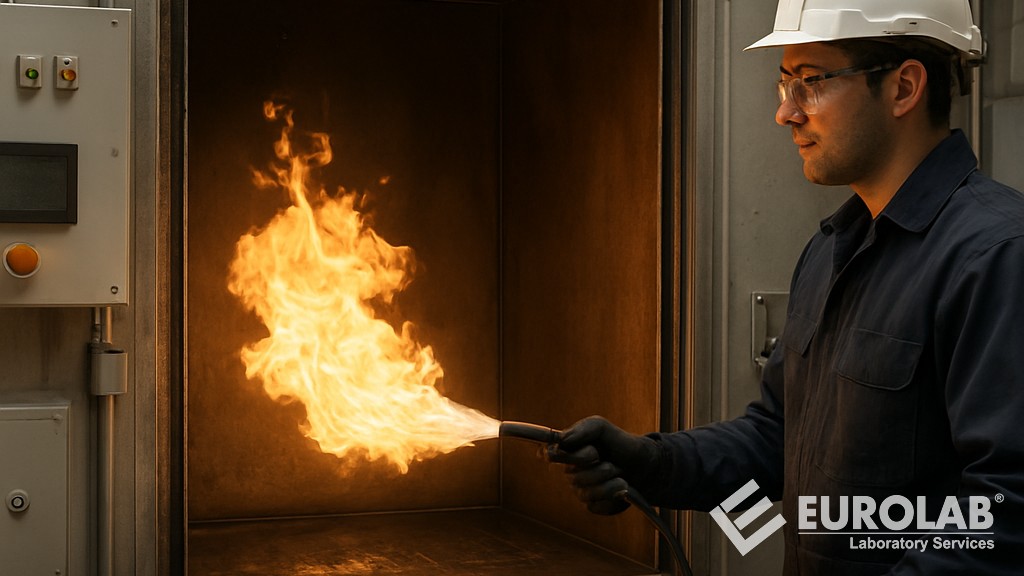
In real industrial accidents, hydraulic leaks don't always produce fine mists. High-pressure ruptures often create coherent, high-velocity jets (solid streams) that can directly impact hot surfaces, welding flames, or manifold fires. A fluid that passes the hollow cone spray test (ISO 15029-1 standard) can support combustion when injected as a jet into a large, stable flame. Therefore, the ISO 15029-2 standard was developed to simulate precisely this worst-case scenario. This test is often referred to as the stabilized flame or counterjet test because the fluid jet is sprayed horizontally into a large, turbulent propane burner flame.
The following equipment is required for the tests:
In general, the testing method involves the following steps:
In short, the ISO 15029-2 standard is a fire resistance test for harsh industrial environments. When a specification requires ISO 15029-2 Category A, it essentially means that this liquid will not feed a fire, even if a high-pressure jet is injected directly into a large flame. For safety engineers in the mining, steel, and hot metal processing industries, a single line in the data sheet can be the difference between a controlled accident and a catastrophic one. The ISO 15029-2 standard remains one of the most respected safeguards available.
For many years, our organization, with its competent and experienced staff, has been understanding the needs of its clients, providing the advanced testing services they require, and assisting them in the establishment, implementation, and improvement of management systems. Within this framework, we also provide testing services compliant with the ISO 15029-2 standard.
To get an appointment, to get more detailed information or to request an evaluation, you can ask us to fill in our form and reach you.

