EN 671 Fixed Fire Suppression Systems - Hose Systems
The European standard “EN 671 Fixed fire extinguishing systems - Hose systems” consists of the following sub-sections published under the same title:
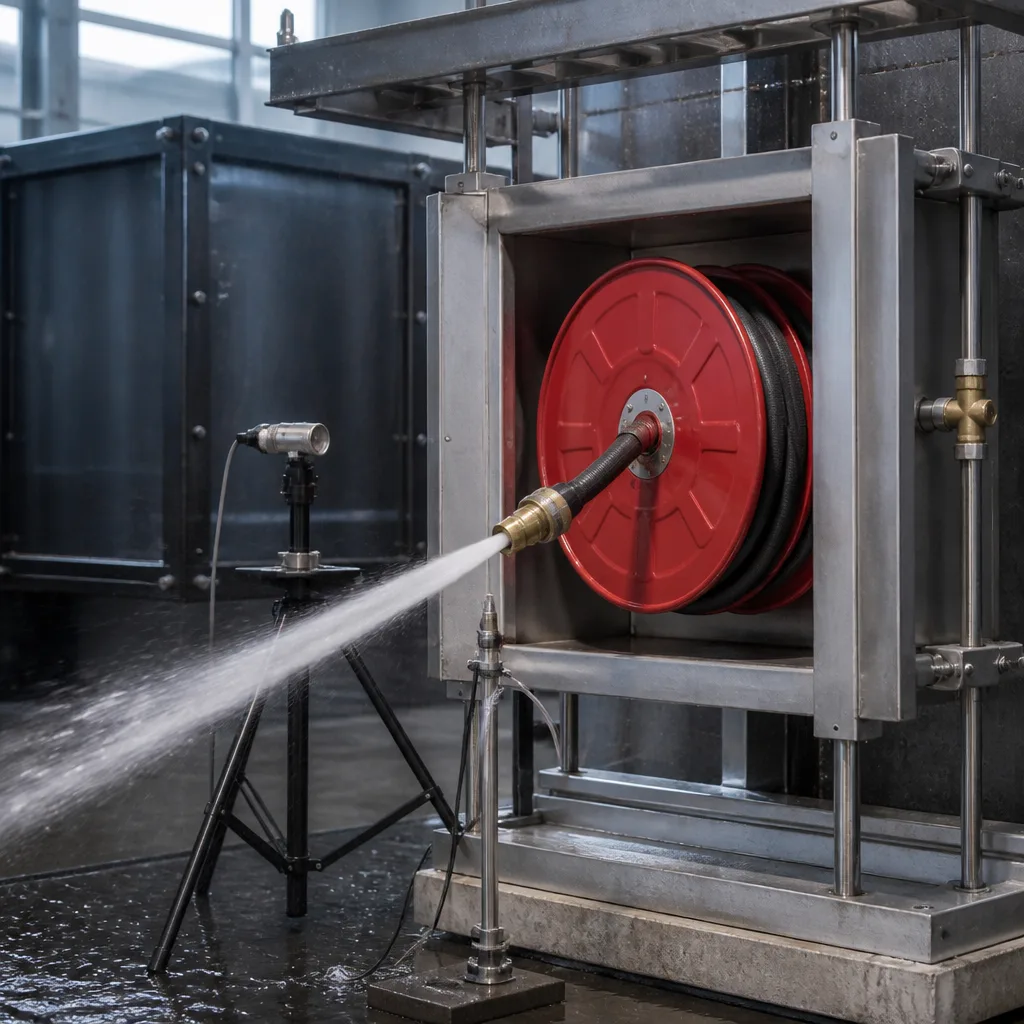
- The standard “EN 671-1 Part 1: Semi-rigid hose reels” describes the requirements and test methods for the construction and performance of semi-rigid fire hose reel systems to be permanently installed in buildings, connected to a water supply, and used by building occupants. It also includes requirements for the conformity assessment and marking of these products.
The requirements may generally apply to other applications as well, for example in marine applications or aggressive environments, but additional requirements may be necessary in such cases.
This standard applies to both manual and automatic fire hose reels, for both cabinet and cabinetless installations.
The EN 671-1 standard guarantees that hose reels installed in buildings provide reliable, user-friendly first-aid fire extinguishing capability for building occupants before professional firefighters arrive. This standard applies to both manual and automatic fire hose reels (with or without cabinets) that have the following characteristics:
- It is constantly dependent on a water source.
- It is designed to be mounted on buildings and other structures.
- It is designed for use by the building's residents.
This standard covers design, materials, performance (flow, throw distance, pressure resistance), operational reliability, and durability. Requirements may be adapted to include additional considerations for specific applications (e.g., marine or aggressive environments).
The basic technical requirements have been defined as follows:
- Hose specifications:
- Type: Semi-rigid hose according to EN 694 standard.
- Inner diameters: 19 mm, 25 mm or 33 mm.
- Length: Usually in a single piece, the maximum length is generally limited to 30 m (it is recommended not to exceed 20 m for ease of use).
- Performance (flow and throwing distance):
- Minimum flow rates at a supply pressure of 0,6 MPa (6 bar) vary depending on the nozzle size.
- Effective spray distance and spray patterns (spray and spray settings at the shut-off nozzle).
- The system must provide controlled discharge for effective fire suppression while remaining manageable.
- Pressure values:
- Working pressure: Typically 1,2 MPa (12 bar) for 19 mm and 25 mm hoses, 0,7 MPa for 33 mm.
- The hoses have been tested for leakage, strength, and burst pressure (e.g., test pressure of 1,8 MPa for smaller hoses).
- The reel and the operation:
- Manual reels: Includes a manual inlet stop valve.
- Automatic reels: They have an automatic inlet valve that opens when the hose is pulled.
- Easy opening with limited tensile forces (specific maximum forces in Newtons depending on hose diameter and the presence of a hose guide).
- Dynamic braking to prevent uncontrolled spinning.
- Smooth rotation and oscillation, or rocking or stationary types (minimum 170 degrees for rocking models).
- The nozzle should offer shut-off, jet, and/or spray modes with clear markings.
- Durability and safety:
- Resistance to impact, corrosion, and aging (especially for plastic components).
- Cabinets (when provided) should open easily and generally include breakable emergency devices.
- Clear identification symbols and markings.
- Long service life under normal conditions.
The EN 671-1 standard defines rigorous testing methods for the following:
- Flow rate and velocity.
- Pressure resistance and leak resistance.
- Mechanical operation (opening, braking, rotating).
- Impact resistance.
- Corrosion resistance and durability.
Compliance with the EN 671-1 standard is widely required by building regulations, fire safety codes, and insurance companies in Europe and many other regions. It ensures:
- Consistent quality and performance.
- Ease of use for non-professionals.
- Reliability in emergency situations.
The products are generally CE marked and certified. They are common in offices, hotels, factories, schools, and public buildings.
- The standard “EN 671-2 Part 2: Flat hose systems” describes the requirements and test methods for the construction and performance of flat hose fire reel systems continuously connected to a water supply for use in buildings. It also includes requirements for the conformity assessment and marking of these products. The requirements may generally also apply to other applications, such as marine applications or in aggressive environments, but additional requirements may be necessary in such cases.
This standard focuses on systems using flexible, collapsible flat hoses, which are typically larger in diameter than semi-rigid hoses and are often used where higher flow rates or different usage characteristics are required.
This standard applies to straight-hose fire hose reel systems for installation in buildings. These systems include:
- It is constantly dependent on a water source.
- It is designed for use by building occupants in the initial stages of a fire.
- Available with or without a protective enclosure, in manual or automatic configurations.
This standard differs from the EN 671-1 standard in the following respects:
- Hose type:
- EN 671-1 standard: Semi-rigid (remains slightly rounded)
- EN 671-2 standard: Straight hoses (foldable when no pressure is applied)
- Typical diameters:
- EN 671-1 standard: 19, 25, 33 mm
- EN 671-2 standard: Up to 52 mm (e.g. 25, 38, 45, 52 mm)
- Reference hose standard:
- EN 671-1 standard: EN 694
- EN 671-2 standard: EN 14540
- Common usage:
- EN 671-1 standard: Compact reels, easier handling.
- EN 671-2 standard: Higher flow capacity, typically in cabinets.
Straight hoses provide more compact storage and are common in wall hydrants or larger hose systems.
The EN 671-2 standard includes detailed test methods for the following:
- Flow rate and throw distance.
- Pressure resistance, leak resistance, and explosion resistance.
- Mechanical operation (pulling, rotating, braking).
- Breast performance and impact resistance.
- Overall durability and operational reliability.
Compliance with the EN 671-2 standard ensures that straight hose systems provide consistent performance, are user-friendly for non-professionals, and remain reliable over time. These systems are commonly used in the following areas:
- Industrial buildings
- Warehouses
- Large commercial areas
- Public buildings where higher water distribution is beneficial.
The standard “EN 671-3 Part 3: Maintenance of semi-rigid hose reels and straight hose systems” describes the inspection and maintenance requirements to ensure that hose reels and hose systems continue to serve their intended purpose, i.e., to provide the initial emergency response to fire fighting before more powerful means are used. This standard applies to hose reel and hose system installations in all types of buildings, regardless of the building's intended use.
In short, this standard ensures the reliability of these systems during the initial fire response phase by building occupants. This standard focuses on ongoing maintenance rather than initial design and performance.
This standard applies to hose reel and hose system installations in all types of buildings, regardless of their intended use. Its purpose is to ensure that the equipment remains in a condition capable of providing immediate and effective fire suppression before professional firefighters arrive. It encompasses both routine checks by responsible personnel and detailed inspections by qualified technicians.
The maintenance program and requirements have been defined as follows:
- Routine checks: These are carried out at specific intervals depending on the risk, environment, and usage. For each system, the following must be ensured:
- Because it is in its designated location
- Because it has accessible, visible and legible usage instructions.
- Because it showed no obvious defect, corrosion, or leakage.
- Annual inspection and maintenance: The hose must be fully extended and pressurized. Basic checks include:
- The components must be free from obstruction, damage, or corrosion, and must not be leaking.
- Clear and legible instructions and markings.
- Secure mounting brackets and accurate operation.
- Sufficient water flow and pressure (a pressure gauge should be used if possible).
- Hose condition: Must be free from cracks, deformation, wear, or damage.
- The reels (rotating, oscillating), valves (manual/automatic), nozzles, and guides must function properly.
- Condition of the supply piping and cabinets (if any).
- The system was left ready for immediate use.
- Periodic hose testing (every 5 years): All hoses must be pressurized to the maximum working pressure specified in EN 671-1 or EN 671-2 standards.
For many years, our organization, with its competent and experienced staff, has been understanding the needs of its clients, providing the advanced testing services they require, and assisting them in the establishment, implementation, and improvement of management systems. Within this framework, we also provide testing services in accordance with the EN 671 standard.



