

The UL 2043 Fire Test for Heat and Visible Smoke Release of Discrete Products and Accessories Mounted in Air Handling Areas standard, developed by Underwriters Laboratories (UL), describes a fire test method to determine the fire performance response of discrete products (including but not limited to electrical, mechanical, and plumbing equipment) intended for mounting in air handling areas such as above ceilings or below floors. These products are subjected to an open flame ignition source and evaluated using a product calorimeter.
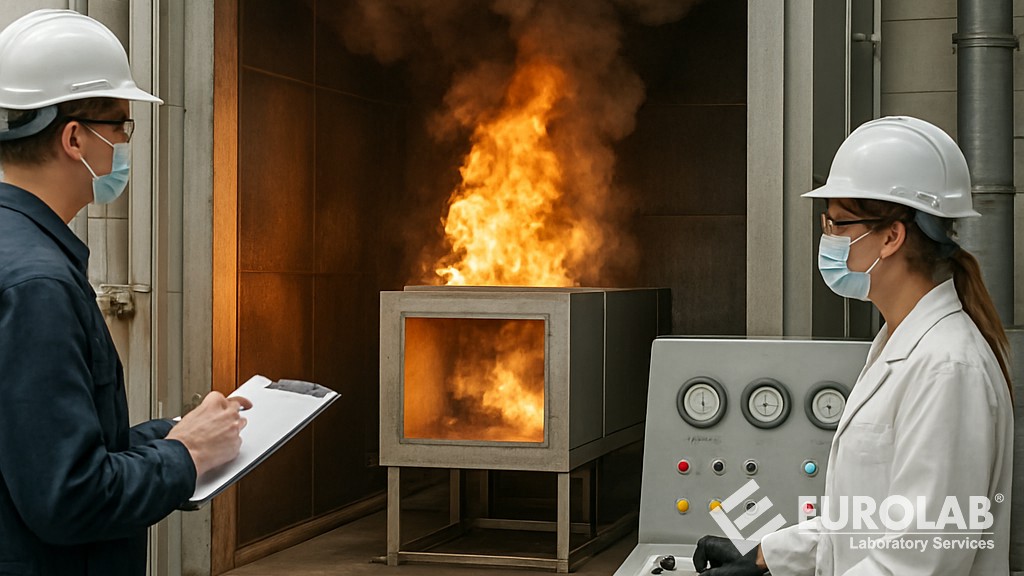
This test method can be used to determine the fire performance and smoke characteristics of separate, discontinuous building materials in situations where the “UL 723 Surface flammability characteristics of building materials” standard is not applicable.
The purpose of this method is to determine the heat release rate and smoke release rate of burning product samples in relation to fire resistance and low smoke generation requirements in accordance with the provisions of the following legal regulations:
This testing method does not provide information about the performance of the products under other fire or test conditions. This test does not examine the toxicity of combustion products. Furthermore, this test does not cover the structural, electrical, or other performance requirements of the product.
The codes specified in this standard refer to the use of the UL 2043 standard for electrical equipment with combustible outer casings. Specifically, the national electrical code and the international mechanical code explicitly state that electrical equipment with metal outer casings is permitted. Consequently, the UL 2043 standard does not apply to electrical equipment with metal outer casings unless otherwise specified in the final product standard requirements.
UL 2043 is a critical safety standard that specifically evaluates materials used in aerial handling environments such as data centers, commercial buildings, and other infrastructure with complex cable management systems. The primary objectives of this standard are:
The UL 2043 standard involves rigorous testing with specific performance metrics:
In short, the UL 2043 standard applies to products and accessories intended for installation in plenum areas (air handling areas above suspended ceilings or below raised floors) or air ducts through which air is circulated for heating, ventilation, and air conditioning (HVAC). These areas are often referred to as perimeter air spaces (plenums).
In a building fire, plenum areas act as highways for fire and smoke because air actively passes through them. If materials in these areas are easily flammable or produce dense smoke, the fire can spread rapidly throughout the building, and the smoke, dispersed by the HVAC system, can endanger occupants even far from the source of the fire.
Therefore, traditional building codes restrict what can be installed in plenum areas, and many local regulations require cables, equipment, and other devices in plenums to be enclosed in metal conduits or listed as having low flame spread and low smoke generation properties. This is where the UL 2043 standard comes into play.
Unlike cable standards such as UL 444 or NFPA 262, which test long cables, the UL 2043 standard is designed for individual products (such as speakers, wireless access points, smoke detectors, floodlights, lighting fixtures, cameras, IoT devices) and their mounting accessories.
The test consists of two separate fire tests carried out in a Steiner tunnel:
Common products requiring UL 2043 certification include:
In conclusion, the UL 2043 standard is the essential fire safety standard for virtually any electronic device mounted above suspended ceilings in commercial buildings. Choosing UL 2043-approved products is not only about compliance with regulations, but also about preventing rapid fire spread and toxic smoke dispersion in areas designed for air movement within the building.
For many years, our organization, with its competent and experienced team, has been understanding the needs of its clients, providing the advanced testing services they require, and assisting them in the establishment, implementation, and improvement of management systems. Within this framework, we also provide testing services compliant with the UL 2043 standard.
To get an appointment, to get more detailed information or to request an evaluation, you can ask us to fill in our form and reach you.

