

The International Organization for Standardization (ISO) standard "ISO 19921 Ships and marine technology - Fire resistance of metallic piping components with flexible and elastomeric seals - Test methods" describes test procedures for determining the fire resistance of metallic valves, pipe joints, and similar piping components incorporating flexible or elastomeric seals used in marine engineering systems. The purpose of this standard is to determine whether pipeline components remain tight after a fire test period on a test bench meeting the requirements of ISO 19922, without any failure that could affect their function, even when subjected to test pressure.
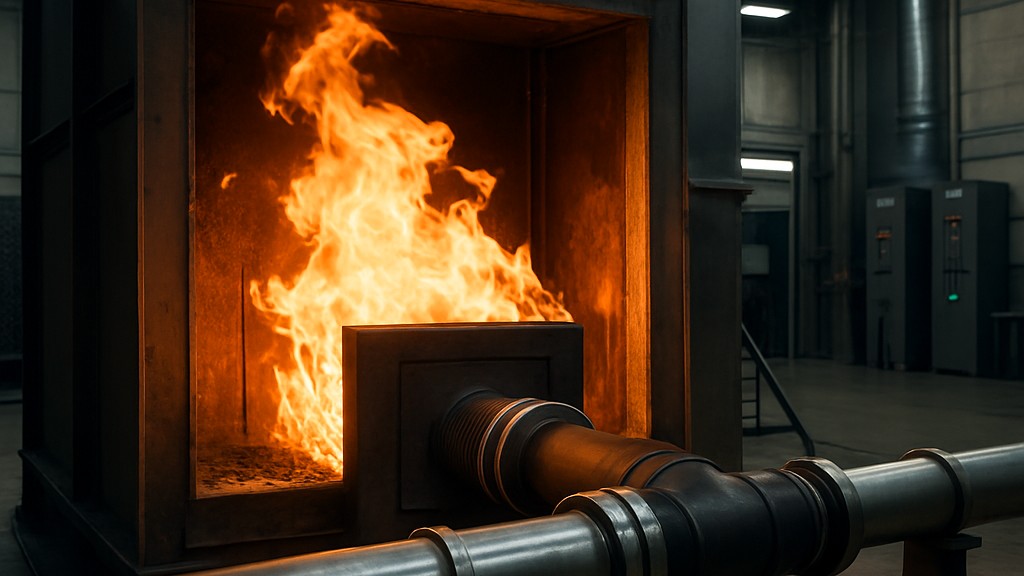
Pipeline components to be tested must be sized to allow flames to completely engulf the test pieces, as required by this standard. The installation of the test pieces must be agreed upon between the customer and the test bench operator. Test pieces may be tested with or without a fire-protective coating, depending on agreement. The designation letter B is used for tests without a fire enclosure, and the designation letter F is used for tests with a fire enclosure. Before testing, test pieces should be stored at ambient temperature for 24 hours.
The number and size of test pieces must be agreed upon between the customer and the test bench operator. However, tests are performed on at least three test pieces of different sizes. The minimum and maximum dimensions of the component batch to be qualified must be tested in all cases. Tests must be performed on a test bench that meets the requirements of ISO 19922.
The test piece should be placed on the test bench so that the burner extends at least 20 mm beyond the test piece on all sides and the test piece is completely surrounded by the flames. After assembly, the test piece should be flushed with water for at least 1 minute to remove as much air as possible from the test piece.
The following values should be measured at the specified points as shown in the figure:
All values should be recorded at intervals of no more than 2 minutes.
This standard is important because it defines standard test methods for evaluating the fire resistance of metallic piping components using flexible (rubber-like) or elastomeric seals, which are commonly used in shipboard systems. These systems typically include fuel, lubricating oil, ballast, cooling, and firefighting systems.
The main reasons why this standard is important are:
In short, the ISO 19921 standard provides a globally accepted, consistent, and fundamental framework for fire safety testing in the maritime industry, ensuring that metallic piping components with elastomeric seals can withstand fire conditions and continue to operate safely, helping to protect lives, ships, and the environment.
Our organization, which has been supporting businesses across all sectors for years through a wide range of testing, measurement, analysis, and evaluation activities, has a strong team of employees who closely follow global developments in science and technology and are constantly improving themselves. In this context, we also provide testing services in accordance with the ISO 19921 Ships and marine technology - Fire resistance of flexible and elastomeric seals and metallic pipe components - Test methods.
To get an appointment, to get more detailed information or to request an evaluation, you can ask us to fill in our form and reach you.

