

The “ISO 22899 Determination of resistance of passive fire protection materials to jet fires” standard, developed by the International Organization for Standardization (ISO), consists of the following subsections published under the same title:
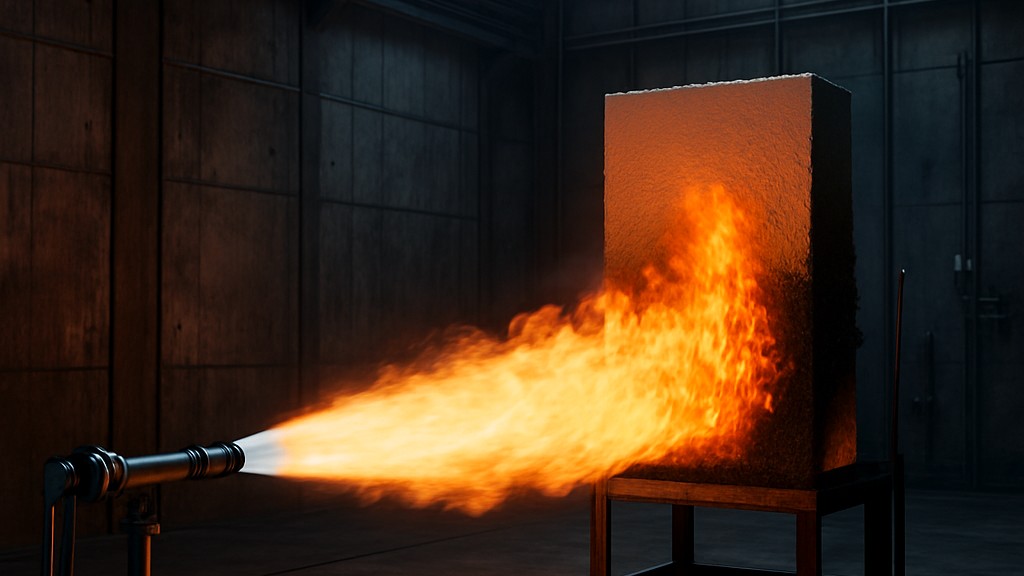
In principle, the method presented in this standard provides an indication of how passive fire protection materials perform in a jet fire that might occur, for example, in petrochemical plants. It aims to simulate the thermal and mechanical loads transferred to the passive fire protection material by large-scale jet fires resulting from the high-pressure release of combustible gas, liquefied gas, or flash liquid fuels. Jet fires lead to high convective and radiative heat fluxes and high abrasive forces. To produce sufficient amounts of both types of heat flux, a gas release at the speed of sound of 0,3 kg s −1 is targeted into a shallow chamber, creating a fireball with a long tail. This increases the flame thickness and consequently the heat dissipated onto the test specimen. Propane is used as fuel because it has a higher tendency to form soot compared to natural gas and therefore can produce a flame with higher brightness. High abrasive forces are generated by the release of a gas jet at the speed of sound at a distance of 1 m from the specimen surface.
The test method defined in ISO 22899-1 is designed to provide an indication of how passive fire protection materials will perform in a jet fire. ISO 22899-1 describes the thickness of the fire protection material (sometimes called passive fire protection) required to resist a jet fire application. ISO 22899-2 provides information on the wear factor, which is the additional thickness required for the tested element/structure above and beyond that required to meet the relevant criteria of ISO 834 (or other regional standards designed to assess fire resistance in a fully developed fire).
The principal purpose of jet fire testing is to determine the amount of additional passive fire protection material required to be applied to a structural element, valve, or penetration seal to resist exposure to an ignited fuel jet, over and above the amount required to meet the ISO/TR 834-3 hydrocarbon fire resistance test criteria. This additional material thickness, known as the wear factor, is determined once for each similar element or structure and can be added to the material thickness determined for similar elements when evaluated for fire resistance according to the methods outlined in ISO/TR 834-3.
This method provides an indication of how passive fire protection materials perform in a jet fire, for example, in petrochemical plants where combustible gases are stored under pressure. It aims to simulate the thermal and mechanical loads imposed on passive fire protection materials by large-scale jet fires resulting from the release of combustible gases, liquefied gases, or liquid fuels under high pressure. Jet fires lead to high corrosive forces along with high convective and radiative heat fluxes. To generate sufficient amounts of both types of heat flux, a fireball with an elongated tail is created by targeting a gas release at the speed of sound of 0,3 kg s⁻¹ into a shallow chamber. This increases the flame thickness and consequently the heat dissipated onto the test specimen.
Propane is used as fuel because it has a higher tendency to produce soot compared to natural gas and therefore can produce a brighter flame. High abrasive forces are generated by releasing a sonic-velocity gas jet 1 m away from the sample surface. The jet velocity is approximately 100 ms⁻¹ at 0,25 m behind the flame recirculation chamber and approximately 60 ms⁻¹ at the rear of the chamber. The average heat flux is approximately 240 kW m⁻² and the maximum heat flux is 300 kW m⁻² . Heat fluxes are highest at the top of the chamber and lowest at the corners and in the jet impact zone. The combination of fuel, release velocity, and experimental setup aims to apply a similar heat load to the samples as would be achieved with a 3 kg s⁻¹ natural gas (60 bar, 20 mm orifice) jet fire released 9 m away from the target.
In principle, this method provides an indication of how passive fire protection materials or systems, or critical process control equipment, perform in a severe jet fire that might occur, for example, in petrochemical plants. Using a medium-scale test, it aims to simulate the thermal and mechanical loads transferred to the passive fire protection material by large-scale jet fires resulting from the release of combustible gas, liquefied gas under pressure, or flash liquid fuels at high pressure. Jet fires cause high convective and radiative heat fluxes and high corrosive forces. To produce sufficient amounts of both types of heat flux, a gas release at the speed of sound of 0,3 kg s −1 is targeted into a partially enclosed chamber, creating a large fireball. Due to the increased flame thickness and radiation from the flame chamber, the heat flux on the sample exceeds the ISO 22899-1 standard. Propane is used as fuel because it has a higher tendency to form soot compared to natural gas and therefore can produce a brighter flame. The high abrasive forces generated by releasing a sound-velocity gas jet 1 m away from the sample surface are equivalent to those produced according to the ISO 22899-1 standard.
Our organization, which has been supporting businesses across all sectors for years through a wide range of testing, measurement, analysis, and evaluation activities, has a strong team of employees who closely follow global developments in science and technology and are constantly improving themselves. In this context, we also provide testing services in accordance with the ISO 22899 standard for "Determining the resistance of passive fire protection materials to jet fires."
To get an appointment, to get more detailed information or to request an evaluation, you can ask us to fill in our form and reach you.

