EN 3-7 Portable Fire Extinguishers - Part 7: Specifications, Performance Characteristics and Test Methods
The standard “DIN EN 3-7 Portable fire extinguishers - Part 7: Specifications, performance requirements and test methods” developed by the German Institute for Standardization (DIN) describes the specifications, performance requirements and test methods for portable fire extinguishers.
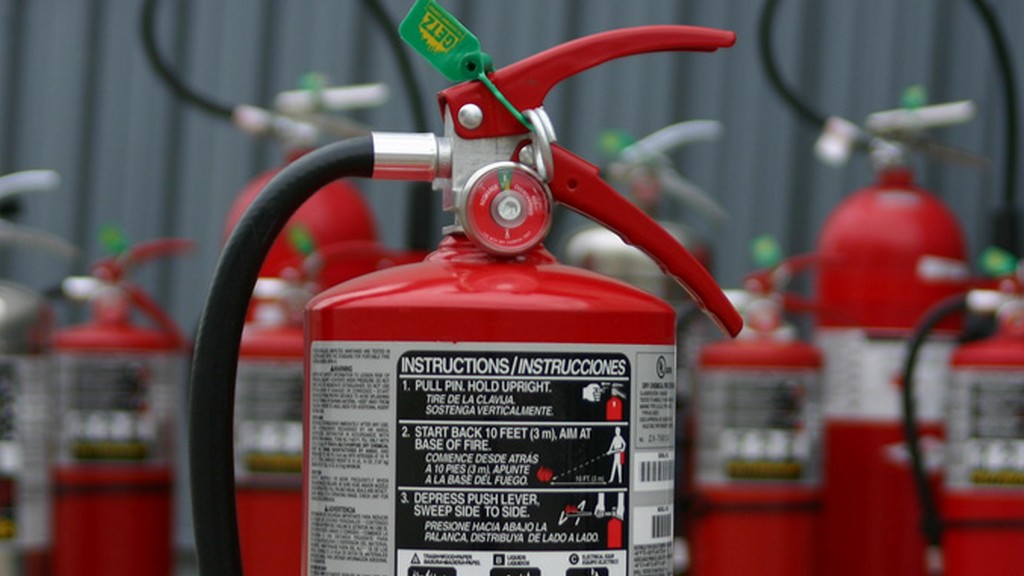
The reference to the suitability of an extinguisher for use on gas fires (class C fires) is at the discretion of the manufacturer, but applies only to powder type extinguishers that have achieved a class B or class A and class B rating.
Suitability of extinguishers for use on class D fires (fires involving combustible metals) is excluded from the scope of this standard for test fires. However, extinguishers claiming class D suitability are covered in all other respects by the requirements specified for powder extinguishers in this standard.
Powder and carbon dioxide fire extinguishers are considered hazardous for use on Class F fires. Powder and carbon dioxide fire extinguishers are therefore excluded from compliance with Class F in this European standard.
The extinguishing of a metal fire is so specific in terms of the metal itself, its shape, the configuration of the fire and similar characteristics that it is not possible to define a representative standard fire for testing purposes. The effectiveness of extinguishers on Class D fires must be determined on a case-by-case basis.
For the purposes of this standard, the following terms and definitions apply:
- Fire extinguishing device refers to a device containing an extinguishing medium that can be ejected by the effect of internal pressure and directed at the fire. This pressure can be stored pressure or pressure generated by the release of auxiliary gas from a cartridge.
- Portable fire extinguisher means a fire extinguisher designed to be carried and operated by hand and whose mass in working order does not exceed 20 kg.
- Clean agent refers to an electrically non-conductive, volatile or gaseous fire extinguishing medium that does not leave a residue on evaporation. Examples include fluorocarbons, perfluorocarbons, and fluoroiodocarbons.
- Halon refers to substance containing one or more organic compounds containing one or more of the elements fluorine, chlorine, bromine, or iodine as primary components.
- Body refers to the shell of the extinguisher that is not equipped with accessories but with all welded/brazed parts.
- Extinguishing medium refers to the substance contained in the extinguisher that causes the fire to go out.
- The load is the mass or volume of the extinguishing medium contained in the extinguisher, expressed as volume (in litres) for water-based extinguishers and as mass (in kilograms) for other extinguishers.
- Water-based extinguisher refers to an extinguisher that contains water, water with additives, or wet chemical. This includes foam.
- Powder extinguisher refers to the extinguisher containing fire extinguishing powder.
- Carbon dioxide extinguisher refers to the extinguisher containing carbon dioxide.
- Halon extinguisher refers to extinguisher containing halon.
- Clean agent extinguisher refers to an extinguisher containing clean agent.
- The operating time refers to the time during which the quench medium is discharged, without any interruption in discharge and with the valve fully open, excluding the discharge of residual propellant.
- Residual load refers to the mass of the medium remaining after a continuous full discharge, including all propellant.
- The maximum pressure at the maximum operating temperature (tested pressure) is the pressure measured in the extinguisher after stabilization at the maximum operating temperature (at least 24 degrees) for at least 60 hours, and for cartridge extinguishers the maximum pressure is the maximum pressure recorded for 0,5 seconds during a period of three minutes, excluding the first second after the release of the propellant gas.
- Tmax is the maximum operating temperature declared by the manufacturer.
- Tmin is the minimum operating temperature declared by the manufacturer.
A portable fire extinguisher is defined by the type of extinguishing media it contains and includes:
- Water-based extinguishers, including foam and wet chemical extinguishers
- Powder type extinguishers
- Carbon dioxide type extinguishers
- Halon type extinguishers
- Clean agent extinguishers
Water-based extinguishers may be manufactured with or without low antifreeze. Water-based extinguishers, including foam with different proportions of low antifreeze, should be treated as separate and distinct models for the purposes of testing the operating temperature and electrical conductivity range and fire rating tests. All other requirements for the design and construction of water-based extinguishers apply to all models, regardless of content.
A portable fire extinguisher consists of the following components:
- Body
- Body fittings fixed or screwed to the body and comprising at least the following: control devices, hose assembly or horns and nozzles, header assembly (which also forms the main cover) and actuation device. The header assembly, actuation device and control devices may be separate or combined into a single unit.
- Extinguishing medium
Portable fire extinguishers should be equipped with a self-closing control valve to provide temporary interruption of the discharge.
Among the numerous tests, measurements, analyses and evaluation studies carried out for businesses in various sectors, our organization also provides testing services defined in the standard “EN 3-7 Portable fire extinguishers - Part 7: Features, performance characteristics and test methods” with its trained and expert staff and advanced technological equipment.



