

The European standard “EN 1363 Fire resistance tests” consists of the following sub-sections published under the same title:
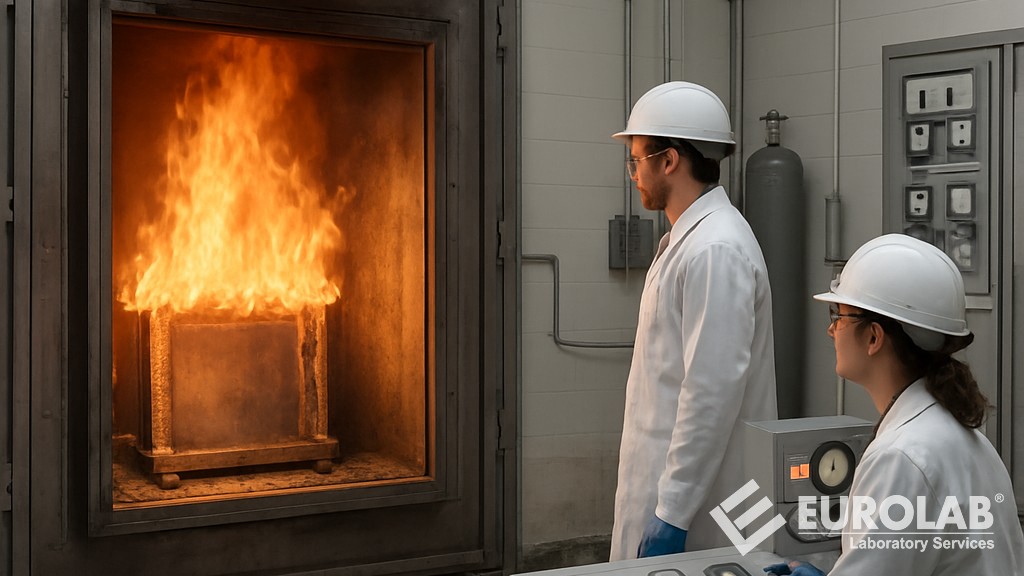
The principle contained in all European standards relating to fire resistance testing is that when aspects and procedures of a test are common to all specific test methods (e.g., temperature/time curve), they are specified in that test method. If a general principle is common to many specific test methods, but the details vary depending on the element being tested (e.g., measurement of the temperature of the unexposed surface), the principle is given in this document, but the details are given in the specific test method. If some aspects of the test are specific to a particular test method (e.g., air leakage test for fire dampers), no details are given in this document.
The obtained test results can be directly applied to other similar elements or variations of the element being tested. The extent to which this application is permitted depends on the direct application area of the test result. This is constrained by providing rules that limit deviation from the tested sample without further evaluation. The rules for determining permitted deviations are given for each specific test method.
Deviations beyond those permitted by direct application are addressed under the extended application of test results. This is the result of an in-depth examination of the design and performance of a particular product through testing by a recognized authority. Further information on direct and extended application is provided in the standard annex (Annex A).
The period during which the tested element meets certain criteria, whether directly or as modified by its extended application area, will allow for further classification.
All values given in this standard are nominal unless otherwise specified.
The main objective of the EN 1363-1 standard is to establish a uniform and reliable method for evaluating how structural elements behave when exposed to fire. This standard provides:
The EN 1363-1 standard does not test a specific product. Instead, it defines a general framework used in conjunction with other fire testing standards. This standard applies to:
The test uses a controlled temperature-time relationship, known as the standard fire curve, which simulates a real fire scenario:
Three main criteria are evaluated during the test:
The main purpose of the EN 1363-2 standard is to provide flexibility in fire testing in the following ways:
In terms of fire exposure, EN 1363-1 uses a standard fire curve, while EN 1363-2 uses alternative fire curves. In terms of scope, EN 1363-1 is based on general rules, while EN 1363-2 is based on advanced/specific conditions. In terms of flexibility, EN 1363-1 shows limited flexibility, while EN 1363-2 shows high flexibility. Essentially, EN 1363-2 is an extension of EN 1363-1.
The test methods described in the EN 1363-2 standard are as follows:
Like the EN 1363-1 standard, this standard also evaluates the following:
However, these have been tested under different fire conditions.
The main purpose of the EN 1363-3 standard is to confirm that fire test furnaces verify the following:
Without this verification, fire resistance test results may not be reliable.
The fundamental concept is furnace calibration. Fire resistance tests largely depend on furnace accuracy. This standard provides procedures to verify the following:
The test methods described in the EN 1363-3 standard are as follows:
The results of tests conducted according to this standard form the basis for the classification of Type A curtain wall systems. For Type B curtain wall systems, the results can be used to determine the fire resistance of parts of curtain wall systems previously tested according to the EN 1364-3 standard and to expand their application area. For the intended EW classification and corner/polygonal samples, the EN 1364-3 standard should be used.
This standard does not cover double-walled facades, cladding systems, or ventilated facade systems in exterior walls. This standard does not address the fire response behavior of shear walls. This standard is intended to be read in conjunction with EN 1363-1 and EN 1363-2 standards, as well as EN 1364-3 for type B shear walls.
The main objectives of the EN 1363-4 standard are as follows:
This standard applies especially to vertical ovens used for testing structural elements such as:
These elements are mounted vertically, simulating real building conditions.
This standard focuses specifically on vertical kiln configuration and performance.
For many years, our organization, with its competent and experienced staff, has been understanding the needs of its clients, providing the advanced testing services they require, and assisting them in the establishment, implementation, and improvement of management systems. Within this framework, we also provide testing services in accordance with the EN 1363 standard.
To get an appointment, to get more detailed information or to request an evaluation, you can ask us to fill in our form and reach you.

