

The “ISO 5658 Reaction to fire tests - Flame spread” standard published by the International Organization for Standardization (ISO) consists of the following subsections published under the same title:
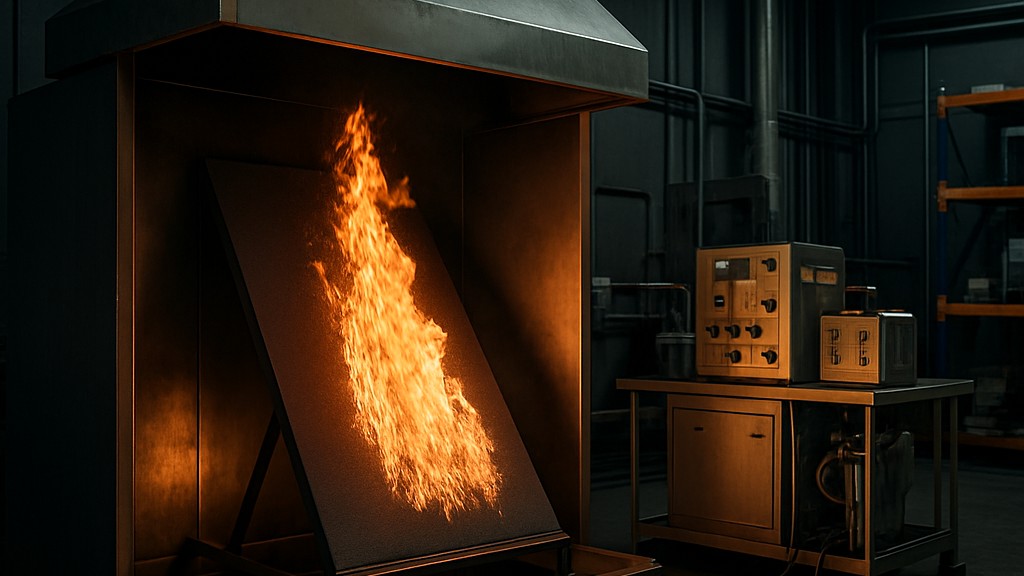
Flame spread tests are designed to measure the combustion process (flaming, radiant, or superheated) outside the zone heated by the ignition source and therefore help understand how a fire spreads from its initial center. This concept relates to flame spread within the compartment or space where the fire originates (i.e., the fire's starting/ignition point/area).
Flame spread tests vary significantly in the conditions specified for characterizing the flame spread process. These conditions include:
The flammability of surfaces is a primary concern in many regulations. For example, primary room surfaces in buildings are flammable linings used on walls or ceilings, as well as floor coverings. Similar flame spread effects can also occur on the surfaces of transportation vehicles (such as ships, trains, aircraft, and buses). To understand the role of bench-scale testing in assessing this hazard, the dominant fire effects must be considered in context.
The ceiling can be a very rapid fire spread and contributes significantly to the hazard. To minimize the fire hazard, the least flammable materials should generally be installed on the ceiling. There is no universal consensus on this point, and some studies have concluded the opposite. In almost every fire scenario, flame spread along the ceiling is wind-assisted, meaning that airflow and flame spread are in the same direction.
In common fire scenarios, flame spread in walls is upward (wind-driven) near the fire source. In other parts of the walls, flame spread is downward (counterflow) because entrained air moves upward against the direction of flame travel. However, a large portion of the wall can be ignited directly by being immersed in the layer of hot gases formed below the ceiling. This ignition does not involve flame propagation at all, but the ceiling's flammability directly accelerates it.
Flame spread on floors within a room is generally very limited until the later stages of a fire. However, flame spread on floors in corridors can be a significant concern. This flame spread is often caused by a room fire impinging on an adjacent corridor and igniting the flooring. A corridor typically has a predominant airflow direction. Flame spread can then proceed in a wind-driven or counter-wind direction. Often, flame spread in both directions can occur simultaneously in corridor flooring materials.
In principle, two different bench-scale test methods are required to represent the two fundamentally different flame propagation processes: wind-assisted propagation and counter-flow propagation. Flame spread rates in these two processes are not similar. Wind-assisted propagation tends to be much faster because there can be a large amount of pure flammable flame tip, while the heating of the material in the counter-flow direction is limited to a very small heating zone. However, research has shown that a test dedicated solely to examining wind-assisted propagation is not necessary.
Both theory and experience suggest that wind-assisted flame spread can generally be predicted directly after determining the heat release rate and the flammability behavior of the sample. These are done on a standard scale using the ISO 5660 standard method for heat release rate and the ISO 5660-1 or ISO 5657 standards for flammability.
This standard is applicable to the measurement and characterization of the properties of materials, products, or assemblies exposed to radiative heat in the presence of a pilot flame under controlled laboratory conditions. It should not be used alone to characterize or assess the fire hazard or fire risk of materials, products, or assemblies under actual fire conditions.
In principle, the test method consists of exposing conditioned samples to a well-defined radiant heat flux field and measuring the ignition time, lateral flame spread, and eventual extinction. A test sample is placed in a vertical position adjacent to a gas-fired radiant panel, where it is exposed to a defined radiant heat flux field. A pilot flame is placed near, but generally not touching, the hotter end of the sample to ignite volatile gases emanating from the surface.
Following ignition, any flame fronts that develop are noted, and a record is made of the time required for the flame front to travel various distances horizontally along the length of the sample. The results are expressed as flame propagation distance versus time, flame front velocity versus heat flow, critical heat flow at extinguishing, and average heat for sustained combustion.
This standard provides data suitable for comparing the performance of materials, composites, or assemblies used as exposed surfaces of walls or other vertically oriented products in construction applications. Some products with profiled surfaces may also be tested with a modified procedure that represents the product's end-use conditions.
Upward flame spread is not limited to vertical surfaces. It is recognized that a sophisticated form of upward, wind-driven flame spread can also occur on surfaces at an angle greater than 20 degrees from the horizontal without any external ventilation. This type of flame spread can occur on both planar inclined surfaces and stepped surfaces such as stairs. In these cases, flame spread can become very rapid and cause serious problems with escape routes such as stairs. When evaluating stepped or inclined surface materials, it may be more appropriate to use a vertical flame spread test rather than a test where the sample is horizontal.
This standard applies to the measurement and characterization of the properties of materials, products, composites, or assemblies in response to radiative heat in the presence of non-impinging pilot flames under controlled laboratory conditions. The heat source can be thought of as representing a single burning item, such as a trash can or an upholstered chair, within an enclosure, and this scenario is generally considered valid in the early development stages of a fire.
This standard should not be used alone to describe or evaluate the fire hazard or fire risk of materials, products, composites or assemblies under actual fire conditions.
In principle, the test method consists of exposing conditioned, vertically oriented samples to a single, well-defined field of radiant heat flux and measuring the ignition time, vertical spread of the flame, and, where appropriate, observing other effects of fire spread, such as flame droplets or spatter and lateral spread. A test sample is placed in a vertical position adjacent to a gas-fired radiant panel that exposes its underside to a defined field of radiant heat flux. A non-impinging line pilot burner is placed above the radiant area of the sample to ignite the volatile gases emanating from the surface.
Following ignition, any flame front that develops is noted and recorded in terms of the time required for the flame front to propagate vertically through the height of the sample, traveling various distances. Results are expressed as ignition time and flame spread distance, expressed over time. Mass loss, heat release, and smoke data may also be measured if necessary.
Our organization, which has been supporting businesses across all sectors for years through a wide range of testing, measurement, analysis, and evaluation activities, has a strong team of employees who closely follow global developments in science and technology and are constantly improving themselves. In this context, we also provide testing services to businesses in accordance with the ISO 5658 "Reaction to Fire Tests - Flame Spread" standard.
To get an appointment, to get more detailed information or to request an evaluation, you can ask us to fill in our form and reach you.

