

The National Fire Protection Association (NFPA) publishes “NFPA 2112 Flame Retardant Clothing for the Protection of Industrial Persons Against Short-Term Heat Exposure from Fire” as one of the consensus-based standards shaping fire safety practices worldwide, outlining the requirements for flame retardant clothing.
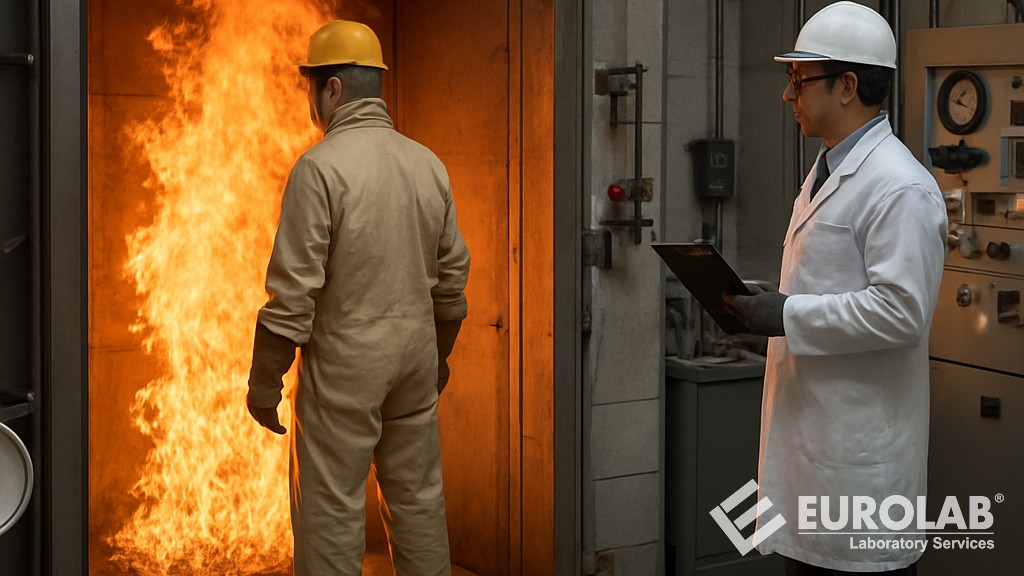
Crucial for manufacturers and certification bodies, this standard protects workers from flash fires and injuries by defining performance requirements and test methods for flame-retardant fabrics and clothing.
The NFPA 2112 standard outlines minimum performance requirements and test methods for flame-retardant fabrics and components, as well as design and certification requirements for garments intended for use in areas with a risk of sudden fires. It also describes specific criteria for testing garments using test methods defined in ASTM F1930 and ASTM D6413 standards.
The NFPA 21127 standard requires less than 50% second and third-degree burns to pass, using the ASTM F1930 mannequin test. Garments are exposed to a three-second flash fire at a temperature of 2 cal/cm², and the total estimated body burn is measured. There are two reasons why the test lasts three seconds:
The upper limit is 50 percent burns because survival rates decrease when the total body surface area of burns exceeds this level.
The garments should be cut to a standard pattern, a size 42-RG jumpsuit, and tested on 100% cotton t-shirts and underwear.
When the fabric is tested using the ASTM D6413 standard test method, it should not melt, drip, or have a flame length exceeding 2 seconds or a charring length exceeding 10,16 cm after 25 washes. In other words, the NFPA 2112 standard requires a maximum burn length of 10,16 cm if a garment is tested according to the ASTM D6413 standard.
NFPA 2112 standard requires the following:
In high-risk industrial environments where flammable gases, volatile liquids, or combustible particles are prevalent, sudden bursts of flames pose a significant threat. These sudden and intense flame explosions can engulf workers in seconds, leading to severe burns and life-altering injuries. NFPA 2112 is a critical standard that sets benchmarks for flame-resistant clothing designed to protect industrial personnel. This standard ensures that protective clothing not only withstands short-term but intense heat exposure but also minimizes the severity of potential injuries.
Essentially, the NFPA 2112 standard addresses the challenges of short-term thermal exposures from fire, replacing the term "sudden fire." These exposures are characterized by intense heat flows (up to 84 kW/m2 for just 3 seconds) that can ignite clothing and cause second or third-degree burns over large areas of the body.
The scope of this standard is targeted: it applies to flame-retardant clothing used in industries prone to such hazards as petrochemical refining, oil and gas extraction, chemical processing, and even some commercial construction work involving natural gas pipelines or electrical arc risks. It does not cover structural fire suppression equipment (NFPA 1971 standard) or electrical arc flash protection alone (NFPA 70E standard), although compliant clothing may overlap with these standards for dual hazards.
The NFPA 2112 standard mandates third-party certification, holding manufacturers accountable to verifiable performance criteria and ensuring objectivity and reliability. This consensus process, endorsed by the U.S. National Standards Institute, aims to balance innovation with safety by bringing together diverse stakeholders, from fabric engineers to end-users.
The NFPA 2112 standard sets comprehensive criteria for fabrics, components, and complete garments, emphasizing that protection is only as strong as its weakest link. Its key elements are:
For many years, our organization, with its competent and experienced staff, has been understanding the needs of its clients, providing the advanced testing services they require, and assisting in the establishment, implementation, and improvement of management systems. Within this framework, we also provide testing services to businesses in accordance with the "NFPA 2112 Flame Retardant Clothing for the Protection of Industrial Personnel Against Short-Term Heat Exposure from Fire" standard.
To get an appointment, to get more detailed information or to request an evaluation, you can ask us to fill in our form and reach you.

