

The standard "UNI 9175 Reaction to fire by applying a small flame to upholstered products - Test method and classification," developed by the Italian Organization for Standardization (UNI), describes a procedure designed to evaluate the response of upholstered furniture to fire when exposed to a small ignition source. This standard includes a test method and classification system for assessing the burning behavior of upholstered products, such as furniture, in the presence or absence of flame or glow. This standard is widely used in Italy to ensure the fire safety of upholstered items, particularly in public and commercial environments.
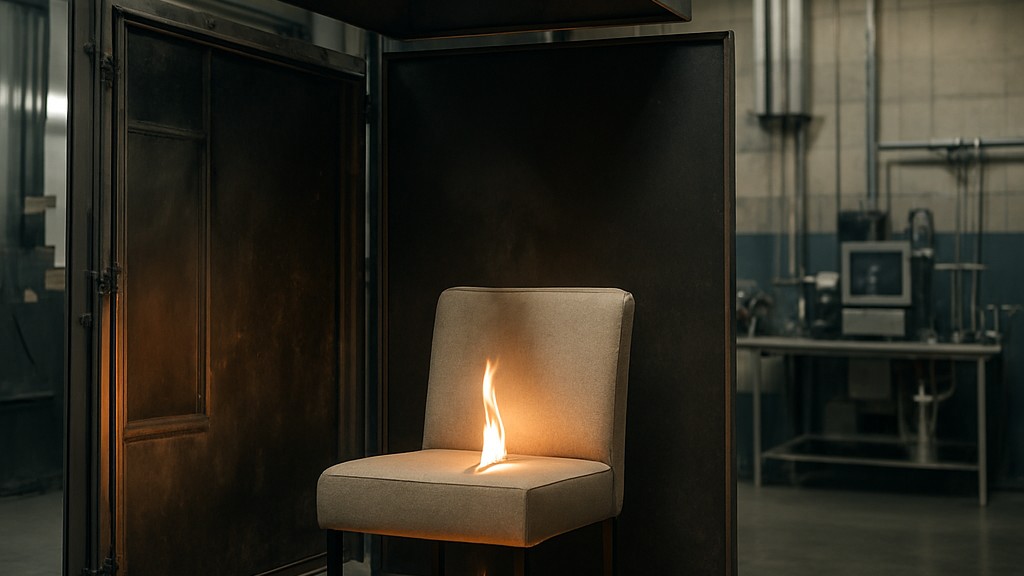
Essentially, the purpose of small-flame fire testing is to determine how upholstered seating (fabric, padding, and interior structure) reacts when exposed to a small, localized flame, simulating a real-world ignition source: a match, lighter, or candle. This testing focuses on fire reaction—how quickly and intensely the product ignites and burns—not its long-term durability in a full-blown fire.
The UNI 9175 standard focuses on determining how upholstered furniture responds to a small flame and provides an indication of fire behavior in the early stages of a fire. This method assesses whether the furniture ignites, bursts into flames, or exhibits incandescent combustion when exposed to a limited ignition source. This standard is critical for assessing the fire safety of materials used in furniture manufacturing, such as fabrics, foams, and other filling materials.
The UNI 9175 standard test method involves applying a small flame to a test fixture made of upholstered furniture materials, typically at the junction of the seat and backrest. The flame is applied in three successive stages with increasing exposure times:
The burner is placed at the junction of the seat and backrest, and to ensure consistency, the flame is applied 50 mm away from the marks formed in previous tests. During the test, the test is monitored for ignition, flaming, or glowing embers. If ignition ceases within 120 seconds of removing the burner, the sample passes. If combustion continues or smoldering occurs within the thickness of the material, the sample fails.
Based on the test results, materials are divided into three categories:
If a sample fails at any stage, no further testing is performed for longer exposure times. Classification helps manufacturers and regulators determine the suitability of materials for specific applications, particularly in high-risk environments such as public buildings.
The UNI 9175 standard is closely related to other Italian fire safety standards such as:
These standards complement the UNI 9175 standard by providing additional test protocols for different material configurations and fire scenarios.
The UNI 9175 standard applies primarily to upholstered furniture designed for use in public spaces such as hotels, theaters, offices, and other commercial environments. Manufacturers are required to submit technical documentation, test samples, and control samples to accredited laboratories for testing. Upon successful completion of testing, a test certificate is issued, and manufacturers may be required to submit a declaration of conformity, including a homologation code, to verify compliance with the standard.
The UNI 9175 standard plays a critical role in improving fire safety by ensuring that upholstered furniture does not significantly contribute to the spread of fire. By classifying materials based on their response to a small flame, the standard helps reduce the risk of rapid fire spread in environments where upholstered furniture is common. This is especially important in densely populated or high-traffic areas where fire hazards pose significant risks to human safety.
This standard is important because it defines the fire response classification for upholstered furniture, specifically focusing on how materials used in seating (such as foam, fabric, and padding) behave when exposed to flame. The primary reasons for considering this standard are:
In short, the UNI 9175 standard is the cornerstone of fire safety for upholstered seating, ensuring that materials are designed to minimise fire hazards whilst also meeting stringent legal requirements.
As a result, the UNI 9175 standard provides a robust framework for assessing the fire safety of upholstered furniture. Its rigorous testing method and classification system ensure that materials used in furniture production meet stringent safety requirements. Compliance with this standard allows manufacturers to produce safer products and gives consumers greater confidence in the fire resistance of upholstered furniture in a variety of environments.
Our organization, which has been operating for many years and meticulously follows global developments in science and technology, employs a team of experienced professionals and a broad infrastructure to conduct testing, measurement, and analysis in a wide range of areas for businesses across all sectors. In this context, we also provide testing services in accordance with the UNI 9175 "Reaction to Fire by Applying a Small Flame to Upholstered Products - Test Method and Classification" standard.
To get an appointment, to get more detailed information or to request an evaluation, you can ask us to fill in our form and reach you.

