

A European standard “EN 13501-5 Fire classification of construction products and building elements - Part 5: Classification using data from external fire exposure on roofs” describes fire performance classification procedures for roofs and roof coverings exposed to external fire, based on the four test methods given in the standard “CEN/TS 1187 Test methods for external fire exposure of roofs” and the relevant extended application rules.
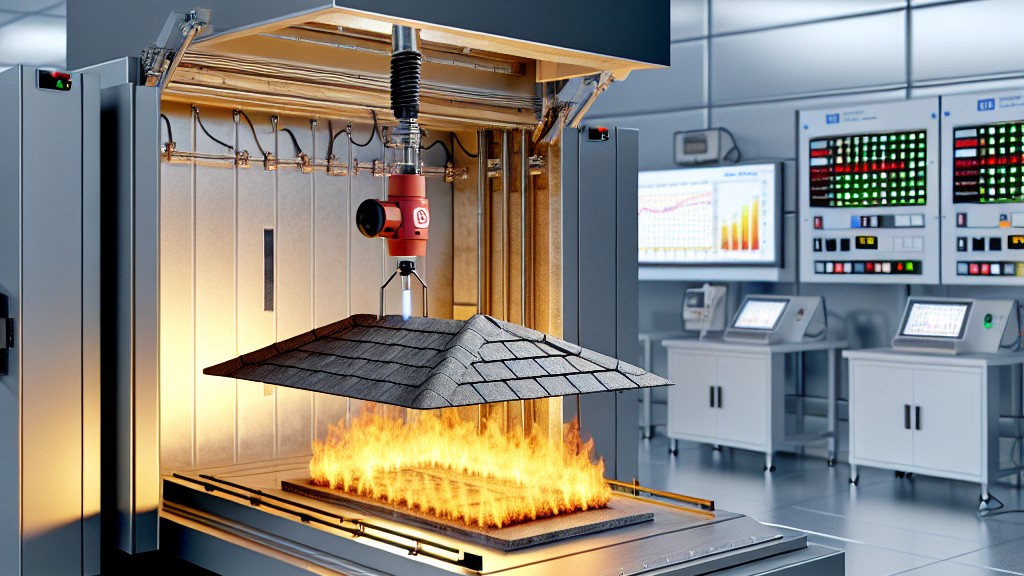
For the classification of a roof and roof covering, only those test methods and application rules for which the relevant classification is foreseen need to be applied. Products are considered in relation to their end-use applications. The distinction between steep-sloping roofs and façades may be subject to national regulations in terms of the test and classification standards to be applied. General information on the four test methods defined in the CEN/TS 1187 standard is included in the annex of this standard (Annex A).
For the purposes of this standard, in addition to the terms and definitions given in EN ISO 13943 and CEN/TS 1187, the following definitions apply:
The external fire performance classification of roofs and roof coverings defined in this standard is based on the test methods included in the CEN/TS 1187 standard. This standard contains four separate test methods corresponding to different fire hazard scenarios. There is no direct relationship between the test methods and therefore no generally acceptable classification hierarchy between them. Products falling within a given class are considered to meet all the requirements of any subclass for the same test method and fire hazard scenario. The classes are given in the table provided in the standard together with their corresponding fire performances.
The four test methods defined in the CEN/TS 1187 standard are those to be used for classification purposes for roofs and roof coverings. The test methods are:
Prior to testing, test samples shall be prepared, conditioned and mounted, if necessary, in accordance with the relevant test method and product standards or other specifications.
The external fire performance of a roof and roof covering includes aspects such as external and internal fire spread, external and internal damage, fire penetration and the formation of flaming droplets or debris. The external fire performance of a roof and roof covering therefore depends not only on the burning behaviour of the exposed surface, the roof covering, but also on the effects of the various components of the roof, such as the nature and thickness of the insulation layers and vapour barriers together with their supporting elements. It may also depend on the connection systems of all components, for example whether they are glued or mechanically fixed.
Therefore, test samples should be representative in all details of practical application regarding:
To reduce the amount of testing, individual test methods specify standard specimen arrangements that cover a wider range of applications. Such standard specifications relate to the types and positioning of supporting decks and substrates and joints.
Our organization, which has been trying to support businesses from every sector with its testing, measurement, analysis and evaluation studies carried out in a wide range for years, has a strong staff that closely follows the developments in the world in the field of science and technology and constantly improves itself. In this context, testing services are also provided to businesses in accordance with the standard “EN 13501-5 Fire classification of building products and building elements - Part 5: Classification using data obtained from external fire exposure on roofs”.
To get an appointment, to get more detailed information or to request an evaluation, you can ask us to fill in our form and reach you.

