

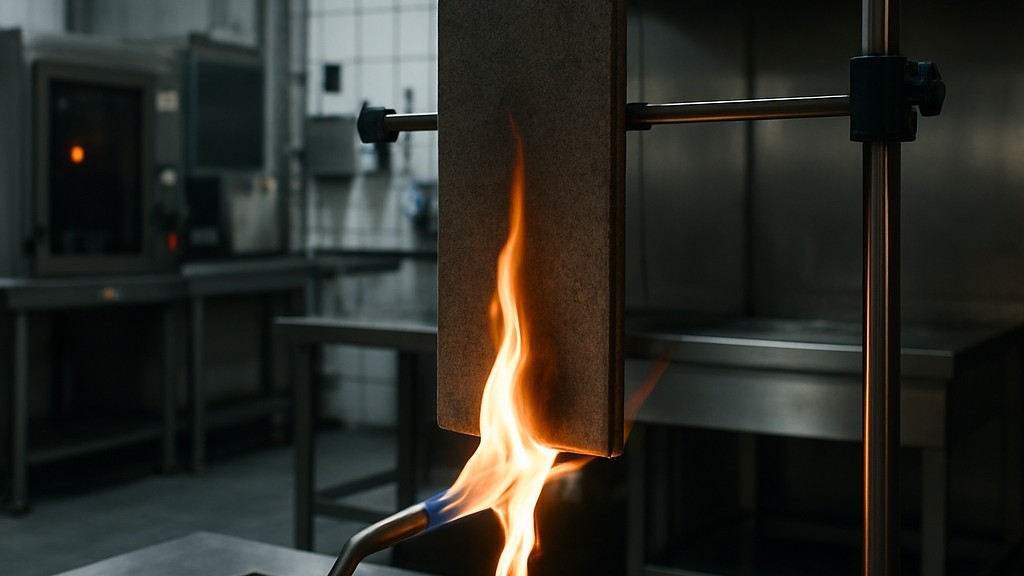
The standard "EN ISO 11925-2 Reaction to fire tests - Ignition of products in direct flame contact - Part 2: Single flame source test", which has its basis in a European standard and was subsequently published by the International Organization for Standardization (ISO), describes a test method for determining the ignitability of products by direct small flame impingement under zero impressed irradiance using vertically oriented samples.
The annexes of this standard are arranged as follows:
For the purposes of this standard, the following definitions apply in addition to the terms and definitions given in the “ISO 13943 Fire safety - Glossary” standard:
The test specimen shall be cut from a representative sample of the product to be tested using the templates specified in this standard. The test specimens shall have dimensions of 250 mm plus or minus 2 mm in length and 90 mm plus or minus 2 mm in width. Specimens normally 60 mm thick or less shall be tested using their full thickness. Specimens normally greater than 60 mm in thickness shall be cut down to 60 mm by cutting away the unexposed surface. If this reduction in specimen size is necessary, the cut surface shall not be exposed to flame. For products normally manufactured to a size smaller than the test specimen, a test specimen of a suitable size shall be produced specifically for testing.
When the product is not essentially a flat product, samples may be tested for their intended end use (e.g., pipe insulation). The product should be supplied in its entirety or in 250 mm long samples.
For each exposure condition, at least six representative samples of the product should be tested. Three samples should be cut longitudinally and three samples should be cut transversely. If a product being tested is asymmetrical throughout its thickness and both surfaces may be exposed to an ignition source, two samples should be tested on each surface to determine the critical impact point. A complete series of tests should be conducted to determine the critical impact point.
If a product has significantly different surface areas, but each of these distinct areas essentially meets the surface specifications of flat products, two tests should be performed at each flame impact point. The critical impact point should be determined. A full series of tests should be performed for the critical impact point. If a product is assembled with closed edges but can also be used with unprotected edges, tests should be performed on both closed and open specimens.
When using a substrate, specimens should be selected in accordance with ISO 14697 or EN 13238. Care should be taken when preparing test specimens to expose the bottom edges of materials applied to the substrates, as in practice the substrate may extend beyond the bottom of the material being tested and not be exposed itself. The configuration of the test specimen should reflect practical considerations such as substrate type and attachment to the substrate.
Test samples and filter papers must be conditioned in accordance with EN 13238 standard.
The EN ISO 11925-2 standard is important because it specifies a method for assessing the flammability of building products when exposed to a small flame, which is crucial for assessing fire safety. This standard is considered important for the following reasons:
In conclusion, the EN ISO 11925-2 standard is an important tool for ensuring fire safety and conscious material selection in construction and ultimately ensuring the safety of life and property.
Our organization, which has been supporting businesses across all sectors for years through a wide range of testing, measurement, analysis, and evaluation activities, boasts a strong team of employees who closely follow global developments in science and technology and are constantly improving themselves. In this context, we also provide testing services in accordance with the EN ISO 11925-2 Reaction to fire tests - Flammability of products in direct contact with flame - Part 2: Single flame source testing."
To get an appointment, to get more detailed information or to request an evaluation, you can ask us to fill in our form and reach you.

