

The European standard "EN 13823 Reaction to fire tests for construction products - Construction products excluding floors subjected to thermal attack by a single burning substance" describes a test method for determining the reaction to fire performance of construction products, excluding floors, and products specified in the Regulation (EU) 2016/364, when subjected to thermal attack by a single burning substance. The calculation procedures used in this method and information on the sensitivity of this test method are included in the annexes of the standard (Annex A and Annex B). Calibration procedures are also included in the annexes of the standard (Annex C and Annex D). This standard was developed primarily to determine the reaction to fire performance of flat products. The processing of some product families, e.g. linear products such as pipes, ducts, cables and similar products, may require special requirements.
For the purposes of this standard, in addition to the terms and definitions given in EN ISO 13943 and EN 13501-1, the following definitions apply:
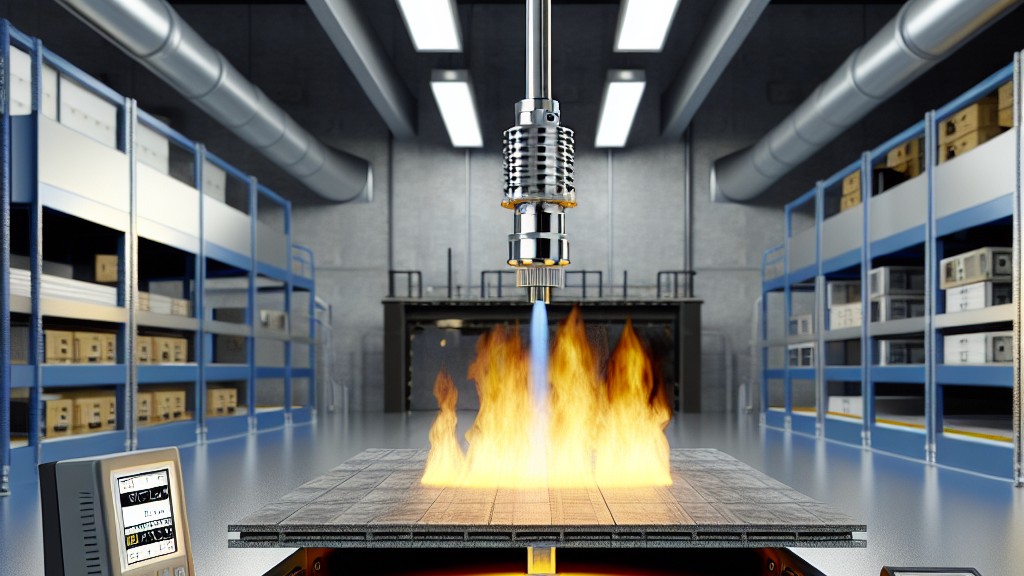
In general, a single combustion test facility shall consist of a test chamber, test apparatus (cart, frame, burners, hood, collector and duct), smoke exhaust system and general measuring equipment. Design drawings for these components are included in the standard appendix (Appendix E). Dimensions given on the drawings are nominal unless tolerances are given in the text. The air supply to the test chamber entering from the bottom of the car shall be clean, uncontaminated air.
The test chamber shall have an internal height of 2,4 m plus/minus 0,05 m in each direction and an internal floor area of 3,0 m plus/minus 0,05 m. The walls shall be made of stone-type building blocks (e.g. cellular concrete), plasterboards, calcium silicate boards or other boards classified as Class A1 or A2. An opening shall be provided in one wall of the test chamber for the introduction of a trolley from the surrounding laboratory into the test chamber. The opening shall be at least 1470 mm wide and 2450 mm high (dimensions of the frame). Windows shall be provided on the two walls facing the front of the two vertical sample planes. An additional door is required to be able to carry a single combustion apparatus and sample when the trolley is in position.
With the trolley in place in the test room, the distance between the long wing sample surface touching the U-profile and the test room wall should be 2,1 m plus/minus 0,05 m. This distance should be measured perpendicular to the wall facing the long wing. Except for the air inlet under the trolley and the fume exhaust opening in the hood, the total area of the openings in the test room should not exceed 0,05 m2.
Both left-hand and right-hand configurations are permitted. To be able to remove the side plates of the hood without removing the collector, attention must be paid to the connection between the frame of the single-burning apparatus and the ceiling of the chamber. It must be possible to move the side plate outwards at the bottom. The relative position of the frame in the test chamber depends on the details of the connection between the chamber and the frame.
In short, the EN 13823 standard assesses how materials behave when exposed to fire, focusing on how they contribute to: flame spread, heat release, smoke production and falling burning debris. This ensures that materials used in buildings do not dangerously accelerate the spread of fire, giving occupants more time to evacuate and reducing damage. Unlike small-scale tests, single burning item testing uses a corner setup containing a single burning item (such as a bin fire) to simulate a more realistic fire scenario. It provides a more accurate estimate of how materials behave in real fires.
The EN 13823 standard provides the basic data for a system that divides materials into categories from A1 (non-flammable) to F (highly flammable) according to their fire performance. This harmonized system enables: easier comparison of materials across Europe and unified building regulations and product marketing.
Under the European Union construction products directive (CPR), many building materials must pass a fire test before they can be CE marked and legally sold. This standard is an important part of compliance.
Our organization, which has been trying to support businesses from every sector with its testing, measurement, analysis and evaluation studies carried out in a wide range for years, has a strong staff that closely follows the developments in the world in the field of science and technology and constantly improves itself. In this context, testing services are also provided to businesses in accordance with the standard “EN 13823 Reaction to fire tests for building products - Building products except floors subject to thermal attack by a single burning substance”.
To get an appointment, to get more detailed information or to request an evaluation, you can ask us to fill in our form and reach you.

