

The ISO 14935 standard, “Petroleum and related products – Determination of flame persistence of fire-resistant liquids,” published by the International Organization for Standardization (ISO), describes a method for evaluating the persistence of a flame applied to the edge of a wick made of non-combustible material immersed in a fire-resistant liquid. This test method does not determine the behavior of spraying a fire-resistant liquid. These test methods are specified in ISO 15029-1 and ISO 15029-2 standards.
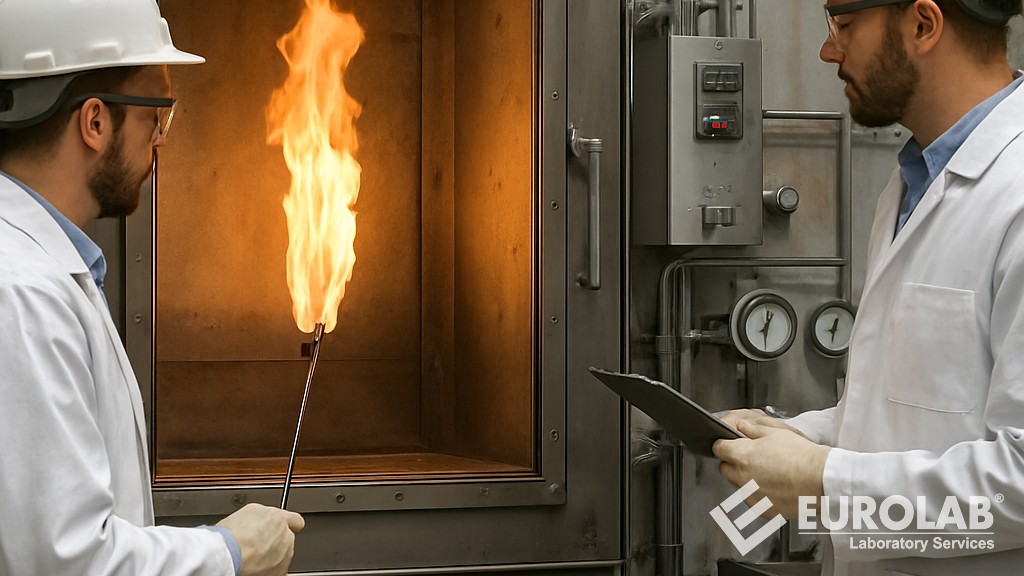
The ISO 14935 standard specifies one of four basic tests for determining flammability. This standard does not apply to certain fluids, such as HFAE and HFAS fluids. HFAE fluids are oil-water emulsions with a low emulsion oil content according to DIN 24320 and ISO 12922 standards. These fluids typically contain 1 to 5 percent emulsion oil by volume. HFAS fluids, on the other hand, are solutions containing a liquid concentrate in water that generally does not exceed 10 percent, according to the ISO 12922 standard.
For the purposes of ISO 14935, flame persistence refers to the persistence of the ignition flame for each of five different application periods, calculated as the average of six determinations.
In principle, a non-combustible aluminosilicate plate is immersed in the liquid being tested and placed in the liquid reservoir with one edge exposed. A small flame is applied to the exposed edge of the plate, and after the ignition flame is removed, the persistence of the flame is measured in seconds. Tests are performed with five different exposure times (2 sec, 5 sec, 10 sec, 20 sec, and 30 sec), and the post-burn duration is measured six times for each of the five exposure times. Consequently, the average of the six recorded results should be calculated from each of the five exposure times. The highest average value is the average duration of continuous burn.
ISO 14935 is an international standard that includes a precise laboratory method for evaluating the fire safety of fire-resistant hydraulic fluids and lubricants used in industrial applications. These fluids are designed to minimize ignition risks in high-temperature or spark-prone environments such as mining equipment, steel mills, or offshore drilling rigs.
This standard focuses on wick flame persistence testing, simulating real-world ignition scenarios by measuring how long a flame remains in a liquid-saturated wick. By measuring the duration of flame after ignition, it ensures that liquids meet stringent fire resistance classifications (e.g., ISO 12922 for fire-resistant hydraulic fluids). This test is critical for compliance with safety regulations in industries where flammable petroleum-based products can cause catastrophic fires. Unlike broader fire safety standards (e.g., ISO 15029 for flash/no-flash tests), ISO 14935 specifically targets the persistence of continuous flames, providing a repeatable metric for product certification and quality control.
The wick flame persistence test method uses a simple but controlled setup to assess flame sustainability. This method generally involves the following steps:
Results are reported with average persistence time in seconds, along with sensitivity guidelines for inter-laboratory comparisons.
This method is fast (less than 10 minutes per sample) and requires minimal equipment, making it accessible for routine quality assurance.
This test is important in scenarios where fire-resistant fluids need to exhibit low flammability:
This standard is particularly valuable for fluids near ignition sources such as die casting machines or presses, where even short-term flame persistence can increase risks.
Compliance with the ISO 14935 standard offers advantages for the following reasons:
In conclusion, the ISO 14935 standard remains a cornerstone for ensuring fire safety of petroleum-derived and synthetic liquids in hazardous environments. By providing a simple and measurable measure of flame persistence, it enables manufacturers, regulators, and end-users to effectively reduce ignition risks. In today's increasingly stringent environmental and safety requirements, compliance with this standard not only protects lives and property but also enhances product marketability.
For many years, our organization, with its competent and experienced staff, has been understanding the needs of its clients, providing the advanced testing services they require, and assisting in the establishment, implementation, and improvement of management systems. Within this framework, we also provide testing services to businesses in accordance with the "ISO 14935 Petroleum and related products - Determination of flame persistence of fire-resistant liquids" standard.
To get an appointment, to get more detailed information or to request an evaluation, you can ask us to fill in our form and reach you.

