
EN ISO 11925 Reaction to Fire Tests - Flammability of Building Products in Direct Contact with Flame

EN ISO 11925 Reaction to Fire Tests - Flammability of Building Products in Direct Contact with Flame

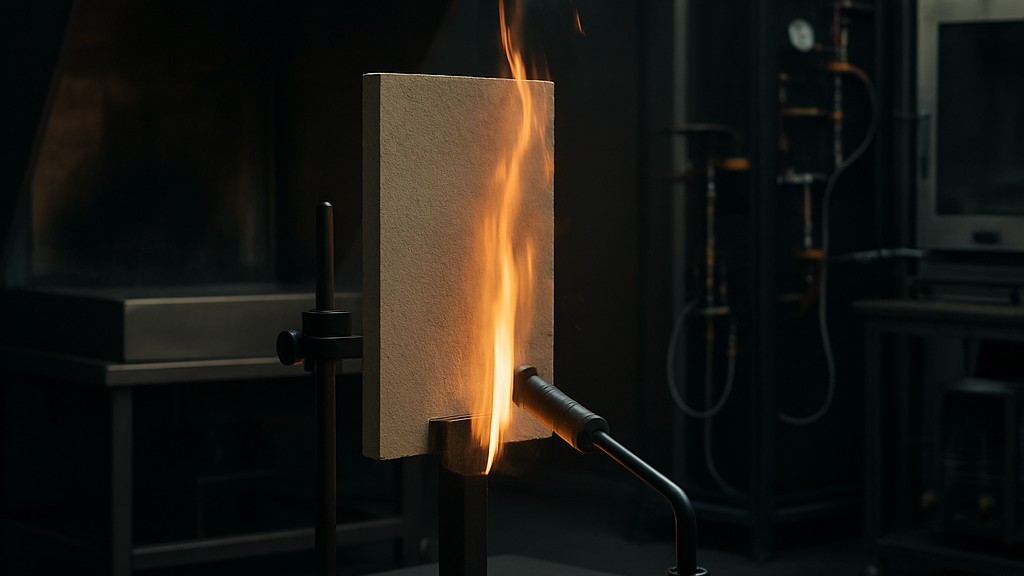
The “EN ISO 11925 Fire reaction tests - Flammability of construction products in direct contact with flame” standard, which is based on a European standard and was subsequently published by the International Organization for Standardization (ISO) , consists of the following sub-sections published under the same title:
EN ISO 11925 Reaction to Fire Tests - Flammability of Building Products in Direct Contact with Flame

  • The standard "EN ISO 11925-1 Part 1: Guide on Flammability" provides guidance on flammability testing for building products. This standard describes the principles of flammability and characterizes different ignition sources. The results of small-scale flammability tests can be used as part of an overall hazard analysis for a specified fire scenario. Therefore, it is important to fully characterize the selected flame or radiation source so that relevant conclusions can be drawn from the test results. The guidance provided in this standard may also be applicable to other application areas (e.g., building materials, plastics).

Fires originate from a wide variety of ignition sources. Statistical analyses of actual fires conducted in many countries have identified the most common primary and secondary sources, particularly in fires in buildings. The most common fire sources can be:

    • Cooking appliances (electric and gas)
    • Space heating appliances (electric, gas and solid fuel)
    • Electric cables
    • Other electrical appliances (such as washing machines, bed warmers, televisions, water heaters)
    • Cigarettes
    • Matches and cigarette lighters
    • Blow lamps, blowtorches and welding torches, hot metal
    • Burning waste, for example in waste paper baskets or bins or in stacked piles
    • Candles

The first substances to ignite were probably:

    • Food, including cooking oil
    • Gases, such as mains gas and bottled gases
    • Liquids, e.g. petrol, paint spirits
    • Textiles, e.g. clothing, curtains
    • Upholstery, e.g. chairs, beds, sofas
    • floor coverings
    • Building structures, e.g. wall cladding, ceilings, partitions
    • Electric cables

Smouldering ignition sources are particularly insidious in real fire situations as they can involve a significant induction period before flaming combustion develops.

  • The standard "EN ISO 11925-2 Part 2: Single flame source test" describes a test method for determining the ignitability of products by direct small flame impingement under zero impressed irradiance using vertically oriented test specimens. Information on the sensitivity of this test method is included in the standard's annex (Annex A). Information on testing non-flat end-use products is included in Annex B. Information on testing perforated end-use products is included in Annex C.

For the purposes of this standard, the following definitions apply in addition to the terms and definitions given in ISO 13943:

    • Product refers to the material, element or component for which information is required.
    • Essentially, a flat product refers to a product that has one of the following characteristics:
      • Planar open surface.
      • A planar open surface with surface irregularities uniformly distributed over the open surface. This surface is subject to the following conditions:
        • At least 50 percent of the surface of a representative square area of ​​250 mm x 250 mm lies at a depth of 6 mm from a plane taken from the highest points on the open surface, or
        • For a surface containing cracks, splits or holes, they shall not exceed 6,5 mm in width or 10 mm in depth, and the total area of ​​such cracks, splits or holes in the surface shall not exceed 30 percent of the representative 250 mm x 250 mm square area of ​​the open surface.
    • Flaming droplets or particles are material that separates from the sample during the fire test procedure and ignites the filter paper below the sample.
    • Multilayer products are products composed of two or more layers of different materials. They can be substantial or insignificant.
    • Sustained flaming is when the flame continues for more than 3 seconds.
    • Ignition refers to the presence of sustained flame.
  • The standard "EN ISO 11925-3 Part 3: Multi-source testing" describes a number of ignition sources that can be used to determine the ignitability of materials, composites, and assemblies when subjected to the direct impingement of flames of varying size and intensity, but without stimulated radiation. The sources can be used in isolation or with the specified test method.
  • This test method determines the flammability of a material, composite, or assembly and is not designed to evaluate any other fire parameter (e.g., flame spread). The possibility that a material composite or assembly will cause secondary ignition of other materials is assessed by observing any burning droplets or debris that may be formed. Secondary ignition of a material in the event of a growing fire can be addressed using the IS0 5657 standard, which assesses the flammability of building products by radiation.

    In principle, samples are exposed to specific flames of varying size and intensity and their ignition behavior is observed. Guidance on applying this range of ignition sources to end-use products or samples that are not substantially flat is included in the annex to the standard (Annex C).

    When building products are exposed to thermal energy, flammable vapors can be generated from their surfaces. Under favorable conditions (especially high temperatures), a critical concentration of flammable vapors can develop, and spontaneous ignition can occur. If a flame is present, either as the sole or supplementary energy source, the ignition process is supported; this mechanism is sometimes called pilot ignition.

    From a sample, the sources of a building product are considered ignited when flames appear on its surface. Ignition, as described in this standard, can be transient or sustained. After ignition occurs, some burning materials create additional fire hazards by creating flaming debris or drips. If this flaming debris lands on the combustible material, secondary ignition can occur, and the fire spreads more rapidly. The local application of a heat source to some materials can cause glowing combustion.

    In short, the EN ISO 11925 series of standards is an important fire testing standard used in building and construction because it evaluates how easily a material ignites when exposed to a small flame.

    Our organization, which has been supporting businesses across all sectors for years through a wide range of testing, measurement, analysis, and evaluation activities, has a strong team of employees who closely follow global developments in science and technology and are constantly improving themselves. In this context, we also provide testing services in accordance with the EN ISO 11925 Reaction to fire tests - Flammability of building products in direct contact with flames standard.

    WhatsApp

