

The standard "ASTM E119 Standard Test Methods for Fire Testing of Building Construction and Materials," developed by the American Society for Testing and Materials (ASTM), describes test methods applicable to composite assemblies of masonry units and structural materials for buildings, including load-bearing and other walls and partitions, columns, beams, joists, floors, and composite floor and beam assemblies for floors and roofs. This standard also applies to other assemblies and structural units that form permanent integral parts of a finished building.
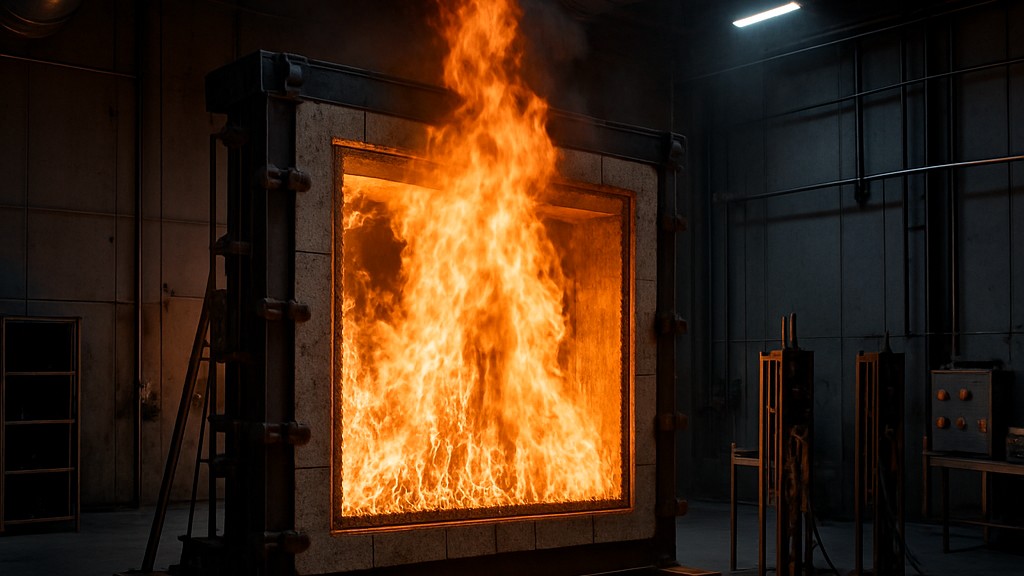
The classifications defined in this standard are intended to record comparative performance against specific fire test conditions throughout the exposure period and are not intended to be construed as determining suitability for use under other conditions or after fire exposure.
This standard is used to measure and describe the response of materials, products or assemblies to heat and flame under controlled conditions, but it does not cover all the factors required for fire hazard or fire risk assessment of materials, products or assemblies under actual fire conditions.
These test methods prescribe a standard fire exposure for comparing test results of building construction assemblies. The results of these tests are a factor in evaluating the predicted fire performance of building construction and assemblies. Applying these test results to predict the performance of actual building construction requires evaluation of the test conditions.
These test methods are intended to evaluate how long specified types of structural elements will contain fire, maintain structural integrity, or exhibit both properties during a predetermined test exposure.
The test exposes a test specimen to a standard fire controlled to reach specific temperatures for a specified period of time. When necessary, the fire exposure is followed by the application of a specified standard fire hose stream in accordance with ASTM E2226. The test provides a relative measure of the fire test response of comparable structural elements under these fire exposure conditions. The exposure is not representative of all fire conditions because conditions vary with changes in the amount, nature, and distribution of the fire load, ventilation, compartment size and configuration, and the heat-sinking properties of the compartment. Variations resulting from the test conditions or the construction of the test specimen, such as size, materials, and method of assembly, also affect the fire test response. For these reasons, it is necessary to evaluate the variation for application to the structure in the field.
This standard provides:
However, this standard does not provide:
In short, the ASTM E119 fire test is a standardized test method used to evaluate the fire resistance of building components and assemblies. One of many fire test standards, this test measures the ability of a building material, such as a wall, partition, roof, or floor, to withstand fire exposure for a specified period of time. Fire test results provide valuable information for building code officials, architects, engineers, and construction professionals.
Testing helps ensure that building components and assemblies meet required fire safety standards and provide a level of protection for occupants and property in the event of a fire. It aids in the design and construction of fire-resistant buildings, enabling the development of effective fire prevention, containment, and evacuation strategies.
To perform this test, multiple building elements are uniformly exposed to fire under temperatures and fire conditions that simulate a real fire scenario. The test evaluates two key performance criteria, including:
The duration of fire exposure typically ranges from 45 minutes to several hours, depending on the fire rating tested. The material under test is monitored for factors such as flame penetration, temperature rise on the exposed side, structural stability, and fire barrier integrity. The duration of resistance before the first critical failure point is also evaluated.
In ASTM E119 fire testing, the fire resistance of a building component is assessed using pass/fail criteria. These criteria play a crucial role in assessing the performance of the tested material and ensuring its compliance with fire safety standards.
The following time-critical events are recorded during ASTM E119 testing. Pass/fail (the assembly's endurance time) is the time at which the first of these events occurs:
Components that successfully meet the criteria demonstrate their ability to withstand fire exposure for the specified duration without compromising their integrity or contributing to the spread of fire. However, specific pass/fail criteria may vary depending on the fire rating tested and applicable building codes.
Our organization, which has been supporting businesses across all sectors for years through a wide range of testing, measurement, analysis, and evaluation activities, has a strong team of employees who closely follow global developments in science and technology and are constantly improving themselves. In this context, we also provide testing services in accordance with ASTM E119 Standard Test Methods for Fire Testing of Building Construction and Materials.
To get an appointment, to get more detailed information or to request an evaluation, you can ask us to fill in our form and reach you.

