

The standard "UNI 9174 Fire response of products exposed to an ignition flame in the presence of radiant heat," developed by the Italian Organization for Standardization (UNI), describes a procedure for determining the fire response of materials and products exposed to both ignition flame and radiant heat. This standard is designed specifically to evaluate the behavior of construction and flooring materials in fire situations, minimizing fire risk and improving safety in buildings and public spaces.
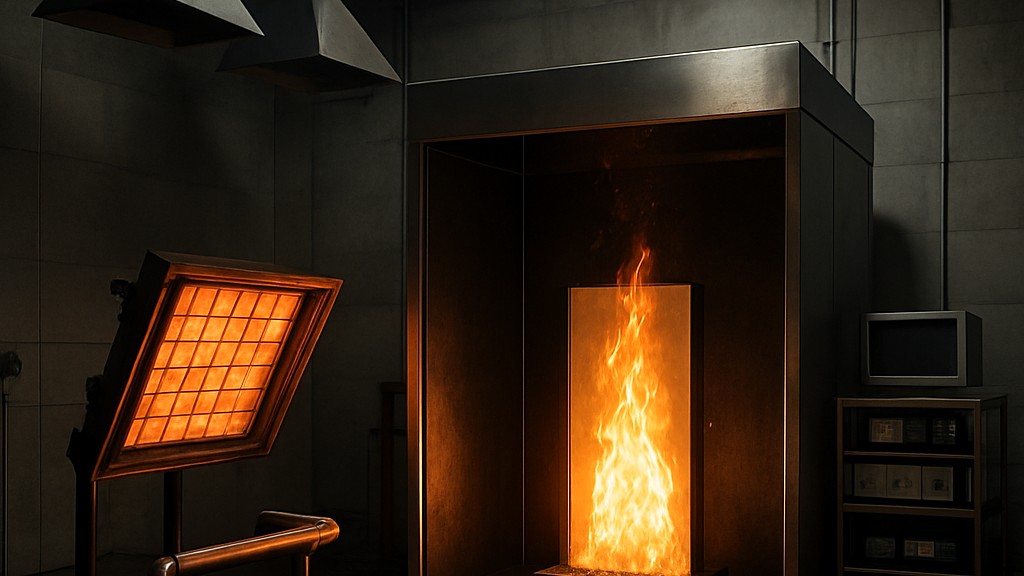
The primary purpose of the UNI 9174 standard is to classify materials based on their flammability and flame spread properties under realistic fire conditions. The test method provides a simulation that combines the effects of a small ignition source (flame) with a controlled radiant heat source, simulating a more realistic early-stage fire environment. This information is important for architects, engineers, and regulatory authorities to select appropriate materials that meet fire safety requirements.
According to the test method described in standard UNI 9174, a sample is mounted vertically and exposed to radiant heat, simulating a heat source such as nearby flames or hot surfaces. After a specified time, an ignition flame is applied to the sample.
This test method detects:
The results are used to assign a reaction-to-fire classification, typically specified in Italian legal regulations as Class 0, Class 1, Class 2, Class 3, or Class 4. Class 1 represents materials with the best fire behavior.
The UNI 9174 standard is critical to ensuring fire safety in a variety of environments such as:
By requiring materials to meet certain classifications under UNI 9174, designers and safety professionals can reduce the risk of fire spread, improve evacuation times, and protect life and property.
Materials tested under UNI 9174 are typically:
UNI 9174 is often used in conjunction with UNI 8456 Storage equipment for bulk materials - Safety code, which focuses more specifically on flame spread and smoke development, and UNI 8457 Combustible products with flame sensitivity on one side only - Reaction to fire by the application of a small flame. Together, these standards provide a comprehensive fire response profile for building materials and furniture.
The UNI 9174 standard is considered important in many industries because it provides a critical assessment of how materials react to fire, particularly in the early stages of a fire, when rapid response is crucial for safety. The key reasons for this standard's importance include:
This helps identify materials that can slow or accelerate the spread of fire, directly affecting the safety of occupants and the survivability of the building.
Without this testing, materials cannot be certified for use in regulated areas.
This is important for fire engineering and building code compliance.
Ultimately, the importance of this standard lies in its ability to prevent fire-related injuries and deaths by ensuring the selection and use of fire-resistant materials. It is not just a regulatory tool, but a life-saving measure integrated into the design, construction, and furnishing of modern spaces.
The UNI 9174 standard is the cornerstone of fire safety regulations, providing a reliable and standardized method for assessing how products behave when exposed to fire-like conditions. It plays a crucial role in ensuring that materials used in construction and furnishings meet the safety criteria required to protect occupants in the event of a fire.
Our organization, which has been supporting businesses across all sectors for years through a wide range of testing, measurement, analysis, and evaluation activities, boasts a strong team of employees who closely follow global developments in science and technology and are constantly improving themselves. In this context, we also provide testing services in accordance with the UNI 9174 standard for "Fire Reaction of Products Exposed to an Ignition Flame in the Presence of Radiant Heat."
To get an appointment, to get more detailed information or to request an evaluation, you can ask us to fill in our form and reach you.

