

The European standard “EN 1021 Furniture - Assessment of flammability of upholstered furniture” consists of the following subsections published under the same title:
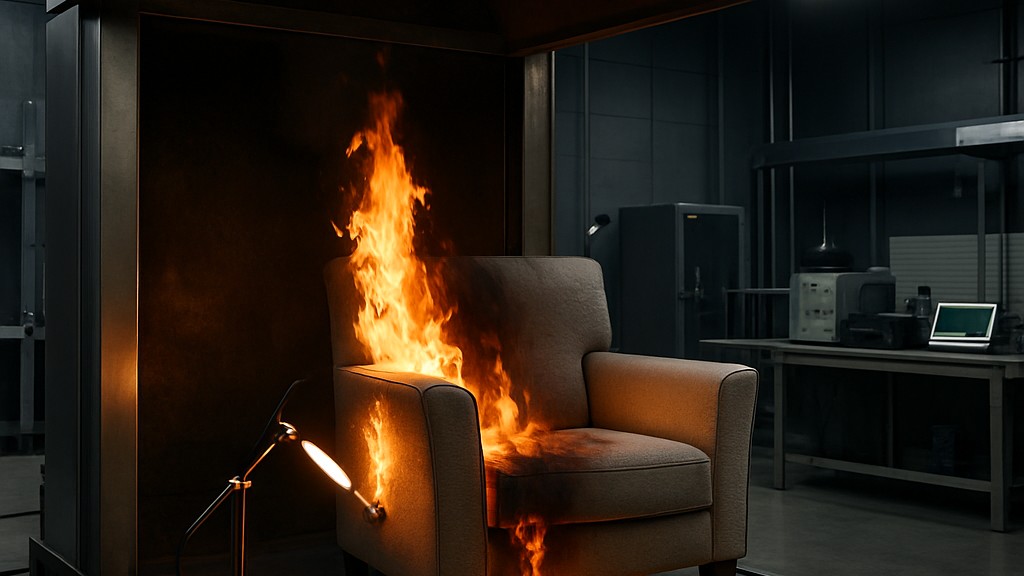
In practice, it is generally found that there is a clear distinction between materials that can char under the influence of the ignition source but do not spread further (non-progressive combustion) and materials in which smoldering expands and spreads (progressive combustion).
Flame ignition is considered to be the formation of any flame initiated by a smoldering source.
In principle, the assembly of upholstery materials is subjected to a smoldering ignition source. The assembly is designed to stylize the joint between a seat and back (or seat and arm) that would occur on a typical chair. The ignitability of an assembly is determined by applying a smoldering ignition source, such as a cigarette. The test method measures the ignitability of the overall composition of materials as constructed in the test fixture, i.e., the outer cover, inner cover, or infill. The tests provide an indication of the ignition behavior of the finished furniture piece, but cannot guarantee it. The results should not be interpreted as applicable to the overall behavior of any individual component. Test samples prepared from materials taken from used furniture may yield different results than those from the same materials before use.
The EN 1021-1 standard is part of a two-part European standard that assesses how well upholstered furniture resists ignition from common sources. Part 1 specifically addresses smoldering cigarettes, a common and dangerous ignition source.
In principle, the assembly of upholstery materials is subjected to a gas flame ignition source. The assembly is designed to stylize the joint between a seat and back (or seat and arm) that would occur on a typical chair. The ignitability of an assembly is determined by applying a gas flame equivalent to a lit match. The test method measures the ignitability of the overall composition of the materials as constructed in the test fixture, i.e., the outer cover, inner cover, infill, and similar composition. The tests provide an indication of the ignition behavior of the finished furniture piece, but cannot guarantee it. The results should not be interpreted as applicable to the overall behavior of any individual component. Test samples prepared from materials taken from used furniture may yield different results than those from the same materials before use.
For the purposes of this standard, all of the following types of behavior are considered to be progressive smouldering ignition:
In practice, it has been found that there is generally a clear distinction between materials that can char under the influence of an ignition source but do not spread further (non-progressive combustion) and materials in which smoldering becomes widespread and spreads (progressive combustion).
All of the following types of behavior are considered flaming combustion:
Our organization, which has been supporting businesses across all sectors for years through a wide range of testing, measurement, analysis, and evaluation activities, has a strong team of employees who closely follow global developments in science and technology and are constantly improving themselves. In this context, we also provide testing services in accordance with the EN 1021 Furniture - Assessment of the flammability of upholstered furniture standard.
To get an appointment, to get more detailed information or to request an evaluation, you can ask us to fill in our form and reach you.

