

The standard “EN ISO 15025 Protective clothing - Flame protection - Test method for limited flame spread”, developed by the International Organization for Standardization (ISO) and later published as a European standard within the scope of harmonization efforts, describes two procedures (surface ignition and under-edge ignition) for determining the flame spread properties of vertically oriented flexible materials in the form of single or multi-component fabrics (coated, quilted, multilayered, sandwich structures and similar combinations) when exposed to a small and defined flame. This standard is not applicable in situations where air supply is restricted or exposure to intense heat sources is required; other test methods are more suitable for these situations. Furthermore, this test method is not suitable for materials exhibiting excessive melting or shrinkage.
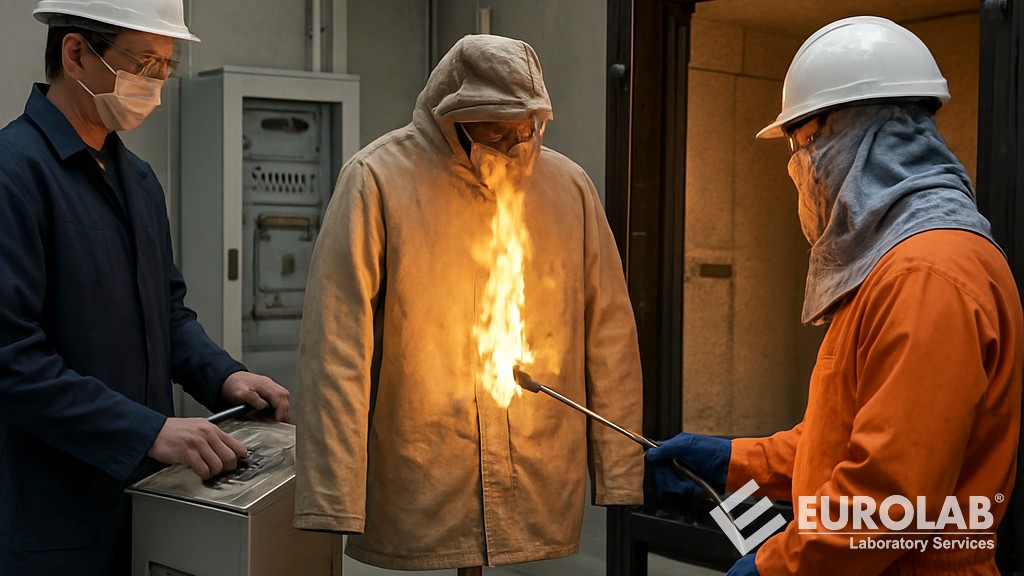
This test method is closely related to the test method specified in the ISO 6941 standard. It uses the same basic equipment, but employs narrower sample holders and templates for a single operation. Materials that do not burn up to the top or vertical edges of the test specimen used in this test can be classified as materials that produce limited flame spread.
This method evaluates the properties of textile fabrics in response to brief contact with a small igniter flame under controlled conditions. The effect of seams on the behavior of fabrics can be determined by this method, with the seam being placed inside the test sample so that it is exposed to the test flame. Wherever possible, scraps should be tested as part of the fabric assembly in which they are or will be used.
In principle, a defined flame from a specific burner is applied to the surface or bottom edge of vertically placed textile samples for 10 seconds. Information about melting, flame spread, and smoldering, as well as the formation of flaming debris, flaming debris, or holes, is recorded. The duration of smoldering and the length of time the smoldering is recorded. Recording the damaged length is optional in the edge ignition procedure.
Surface exposure tests can be performed on both sides of multilayer fabric assemblies and, in the case of single-layer fabrics with different properties on both sides.
For edge ignition tests, each layer of a multilayer assembly can be tested individually or as a whole. To determine whether stitching the edges of the test specimens is necessary, the relevant product standards specifying this test method should be consulted.
EN ISO 15025 is one of the most important standards when it comes to testing the flame spread properties of materials used in heat and flame protective clothing. This standard replaced the older EN 532 standard and remains the fundamental test method referenced by numerous clothing standards such as EN ISO 11611 (welding), EN ISO 11612 (general heat and flame), and EN 61482-1-2 (live work - arc flash).
This standard includes two methods for evaluating the limited flame spread properties of materials or groups of materials when exposed to a small and defined flame: Procedure A and Procedure B. These test methods are designed primarily for vertically oriented samples used in protective clothing. However, the following are outside the scope of this standard:
The two test methods are described as follows:
After flame application, the sample is evaluated according to six criteria:
If a material passes procedure A, it is classified as A1. If it fails A1 but passes procedure B, it is classified as A2. If it fails both, the material does not meet the limited flame spread requirement.
Almost every garment certified according to the EN ISO 11612 standard must achieve at least class A1 or A2. Garments used for welding work (EN ISO 11611 standard) require Class 1 (A1) or Class 2 (A1 and higher radiant heat). Many naturally flame-retardant fabrics (aramids, modacrylic blends, flame-retardant cotton) easily achieve class A1. Thermoplastic fabrics (100% polyester, nylon) generally melt and cannot reach class A1, but can pass to class A2 if the melt does not emit flame.
Despite being a relatively simple small flame test, passing the EN ISO 15025 standard is a mandatory first step a fabric must take before being evaluated for serious heat and flame protective clothing. This standard serves as a fundamental screening tool to eliminate materials that are easily flammable or will continue to burn after the flame source is removed.
In short, if a work garment claims to conform to EN ISO 11612, EN ISO 11611, or similar standards, the fabric has almost certainly tested and passed EN ISO 15025 Procedure A or Procedure B, which is essential evidence of its limited flame spread performance.
For many years, our organization, with its competent and experienced staff, has been understanding the needs of its clients, providing the advanced testing services they require, and assisting them in the establishment, implementation, and improvement of management systems. Within this framework, we also provide testing services to businesses in accordance with the "EN ISO 15025 Protective clothing - Flame protection - Test method for limited flame spread" standard.
To get an appointment, to get more detailed information or to request an evaluation, you can ask us to fill in our form and reach you.

