

The standard “GB/T 8626 Flammability test method for building materials” published among the National Standards of the People’s Republic of China describes a test method for determining the flammability of building products by direct small flame impingement under zero-impact radiation using specimens tested in a vertical position. Products that melt and shrink from flame without igniting are handled by the additional procedure in the annex of this standard (Annex A). Information on the sensitivity of the test method is also provided in the annex of the standard (Annex B).
For the purposes of this standard, the terms and definitions given in the “ISO 13943 Fire safety - Glossary” standard apply. Furthermore, a product refers to the material, element, or component about which information is requested.
For products that are not essentially flat and are to be tested in their end-use form, the flame is applied as described above. A full description of the holding method should be given in the test report. A change in apparatus or procedure may be required, but many non-flat products normally require only a change in the sample support frame. However, in some cases, the burner mounting may not be suitable and the ignition source may need to be manually held and applied.
When performing the tests, one of two ignition times is selected: 15 seconds or 30 seconds. The test start time is the ignition start time. When starting the test, it is verified that the air flow rate in the combustion box chimney meets the requirements. 6 samples are taken from the conditioning chamber and the test is completed within 30 minutes. If necessary, the sample can also be taken from the conditioning chamber and placed in a test device in a closed box. The sample is closed by the two edges and the upper edge of the sample by the sample clamp and placed in the sample clamp with the fire tip 30 mm from the bottom of the sample clamp. The sample frame can be marked to ensure that the lower edge of the sample is in the correct position. The burner angle is set at 45 degrees and the positioner is used to verify the distance between the burner and the sample. Two pieces of filter paper are placed in the aluminum foil collection tray under the sample. This operation should be completed within 3 minutes before the test.
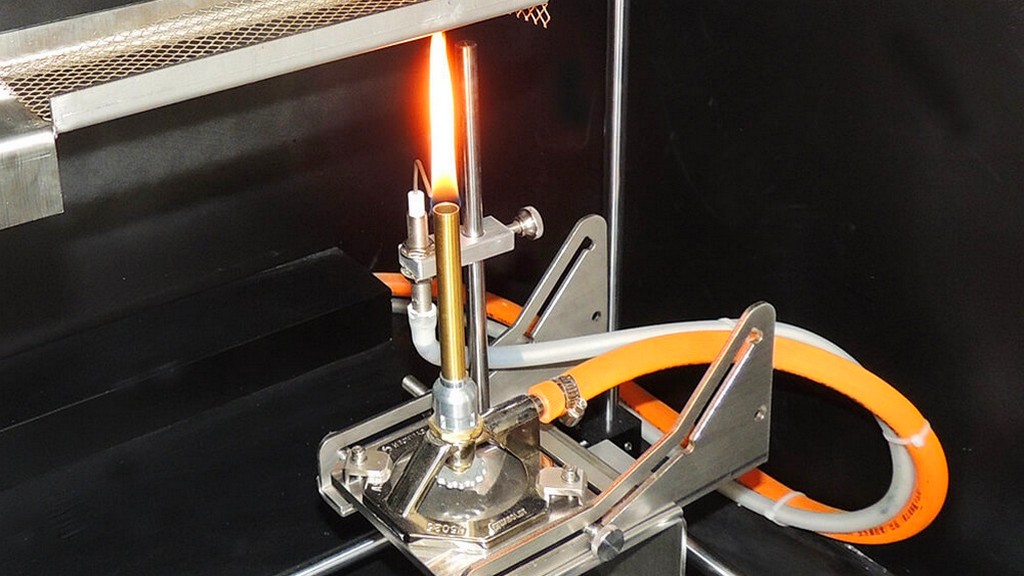
During the test, the burner located in the vertical direction is ignited and waited until the flame becomes stable. The burner fine adjustment valve is adjusted and 9 measuring devices are used to measure the flame height. The flame height should be 20 mm plus/minus 1 mm. This process is carried out in a predetermined location away from the burner to prevent accidental ignition of the sample. The flame height should be measured before each ignition of the sample.
The burner is tilted 45 degrees along the vertical axis of the burner and advanced horizontally until the flame reaches the preset sample contact point. The timing device is started at the moment the flame makes contact with the test sample. The flame is applied for 15 or 30 seconds and then the burner is withdrawn smoothly and continuously.
Tests may need to be carried out on surface exposure or on edge exposure or both. Recommendations on exposure conditions are contained in the relevant product standards. For surface exposure, for all substantially flat products, the flame is applied to the centre line of the specimen, 40 mm above the bottom edge. Any different surfaces which may be exposed in the application shall be tested. For edge exposure, for substantially flat single-layer or multi-layer products having a total thickness of 3 mm or less, the flame is applied to the centre point below the test specimen. For substantially flat single-layer or multi-layer products having a total thickness of more than 3 mm, the flame is applied to the centre of the width of the bottom edge of the test specimen, 1,5 mm behind the surface. For all multi-layer products having a thickness greater than 10 mm, an additional set of tests shall be carried out by rotating the specimen 90 degrees about its vertical axis and impinging the flame on the lower edge of the centre line of the bottom side of each different layer.
Among the numerous testing, measurement, analysis and evaluation studies carried out for businesses in various sectors, our organization also provides testing services defined in the "GB/T 8626 Flammability test method for building materials" standard with its trained and expert staff and advanced technological equipment.
To get an appointment, to get more detailed information or to request an evaluation, you can ask us to fill in our form and reach you.

