

The “ASTM D2863 Standard Test Method for Measuring Minimum Oxygen Concentration Required to Support Wax-Like Combustion of Plastics (Oxygen Index)” standard, developed by the American Society for Testing and Materials (ASTM), is a fire test response standard. This standard describes a method for measuring the minimum oxygen concentration (volume percentage) required to support flaming combustion in a flowing oxygen and nitrogen mixture. This test method comprises three test procedures. Procedure A involves surface ignition, Procedure B involves spreading ignition, and Procedure C is a short procedure involving comparison with a specified minimum value of the oxygen index.
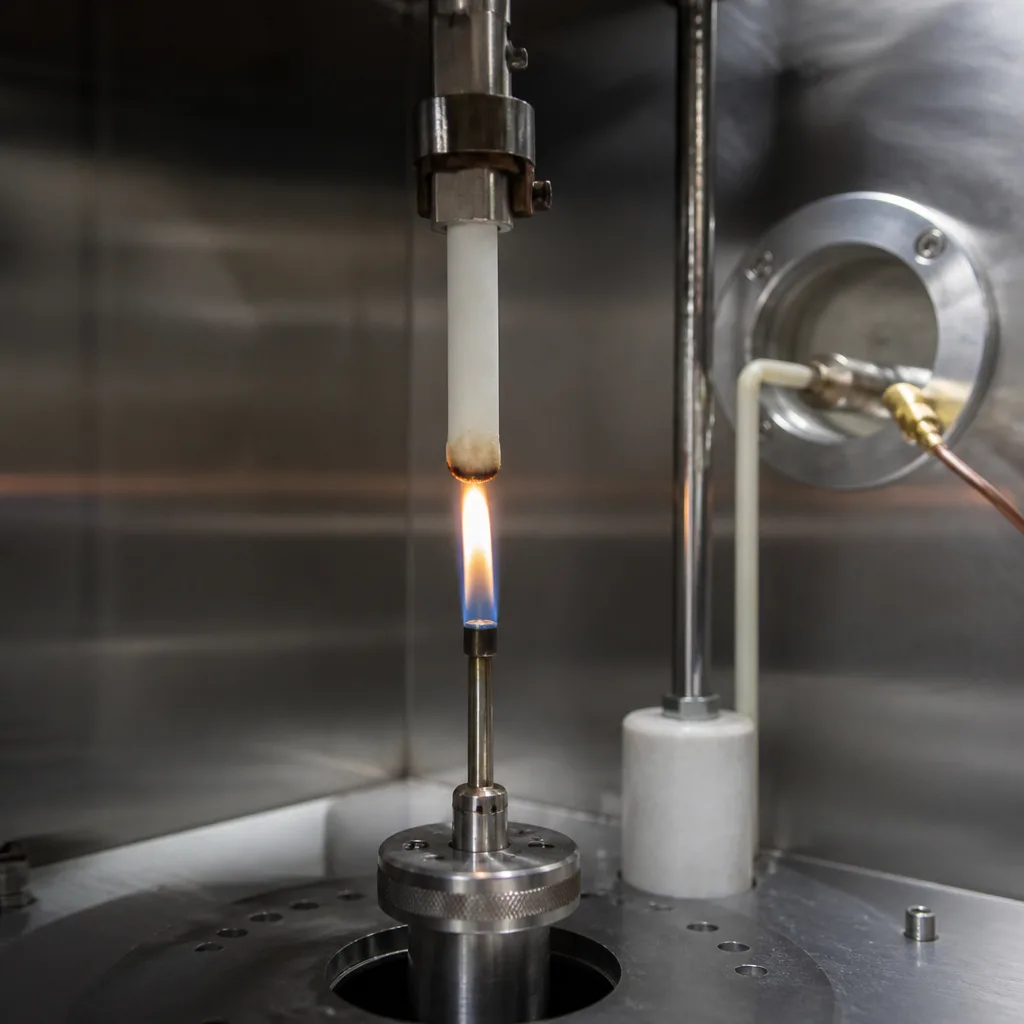
Test samples used in the tests are prepared according to one of six sample types.
The ASTM D2863 standard specifies three test procedures:
The appropriate procedure depends on the type of material and the purpose of the test.
This testing method allows for the testing of structurally self-supporting materials in the form of vertical bars or sheets up to 10,5 mm thick. Such materials are solid, laminated, or cellular materials with an apparent density greater than 15 kg/ m³ .
This test method also allows for testing flexible sheet or film materials while they are supported vertically. In some cases, this test method is also suitable for cellular materials with an apparent density of less than 15 kg/ m³ .
This testing method measures and describes the response of materials, products, or devices to heat and flame under controlled conditions, but by itself, it does not encompass all the factors necessary for a fire hazard or fire risk assessment of materials, products, or devices under actual fire conditions.
The ASTM D2863 standard is one of the most widely recognized flammability testing standards for plastics and polymeric materials. It establishes a laboratory method for determining the minimum oxygen concentration (oxygen index) in the oxygen/nitrogen mixture required to sustain a material's candle-like combustion. Since atmospheric air contains approximately 21 percent oxygen, the limiting oxygen index (LOI) value provides a suitable numerical indication of a material's relative flammability. Materials with higher limiting oxygen index values are generally more resistant to ignition and flame propagation under controlled laboratory conditions.
The ASTM D2863 standard is used worldwide by material manufacturers, automotive suppliers, aerospace companies, electronics manufacturers, and research laboratories to compare the flammability properties of plastics and other polymeric materials. The primary purpose of this standard is to determine the oxygen concentration required for a material to continue burning after ignition.
Unlike pass/fail flammability tests, the ASTM D2863 standard provides a quantitative value known as the oxygen index (OI) or limiting oxygen index (LOI), which allows engineers to compare the flame resistance of different materials.
This test is especially valuable in the following situations:
In principle, the test specimen is placed vertically inside a transparent combustion column into which a carefully controlled mixture of oxygen and nitrogen flows upwards. After the gas composition is stabilized, the upper end of the specimen is ignited using a standard flame. The operator observes whether the specimen continues to burn. The oxygen concentration is adjusted through successive tests until the minimum oxygen level capable of sustaining combustion is determined. This concentration is reported as the oxygen index (LOI). Mathematically, the LOI is the minimum oxygen concentration required for sustained combustion.
The ASTM D2863 standard supports various sample configurations for rigid and flexible plastics. Typical materials include:
This standard defines multiple sample sizes depending on the material shape and thickness. It is generally designed for self-supporting samples, but flexible materials may require additional support during testing.
In short, the oxygen index indicates how easily a material burns:
The goal of this process is to test the role and privilege manipulation in order to access the resources of a
Actual values vary depending on additives, fillers, reinforcement, density, and processing conditions.
Organizations that commonly perform ASTM D2863 standard tests include:
In conclusion, the ASTM D2863 standard is a globally recognized flammability testing standard for determining the limiting oxygen index (LOI) of plastics and polymeric materials. By measuring the minimum oxygen concentration required to sustain combustion, it provides a reliable numerical indication of a material's relative flame resistance. While it does not simulate real fire conditions or replace comprehensive fire performance testing, it remains an important tool for material development, quality control, product comparison, and evaluation of flame-retardant technologies in the automotive, aerospace, electrical, construction, and consumer product industries.
For many years, our organization, with its competent and experienced team, has been understanding the needs of its clients, providing the advanced testing services they require, and assisting them in the establishment, implementation, and improvement of management systems. Within this framework, we also provide testing services in accordance with the ASTM D2863 standard.
To get an appointment, to get more detailed information or to request an evaluation, you can ask us to fill in our form and reach you.

